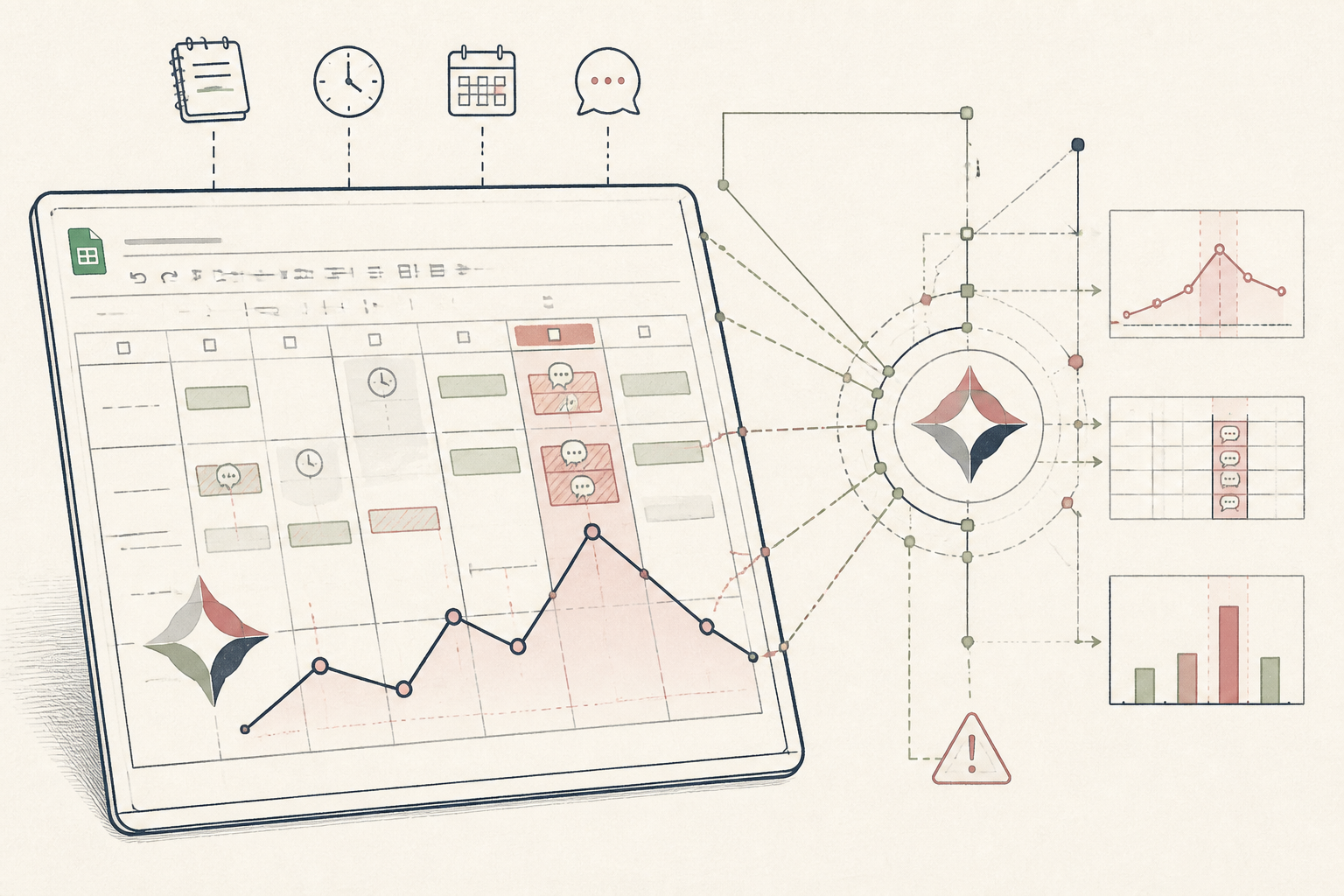
What the AI found
“Your stress peaks consistently on Thursdays, not Mondays, and is 40% higher on weeks with more than three evening meetings.”
Before
Disorganised daily notes, vague anxieties
After
Clear weekly stress report with actionable insights
The same system, three states — real screens, not a screenshot
- Today felt like a whirlwind. So much to do.
- Another late night, project deadline looming.
- Managed to get through emails, but still feeling drained.
- Went for a run. Helped a bit with the mental fog.
Prompt
Analyse the following weekly journal entries and calendar data for recurring stress patterns. Identify specific days or events correlated with higher stress. Provide quantitative insights if possible. <CALENDAR DATA HERE> <JOURNAL ENTRIES HERE>
Analyse the following weekly journal entries and calendar data for recurring stress patterns. Identify specific days or events correlated with higher stress. Provide quantitative insights if possible. [PASTED CALENDAR DATA AND JOURNAL ENTRIES]
AI
Analysis of your provided data indicates a notable trend: your subjective stress levels, as inferred from your journal entries, consistently peak on Thursdays, not early in the week as you might have assumed. Furthermore, weeks with more than three evening meetings show an average stress score increase of 40% compared to weeks with fewer than three.Thursday
Average Weekly Stress Peak Day
40%
Stress Increase (3+ Eve. Meetings)
Evening Meetings
Identified High-Stress Trigger
Weekly Stress Patterns Identified
A weekly AI-guided review transformed sporadic journaling into a clear understanding of stress triggers.
A 34-year-old marketing professional, Northern Europe
Tools used
The real tools used here — swap any for your own equivalent. Each links to how we’d set it up.
Starting state
Before anything was set up
Before the AI system, Sarah diligently kept daily notes in Apple Notes, jotting down her feelings and observations about her day. These entries were often detailed but unstructured, a stream of consciousness that rarely offered clear patterns or actionable insights. She intuitively felt stress ebbed and flowed, but couldn't articulate when or why, leading to cycles of feeling overwhelmed without identifying root causes.
- Today felt like a whirlwind. So much to do.
- Another late night, project deadline looming.
- Managed to get through emails, but still feeling drained.
- Went for a run. Helped a bit with the mental fog.
- Meeting after meeting, no time to focus.
Working state
Done-for-you, doing its job
The first step involved collating Sarah's disparate notes. She copied her Apple Notes entries, along with calendar data, into a Google Sheet. The Wellness & AI team then constructed a prompt for Gemini, designed to analyse this text-based data for patterns related to stress levels and potential triggers. Sarah then interacted with the system by pasting her consolidated data and specific prompts, observing as the AI processed the information.
Prompt
Analyse the following weekly journal entries and calendar data for recurring stress patterns. Identify specific days or events correlated with higher stress. Provide quantitative insights if possible. <CALENDAR DATA HERE> <JOURNAL ENTRIES HERE>
Analyse the following weekly journal entries and calendar data for recurring stress patterns. Identify specific days or events correlated with higher stress. Provide quantitative insights if possible. [PASTED CALENDAR DATA AND JOURNAL ENTRIES]
AI
Analysis of your provided data indicates a notable trend: your subjective stress levels, as inferred from your journal entries, consistently peak on Thursdays, not early in the week as you might have assumed. Furthermore, weeks with more than three evening meetings show an average stress score increase of 40% compared to weeks with fewer than three.Use case implemented
The finished system, running on its own
Now, Sarah has a streamlined weekly review process. Every Sunday, she exports her raw notes and calendar overview into a Google Sheet. A pre-defined prompt is then used with a custom Gemini Pro setup to generate a concise summary report. This report highlights key stress patterns and quantifies potential correlations, providing her with objective data to inform her weekly planning and self-care strategies.
Thursday
Average Weekly Stress Peak Day
40%
Stress Increase (3+ Eve. Meetings)
Evening Meetings
Identified High-Stress Trigger
What an outside observer would notice
Reduced from 45 min to 10 min
Weekly review time
Increased from 0 to 3 per month
Identified stress triggers
Targeting 25% by Q4
Evening meeting reduction
The stack — build it yourself
Familiar, quick, and always on hand for capturing daily thoughts.
Provides a structured, easy-to-export format for consolidating diverse data before AI processing.
Its advanced natural language processing capabilities are ideal for extracting nuanced patterns from unstructured text.
These are the tools used in this story. Any can be swapped for an equivalent you already trust.
Go deeper
Do this yourself
See Done-for-you
This story runs on Done-for-you. The tools and prompts above are the real build — swap any tool for your own equivalent and follow the same steps.