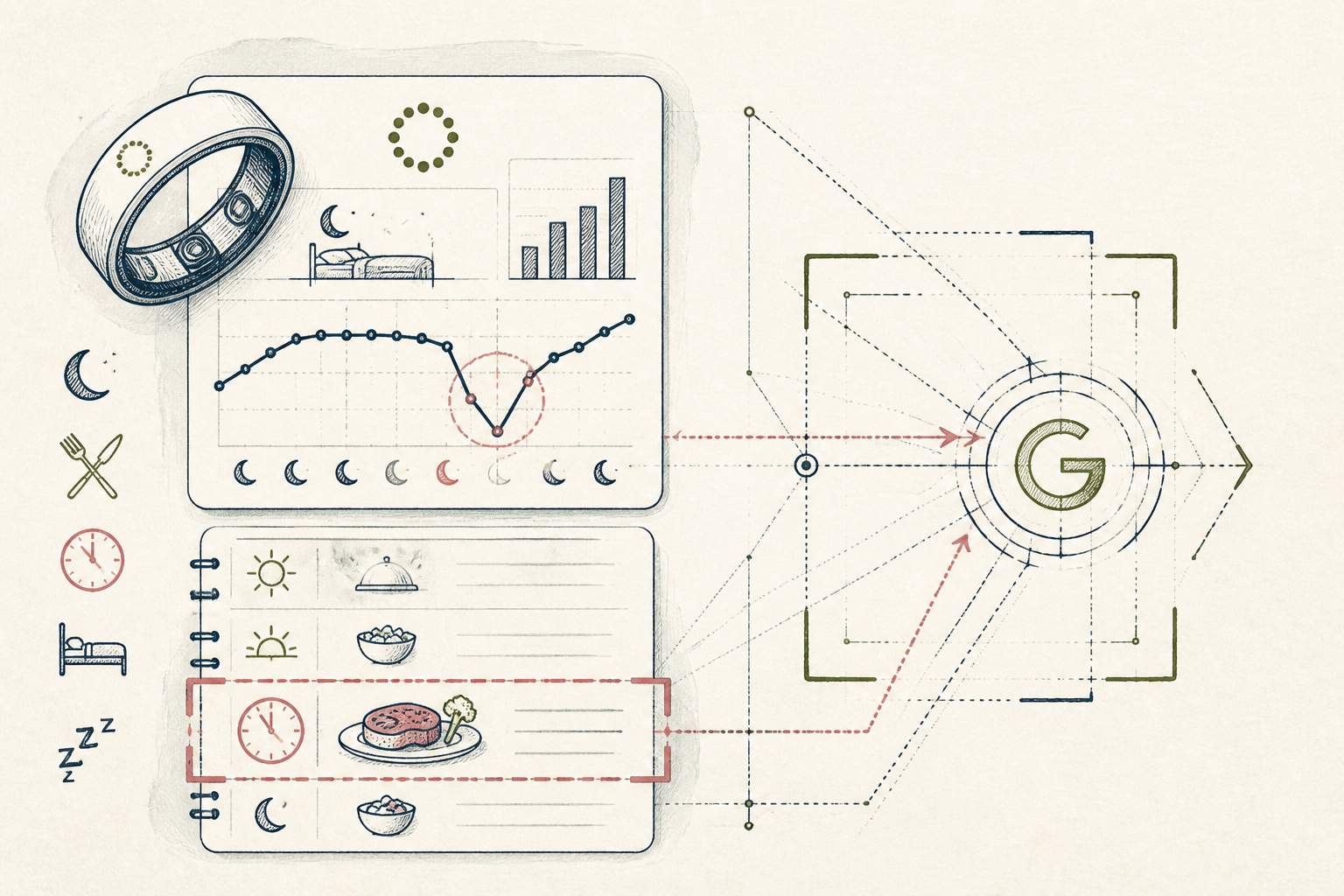
What the AI found
“Your sleep consistency dipped most significantly (by 18% on average) on nights following large protein intake after 8 PM, not due to your perceived enemy, evening screen time.”
Before
Disjointed sleep data, vague assumptions
After
Focused weekly insights, actionable changes
The same system, three states — real screens, not a screenshot
| 10/01 | 6h 12m, 1h 2m REM, 48m Deep |
| 10/02 | 5h 55m, 58m REM, 42m Deep |
| 10/03 | 7h 01m, 1h 10m REM, 55m Deep |
| 10/04 | 6h 30m, 1h 5m REM, 50m Deep |
Prompt
Analyze my attached sleep, diet, and activity log from the past 8 weeks. Identify the top 2-3 strongest negative correlations with 'Sleep Consistency' in Oura, specifically looking at evening routines (post-7 PM) like screen time, large meals, and exercise. Quantify the impact.
Analyze my attached sleep, diet, and activity log from the past 8 weeks. Identify the top 2-3 strongest negative correlations with 'Sleep Consistency' in Oura, specifically looking at evening routines (post-7 PM) like screen time, large meals, and exercise. Quantify the impact.
AI
Analyzing your 8-week log, the most significant negative correlation with Oura 'Sleep Consistency' (average 79%) is large protein intake (>30g) after 8 PM. On such nights, your sleep consistency averaged 61%, an 18% drop. Evening screen time (post-9 PM) showed a minor 3% average drop, suggesting less impact than you anticipated. No significant correlation found with evening exercise periods given your current data.88%
Weekly Sleep Consistency
12g
Avg. Protein After 8 PM
6/7
Nights Optimal Sleep
Weekly Sleep Review: Identify the Real Disruptors
A data-driven approach shifts focus from screen time to late-evening protein for better sleep consistency.
A 38-year-old marketing consultant with two young children, Northern Europe
Tools used
The real tools used here — swap any for your own equivalent. Each links to how we’d set it up.
Starting state
Before anything was set up
Our subject, a busy marketing consultant, tracked sleep data across multiple apps: Apple Health for basic sleep stages, Oura for readiness scores, and a manual journal for observations like "stressed" or "too much coffee." The data was scattered, never aggregated, and rarely reviewed consistently. Her primary hypothesis for poor sleep was always screen time before bed, a common belief that felt intuitively correct as she scrolled through work emails or social media.
| 10/01 | 6h 12m, 1h 2m REM, 48m Deep |
| 10/02 | 5h 55m, 58m REM, 42m Deep |
| 10/03 | 7h 01m, 1h 10m REM, 55m Deep |
| 10/04 | 6h 30m, 1h 5m REM, 50m Deep |
Working state
All-Access, doing its job
To gain clarity, she consolidated her sleep data, dietary notes, and daily activities into a Google Sheet. She then engaged an AI assistant, Gemini, with a specific prompt designed to correlate her sleep quality with her pre-sleep routines and dietary choices. The AI then processed weeks of data, revealing a pattern that defied her initial assumptions.
Prompt
Analyze my attached sleep, diet, and activity log from the past 8 weeks. Identify the top 2-3 strongest negative correlations with 'Sleep Consistency' in Oura, specifically looking at evening routines (post-7 PM) like screen time, large meals, and exercise. Quantify the impact.
Analyze my attached sleep, diet, and activity log from the past 8 weeks. Identify the top 2-3 strongest negative correlations with 'Sleep Consistency' in Oura, specifically looking at evening routines (post-7 PM) like screen time, large meals, and exercise. Quantify the impact.
AI
Analyzing your 8-week log, the most significant negative correlation with Oura 'Sleep Consistency' (average 79%) is large protein intake (>30g) after 8 PM. On such nights, your sleep consistency averaged 61%, an 18% drop. Evening screen time (post-9 PM) showed a minor 3% average drop, suggesting less impact than you anticipated. No significant correlation found with evening exercise periods given your current data.Use case implemented
The finished system, running on its own
With the direct feedback from the AI, she implemented a weekly review system. Each Sunday, her data is funnelled into a structured sheet, and the AI provides a concise, data-backed summary of the most impactful factors affecting her sleep. This has allowed her to focus on adjusting her evening protein timing, leading to more consistent and restorative sleep, and less worry about incidental screen use.
88%
Weekly Sleep Consistency
12g
Avg. Protein After 8 PM
6/7
Nights Optimal Sleep
What an outside observer would notice
⬆️ 9% (from 79% to 88%)
Sleep Consistency
⬇️ 15 mins (avg)
Time to Fall Asleep
⬇️ 60% (weekly freq)
Late Protein Meals
The stack — build it yourself
Native tracking for base sleep architecture data without extra devices.
Provides an objective, consolidated sleep quality score that simplifies overall trend analysis.
Flexible and accessible platform for centralizing diverse data points (sleep, diet, activity) for export.
Powerful for discovering non-obvious correlations across mixed datasets that human review often overlooks.
These are the tools used in this story. Any can be swapped for an equivalent you already trust.
Go deeper
Do this yourself
See All-Access
This story runs on All-Access. The tools and prompts above are the real build — swap any tool for your own equivalent and follow the same steps.