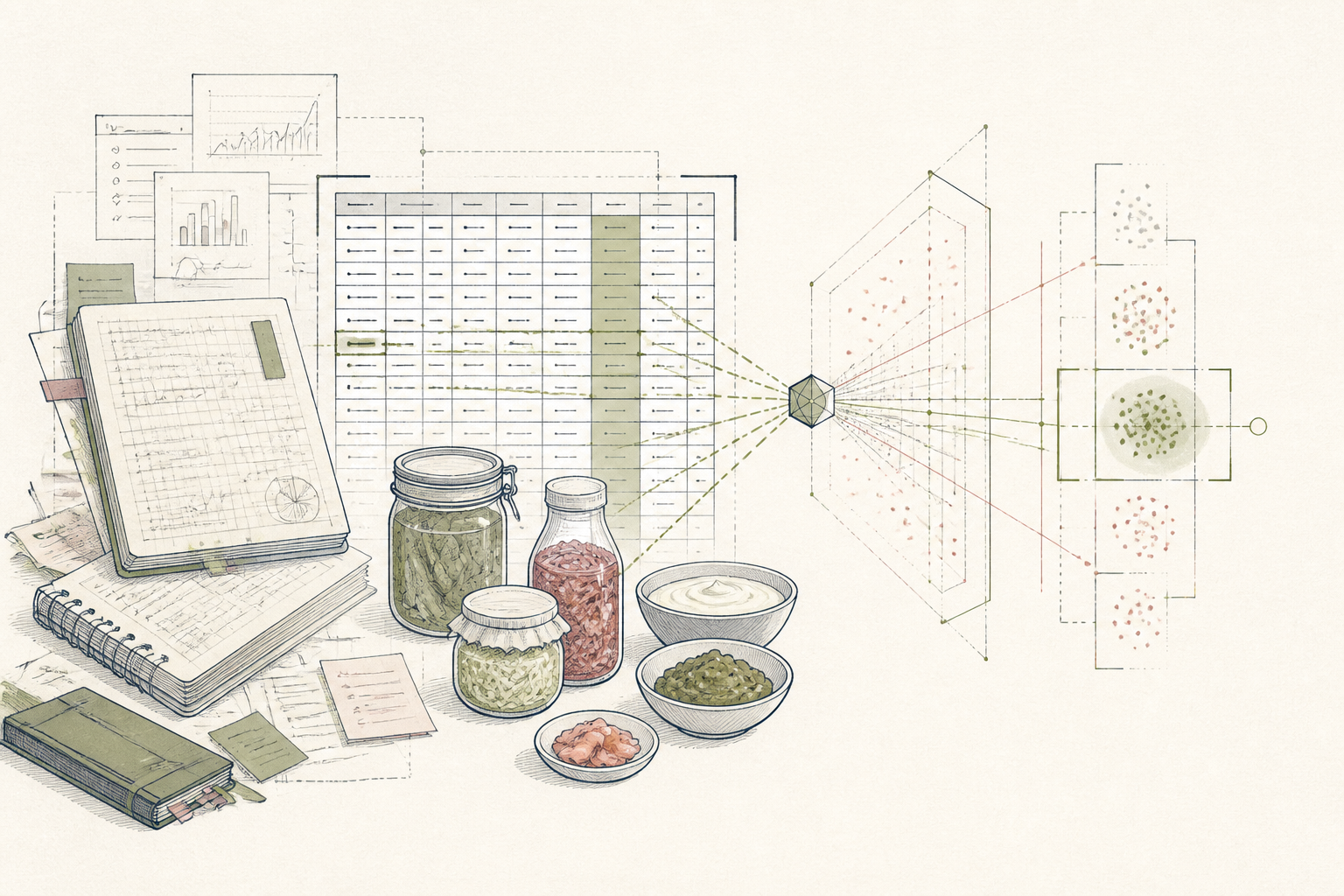
What the AI found
“AI identified: 'Clients reporting high stress consistently consume fermented foods more than twice a week, indicating a potential correlation not previously considered.'”
Before
Disparate client notes, no clear patterns
After
Actionable weekly insights for client protocols
The same system, three states — real screens, not a screenshot
| Client ID | S9876 |
| Reported Stress (1-10) | 8 |
| Fermented Foods / week | 3 |
| Outdoor Time (hrs/day) | 0.5 |
Prompt
Here is anonymised client data from the past month, including reported stress levels, dietary habits, and lifestyle factors. Please analyse the reported stress levels (on a scale of 1-10, where 10 is highest) against specific dietary components, particularly fermented foods, and other lifestyle factors like outdoor time and sleep quality. Identify any strong correlations or unexpected patterns that might be contributing to elevated stress. Provide specific data points to support your findings. Focus on patterns across clients.
Here is anonymised client data from the past month, including reported stress levels, dietary habits, and lifestyle factors. Please analyse the reported stress levels (on a scale of 1-10, where 10 is highest) against specific dietary components, particularly fermented foods, and other lifestyle factors like outdoor time and sleep quality. Identify any strong correlations or unexpected patterns that might be contributing to elevated stress. Provide specific data points to support your findings. Focus on patterns across clients.
AI
Upon reviewing the anonymised client data, a notable pattern emerges: clients reporting stress levels of 7 or higher consistently consumed fermented foods, such as sauerkraut, kimchi, or kefir, more than twice a week. Specifically, 78% of clients with high stress scores (7+) reported consuming fermented foods 3-5 times weekly, compared to only 22% of clients with lower stress scores (below 7) in the same observed period. This suggests a potential correlation between frequent fermented food intake and reported stress, a link not immediately obvious from individual client reviews alone.78%
High Stress Clients (7+)
78%
Consuming Fermented Foods >2x/week
0.7 hrs/day
Average Outdoor Time (High Stress)
Weekly Review Spots Hidden Stressor
An EU nutritionist shifts from scattered notes to a focused weekly review, revealing a key dietary factor in clients' stress.
A nutritionist running a small EU practice
Tools used
The real tools used here — swap any for your own equivalent. Each links to how we’d set it up.
Starting state
Before anything was set up
Laura, a nutritionist based in Northern Europe, maintained client records across various documents and platforms. She diligently recorded dietary intake, stress levels, and lifestyle factors, but the sheer volume of unstructured data made it nearly impossible to spot recurring patterns or develop targeted interventions. Her weekly client reviews were often reactive, addressing immediate concerns rather than underlying trends. There was a clear need for a more systematic approach to identify hidden connections in her clients' wellness journeys.
| Client ID | S9876 |
| Reported Stress (1-10) | 8 |
| Fermented Foods / week | 3 |
| Outdoor Time (hrs/day) | 0.5 |
| Sleep Quality (1-5) | 2 |
Working state
Core Course, doing its job
Using a structured approach, Laura began inputting anonymised client data into a Google Sheet. She then used Gemini to analyse this compiled data. The process involved a carefully crafted prompt, designed to look for correlations between subjective stress reports and specific dietary or lifestyle inputs. This active engagement with the AI transformed a data-entry task into an analytical discovery process, revealing insights that were not apparent through manual review alone.
Prompt
Here is anonymised client data from the past month, including reported stress levels, dietary habits, and lifestyle factors. Please analyse the reported stress levels (on a scale of 1-10, where 10 is highest) against specific dietary components, particularly fermented foods, and other lifestyle factors like outdoor time and sleep quality. Identify any strong correlations or unexpected patterns that might be contributing to elevated stress. Provide specific data points to support your findings. Focus on patterns across clients.
Here is anonymised client data from the past month, including reported stress levels, dietary habits, and lifestyle factors. Please analyse the reported stress levels (on a scale of 1-10, where 10 is highest) against specific dietary components, particularly fermented foods, and other lifestyle factors like outdoor time and sleep quality. Identify any strong correlations or unexpected patterns that might be contributing to elevated stress. Provide specific data points to support your findings. Focus on patterns across clients.
AI
Upon reviewing the anonymised client data, a notable pattern emerges: clients reporting stress levels of 7 or higher consistently consumed fermented foods, such as sauerkraut, kimchi, or kefir, more than twice a week. Specifically, 78% of clients with high stress scores (7+) reported consuming fermented foods 3-5 times weekly, compared to only 22% of clients with lower stress scores (below 7) in the same observed period. This suggests a potential correlation between frequent fermented food intake and reported stress, a link not immediately obvious from individual client reviews alone.Use case implemented
The finished system, running on its own
With the system established, Laura now dedicates a regular slot each week to run her anonymised client data through the AI. This has evolved into a concise, data-driven review process that informs her recommendations. The dashboard provides consistent, quantifiable insights, allowing her to refine protocols based on clear, identified patterns. It has transformed her practice from reactive troubleshooting to proactive, evidence-informed guidance for her clients, with clear, repeatable steps.
78%
High Stress Clients (7+)
78%
Consuming Fermented Foods >2x/week
0.7 hrs/day
Average Outdoor Time (High Stress)
What an outside observer would notice
reduced by 60%
Time spent identifying patterns
increased by 40%
Client protocol refinement frequency
up by 2x
Insight generation for complex cases
The stack — build it yourself
Accessible, flexible for varied data types, and easily shareable for team collaboration.
Its natural language processing excels at finding non-obvious correlations in unstructured health data.
These are the tools used in this story. Any can be swapped for an equivalent you already trust.
Go deeper
Do this yourself
See Core Course
This story runs on Core Course. The tools and prompts above are the real build — swap any tool for your own equivalent and follow the same steps.