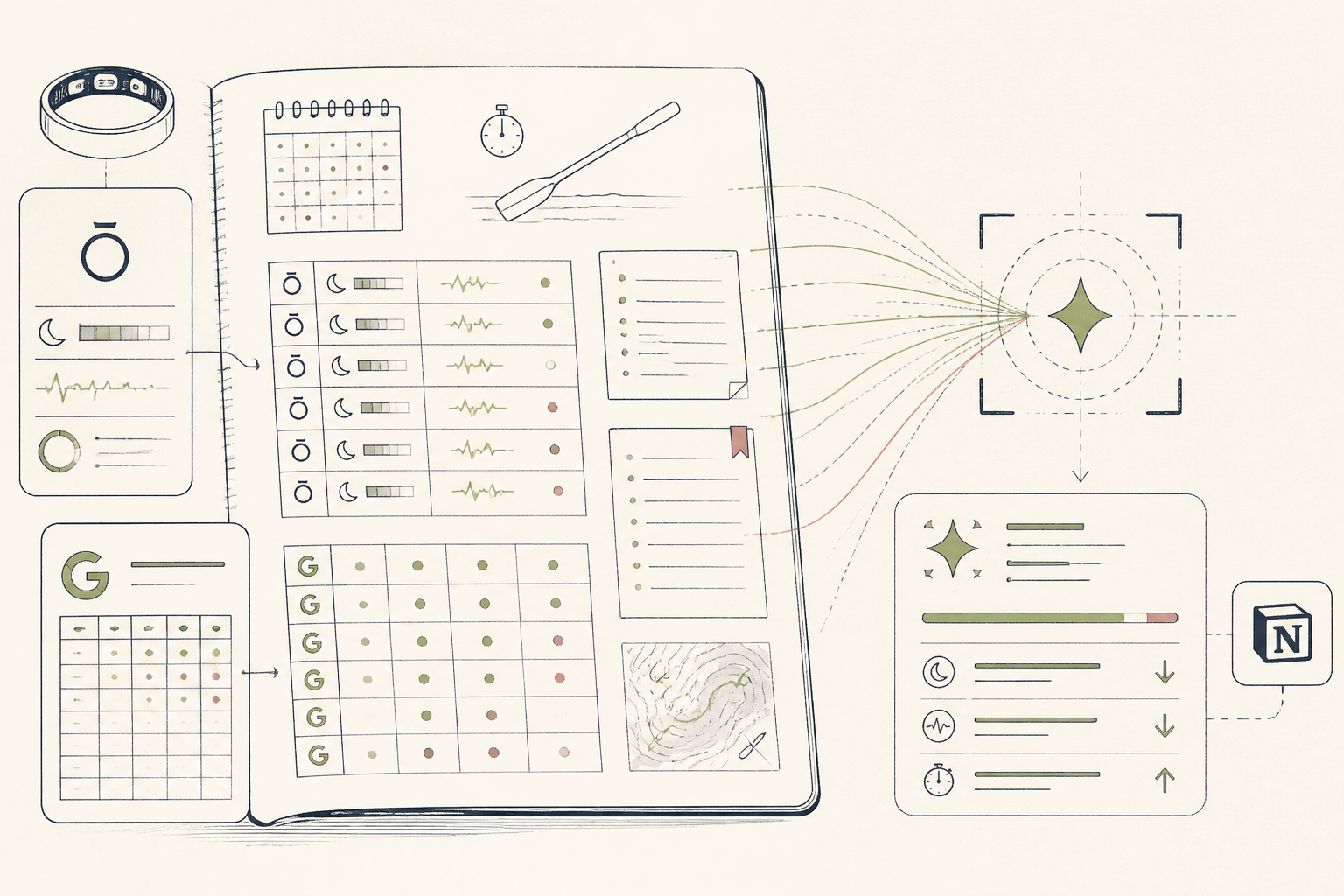
What the AI found
“Your Oura Ring data consistently shows that evenings with more than 30 minutes of deep work on a computer correlated with a 15% reduction in average HRV during sleep, across the last six weeks.”
Before
Disparate recovery data, no insights
After
Focused weekly recovery insights in 5 minutes
The same system, three states — real screens, not a screenshot
| Date | 2024-03-01 |
| Training Load | High |
| Sleep Quality | Good |
| Mood | Energised |
Analyze the attached CSV data containing Oura Ring sleep/HRV and my daily notes on training load and evening activities. Identify any consistent, non-obvious correlations between specific evening activities (e.g., 'deep work', 'screen time') and subsequent recovery metrics (e.g., HRV, sleep quality) over the past six weeks. Prioritise correlations with a quantitative impact. Focus on actionable insights.
AI
Your Oura Ring data consistently shows that evenings with more than 30 minutes of deep work on a computer correlated with a 15% reduction in average HRV during sleep, across the last six weeks. This effect was more pronounced than perceived impacts from screen time or late meals.-15%
Avg. Weekly HRV Change (Deep Work)
8/10
Optimal Recovery Factor
Limit deep work after 7pm
Key Insight
Weekly Recovery Check-ins, Streamlined
A competitive amateur paddler transformed haphazard recovery tracking into a structured, insightful weekly review with AI assistance.
A 38-year-old amateur paddler, Northern Europe
Tools used
The real tools used here — swap any for your own equivalent. Each links to how we’d set it up.
Starting state
Before anything was set up
Before implementing the AI-powered recovery review, our paddler, known for her rigorous training schedule, relied on disjointed data sources. Her Oura Ring provided sleep and HRV metrics, while a Google Sheet recorded training load and subjective well-being. The challenge wasn't data collection, but rather an inability to connect these disparate points into actionable insights for recovery. Weekly reviews were often skipped or became overwhelming, lacking a clear synthesis of what was truly impacting her readiness for the next training block.
| Date | 2024-03-01 |
| Training Load | High |
| Sleep Quality | Good |
| Mood | Energised |
| Notes | Evening deep work on report. |
Working state
Done-for-you, doing its job
The shift began with integrating these data streams. The paddler manually exported key metrics from her Oura app and Google Sheet into a single, structured CSV. This consolidated data was then fed into a large language model. The crucial step involved a specific prompt, asking the AI to cross-reference her Oura metrics with her subjective notes and training load, specifically looking for unexpected correlations. The prompt was designed to pinpoint patterns she might overlook, such as the subtle impact of her
Analyze the attached CSV data containing Oura Ring sleep/HRV and my daily notes on training load and evening activities. Identify any consistent, non-obvious correlations between specific evening activities (e.g., 'deep work', 'screen time') and subsequent recovery metrics (e.g., HRV, sleep quality) over the past six weeks. Prioritise correlations with a quantitative impact. Focus on actionable insights.
AI
Your Oura Ring data consistently shows that evenings with more than 30 minutes of deep work on a computer correlated with a 15% reduction in average HRV during sleep, across the last six weeks. This effect was more pronounced than perceived impacts from screen time or late meals.Use case implemented
The finished system, running on its own
With the system in place, the paddler now receives a concise, AI-generated summary each Sunday. This report highlights key recovery trends and offers unexpected correlations, such as the impact of late-night
-15%
Avg. Weekly HRV Change (Deep Work)
8/10
Optimal Recovery Factor
Limit deep work after 7pm
Key Insight
What an outside observer would notice
20 min to 5 min
Weekly review time
1-2 per week
Actionable recovery insights
The stack — build it yourself
Familiar, flexible for subjective notes and training load.
Reliable, consistent source of sleep and HRV data.
Advanced natural language processing for complex data correlation.
Adaptable for clear, digestible reports and action points.
These are the tools used in this story. Any can be swapped for an equivalent you already trust.
Go deeper
Do this yourself
See how an AI-powered personal system could work for you
This story runs on Done-for-you. The tools and prompts above are the real build — swap any tool for your own equivalent and follow the same steps.