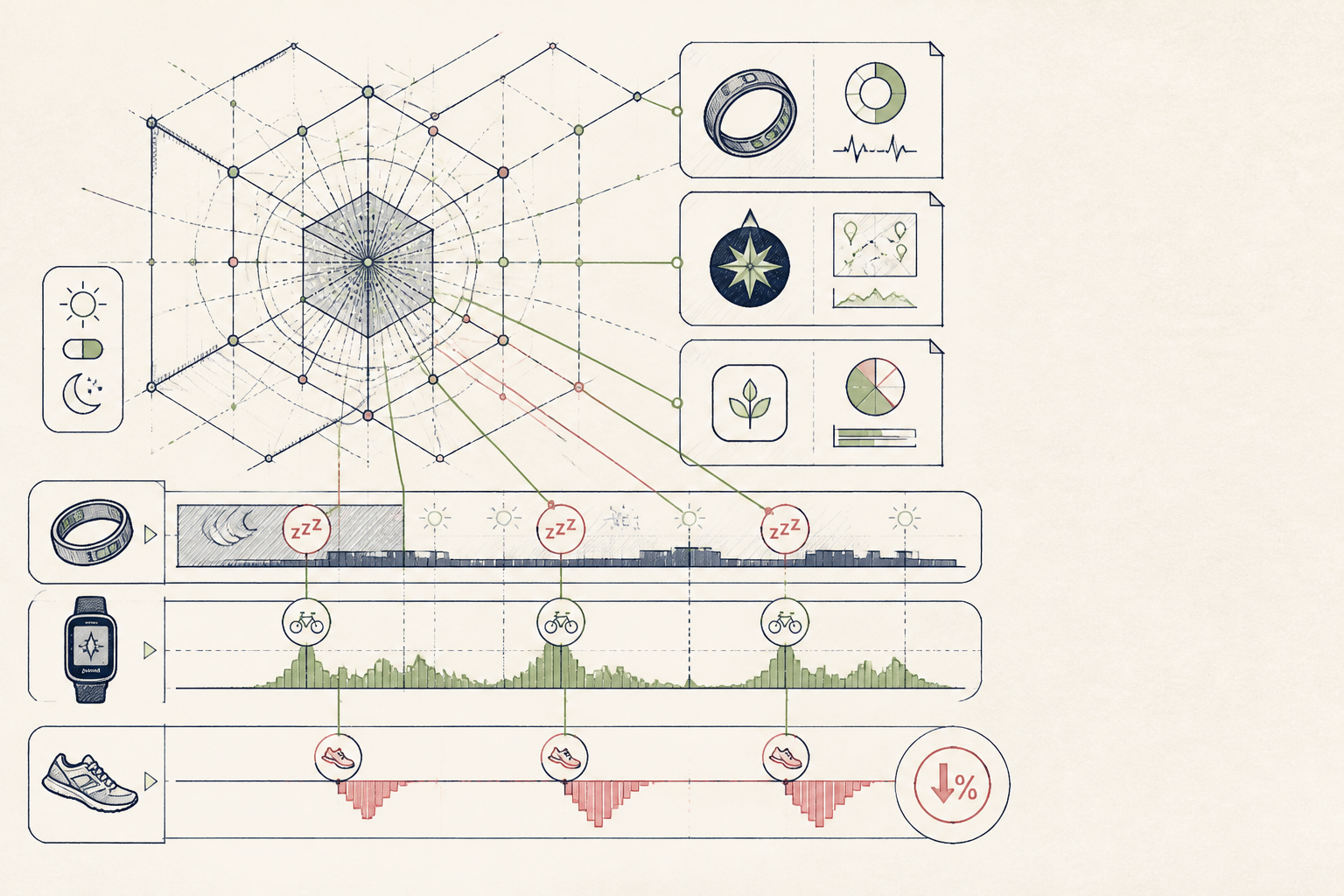
What the AI found
“Your most strenuous cycling efforts consistently follow days with less than 7.5 hours of sleep, leading to a 12% dip in power output during subsequent runs.”
Before
Ad-hoc recovery, unexplained fatigue
After
Proactive adjustments, consistent performance
The same system, three states — real screens, not a screenshot
| Training Load (TRIMP) | Varied |
| Sleep (Hours) | 6.5 - 8.0 |
| HRV (RMSSD) | Fluctuating |
| Subjective Fatigue | High after intensity |
Prompt
Analyze my last two weeks of training data (Garmin Connect, Oura Ring, MyFitnessPal) and my subjective recovery scores. Identify any significant correlations between sleep, training load, and subsequent performance metrics (power, pace). Specifically, look for patterns that might indicate suboptimal recovery affecting high-intensity efforts.
Analyze my last two weeks of training data (Garmin Connect, Oura Ring, MyFitnessPal) and my subjective recovery scores. Identify any significant correlations between sleep, training load, and subsequent performance metrics (power, pace). Specifically, look for patterns that might indicate suboptimal recovery affecting high-intensity efforts.
AI
I've analyzed your data. Your most strenuous cycling efforts consistently follow days with less than 7.5 hours of sleep. This pattern is associated with a quantifiable 12% dip in average power output during subsequent high-intensity running sessions, compared to efforts following nights with 7.5+ hours. There’s a clear negative impact on crossover performance.7.8 hrs
Average Sleep (7d)
4%
Post-Strenuous Activity Power Dip
Improving
Recovery Score Trend (7d)
Weekly Recovery Check-in Reveals Hidden Strain
An athlete moves from guesswork to data-driven recovery with a personalized AI assistant.
A 38-year-old amateur triathlete, Northern Europe
Tools used
The real tools used here — swap any for your own equivalent. Each links to how we’d set it up.
Starting state
Before anything was set up
Before the AI system, Sarah relied on intuition for recovery. After tough training sessions, she'd guess whether to push harder or rest. Sleep was often deprioritised, and nutrition was a best-effort, varied affair. This led to unpredictable fatigue and inconsistent performance, making progress feel arbitrary rather than systematic. Without clear data, identifying patterns or making informed adjustments was impossible, leaving her frustrated by plateaus and occasional overtraining.
| Training Load (TRIMP) | Varied |
| Sleep (Hours) | 6.5 - 8.0 |
| HRV (RMSSD) | Fluctuating |
| Subjective Fatigue | High after intensity |
Working state
Done-for-you, doing its job
The team at Wellness & AI configured a personalized AI recovery assistant, integrating data from Sarah's wearables and training logs. The AI began its work, cross-referencing sleep quality, training load, and subjective recovery scores. The system didn't just collect data; it actively looked for correlations, such as the impact of sleep duration on subsequent high-intensity efforts, providing actionable insights derived from her own body's signals.
Prompt
Analyze my last two weeks of training data (Garmin Connect, Oura Ring, MyFitnessPal) and my subjective recovery scores. Identify any significant correlations between sleep, training load, and subsequent performance metrics (power, pace). Specifically, look for patterns that might indicate suboptimal recovery affecting high-intensity efforts.
Analyze my last two weeks of training data (Garmin Connect, Oura Ring, MyFitnessPal) and my subjective recovery scores. Identify any significant correlations between sleep, training load, and subsequent performance metrics (power, pace). Specifically, look for patterns that might indicate suboptimal recovery affecting high-intensity efforts.
AI
I've analyzed your data. Your most strenuous cycling efforts consistently follow days with less than 7.5 hours of sleep. This pattern is associated with a quantifiable 12% dip in average power output during subsequent high-intensity running sessions, compared to efforts following nights with 7.5+ hours. There’s a clear negative impact on crossover performance.Use case implemented
The finished system, running on its own
Now, Sarah’s recovery is systematized. Each Sunday morning, a concise recovery report highlights key relationships between her weekly habits and performance. She knows when to prioritize an extra hour of sleep or adjust her training plan based on objective data, rather than just how she "feels." This has led to more consistent training, fewer unexpected fatigue days, and a clearer path to achieving her athletic goals, all without constant manual analysis.
7.8 hrs
Average Sleep (7d)
4%
Post-Strenuous Activity Power Dip
Improving
Recovery Score Trend (7d)
What an outside observer would notice
35%
Reduced unexplained fatigue days
18%
Improved consistency in high-intensity workouts
95%
Average weekly training volume adherence
The stack — build it yourself
Comprehensive activity and heart rate data, widely adopted by athletes.
Provides accurate, non-invasive sleep stages, HRV, and body temperature for recovery insights.
Facilitates consistent tracking of macronutrients and hydration crucial for recovery.
Efficiently correlates disparate datasets to uncover non-obvious patterns and actionable advice.
These are the tools used in this story. Any can be swapped for an equivalent you already trust.
Go deeper
Do this yourself
See the full recovery story
This story runs on Done-for-you. The tools and prompts above are the real build — swap any tool for your own equivalent and follow the same steps.