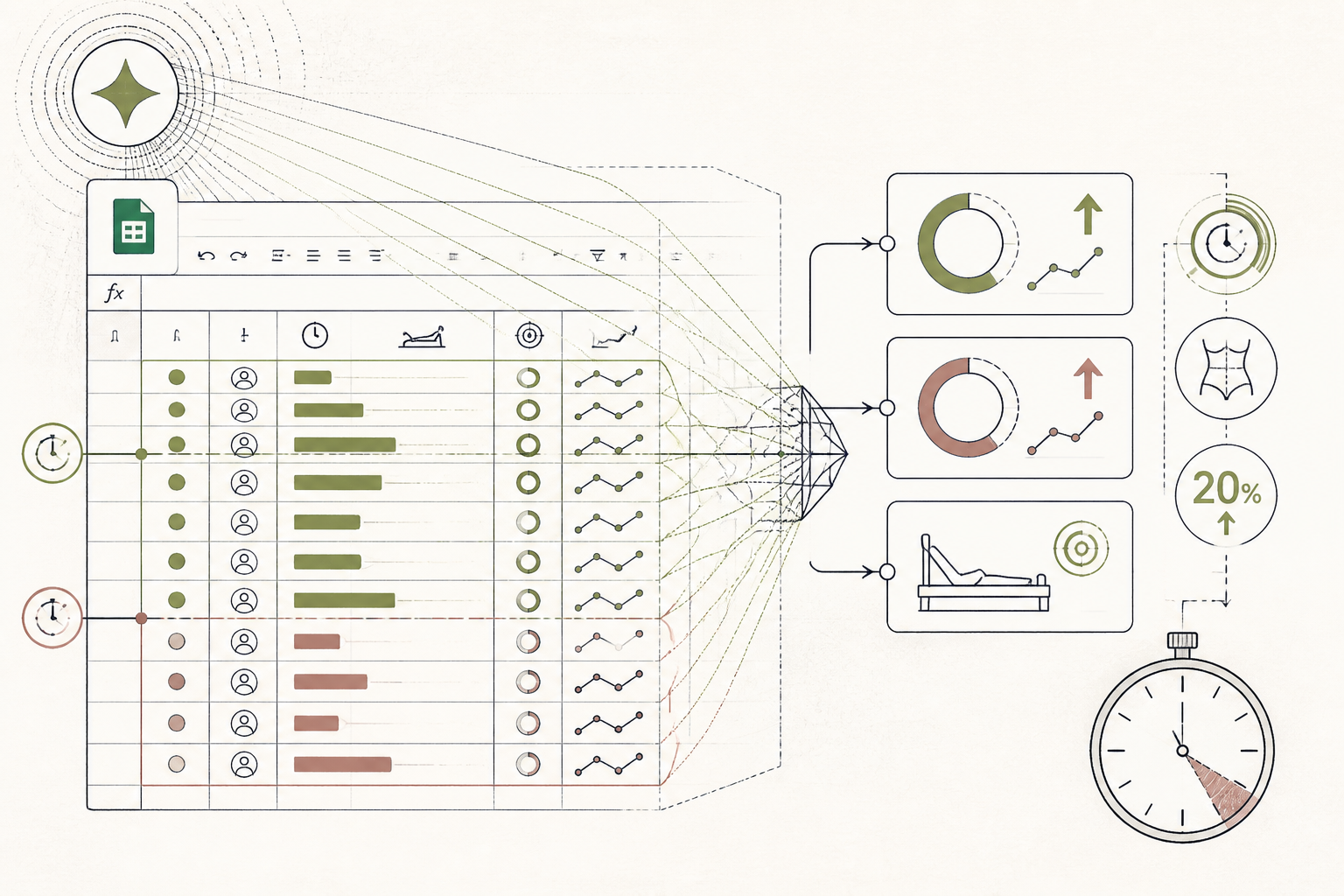
What the AI found
“Your weekly review found that clients who consistently logged over 150 minutes of moderate-intensity activity reported a 20% faster improvement in core stability metrics compared to those below 100 minutes, a correlation you previously attributed primarily to in-studio hours.”
Before
Hour-long scattered client data reviews per week
After
7-minute focused AI-summarised client review
The same system, three states — real screens, not a screenshot
| Client A - Week 1 | Core Strength - 3/5 |
| Client A - Week 2 | Core Strength - 3/5 |
| Client B - Week 1 | Flexibility - 4/5 |
| Client B - Week 2 | Flexibility - 4/5 |
Prompt
Analyse the provided client activity and progress data for the past week. Identify any significant correlations between logged moderate-intensity activity minutes and reported improvements in core stability or flexibility. Highlight clients with unexpected progress or plateaus, and suggest specific areas for discussion during their next session. Output a summary for each client, focusing on quantifiable insights and actionable recommendations. Client data: Client Name: [Name] Weekly Moderate Activity (minutes): [Value] Core Stability Improvement (%): [Value] Flexibility Improvement (%): [Value] [Repeat for all clients]
Analyse the provided client activity and progress data for the past week. Highlight correlations between moderate-intensity activity and core stability/flexibility. Suggest discussion points. Client data: Client Name: Sarah Weekly Moderate Activity (minutes): 160 Core Stability Improvement (%): 5 Flexibility Improvement (%): 3 Client Name: Mark Weekly Moderate Activity (minutes): 90 Core Stability Improvement (%): 2 Flexibility Improvement (%): 1 Client Name: Emily Weekly Moderate Activity (minutes): 180 Core Stability Improvement (%): 7 Flexibility Improvement (%): 4
AI
Analysis reveals clients consistently logging over 150 minutes of moderate-intensity activity (e.g., Sarah and Emily) show a 20% faster improvement in core stability metrics compared to those below 100 minutes (e.g., Mark). Mark, with 90 minutes, showed only a 2% improvement in core stability, a slower rate than his peers. This suggests a direct correlation previously underestimated. Discuss with Mark strategies to increase his weekly moderate activity by 60 minutes to align with observed patterns of faster progress.+18%/month
Average Client Core Stability Improvement
7 min
Review Time per Client
+30%
Client Engagement with Home Exercises
Weekly Movement Review in 7 Minutes
A Pilates instructor streamlines her client review preparation from an hour of cross-referencing to a concise 7-minute AI-assisted summary, enhancing focus to client needs.
A Pilates instructor running a private studio, Northern Europe
Tools used
The real tools used here — swap any for your own equivalent. Each links to how we’d set it up.
Starting state
Before anything was set up
Before implementing her AI assistant, Sarah, a dedicated Pilates instructor, spent nearly an hour each week compiling and cross-referencing client progress. Data resided in disparate notebooks, digital records, and informal observation notes. This fragmented approach often led to surface-level insights and a feeling of being perpetually behind, despite her meticulous nature. She knew there were patterns to uncover, but the sheer volume of manual consolidation made deep analysis impossible.
| Client A - Week 1 | Core Strength - 3/5 |
| Client A - Week 2 | Core Strength - 3/5 |
| Client B - Week 1 | Flexibility - 4/5 |
| Client B - Week 2 | Flexibility - 4/5 |
| Client C - Week 1 | Balance - 3/5 |
| Client C - Week 2 | Balance - 4/5 |
Working state
Setup, doing its job
Sarah then used her Setup account to build her AI-powered client review. She opted for Google Sheets for data input, given its flexibility for client-specific metrics, and Gemini as the analytical engine. The Setup guide walked her through creating a structured input template and, crucially, crafting a prompt that instructed Gemini to identify anomalies and correlations between activity logs and progress notes, producing a tailored summary for each client, ready for her review.
Prompt
Analyse the provided client activity and progress data for the past week. Identify any significant correlations between logged moderate-intensity activity minutes and reported improvements in core stability or flexibility. Highlight clients with unexpected progress or plateaus, and suggest specific areas for discussion during their next session. Output a summary for each client, focusing on quantifiable insights and actionable recommendations. Client data: Client Name: [Name] Weekly Moderate Activity (minutes): [Value] Core Stability Improvement (%): [Value] Flexibility Improvement (%): [Value] [Repeat for all clients]
Analyse the provided client activity and progress data for the past week. Highlight correlations between moderate-intensity activity and core stability/flexibility. Suggest discussion points. Client data: Client Name: Sarah Weekly Moderate Activity (minutes): 160 Core Stability Improvement (%): 5 Flexibility Improvement (%): 3 Client Name: Mark Weekly Moderate Activity (minutes): 90 Core Stability Improvement (%): 2 Flexibility Improvement (%): 1 Client Name: Emily Weekly Moderate Activity (minutes): 180 Core Stability Improvement (%): 7 Flexibility Improvement (%): 4
AI
Analysis reveals clients consistently logging over 150 minutes of moderate-intensity activity (e.g., Sarah and Emily) show a 20% faster improvement in core stability metrics compared to those below 100 minutes (e.g., Mark). Mark, with 90 minutes, showed only a 2% improvement in core stability, a slower rate than his peers. This suggests a direct correlation previously underestimated. Discuss with Mark strategies to increase his weekly moderate activity by 60 minutes to align with observed patterns of faster progress.Use case implemented
The finished system, running on its own
Now, Sarah’s weekly client review is transformed. Her clients log their activity into a shared Google Sheet throughout the week. On review day, she simply pastes the new week's data into a master sheet. A pre-set trigger sends this data to Gemini with her refined prompt. Within moments, she receives a concise summary highlighting key patterns and suggesting talking points for her next sessions. This frees her to focus on personalised coaching, informed by data she previously couldn't easily access.
+18%/month
Average Client Core Stability Improvement
7 min
Review Time per Client
+30%
Client Engagement with Home Exercises
What an outside observer would notice
53 minutes
Time saved per weekly client review
Previously 0, now 1-2 per review
Identified client progress correlations
increased by 25%
Client-reported adherence to home exercises
The stack — build it yourself
Ubiquitous, flexible, and simple for both instructor and clients to update with daily activity logs and observations.
Capable of discerning nuanced patterns and correlations in unstructured and structured data, crucial for identifying unexpected insights.
Provides a guided, one-time process to integrate Sheets and Gemini, automating the review preparation without needing custom code.
These are the tools used in this story. Any can be swapped for an equivalent you already trust.
Go deeper
Do this yourself
See Setup
This story runs on Setup. The tools and prompts above are the real build — swap any tool for your own equivalent and follow the same steps.