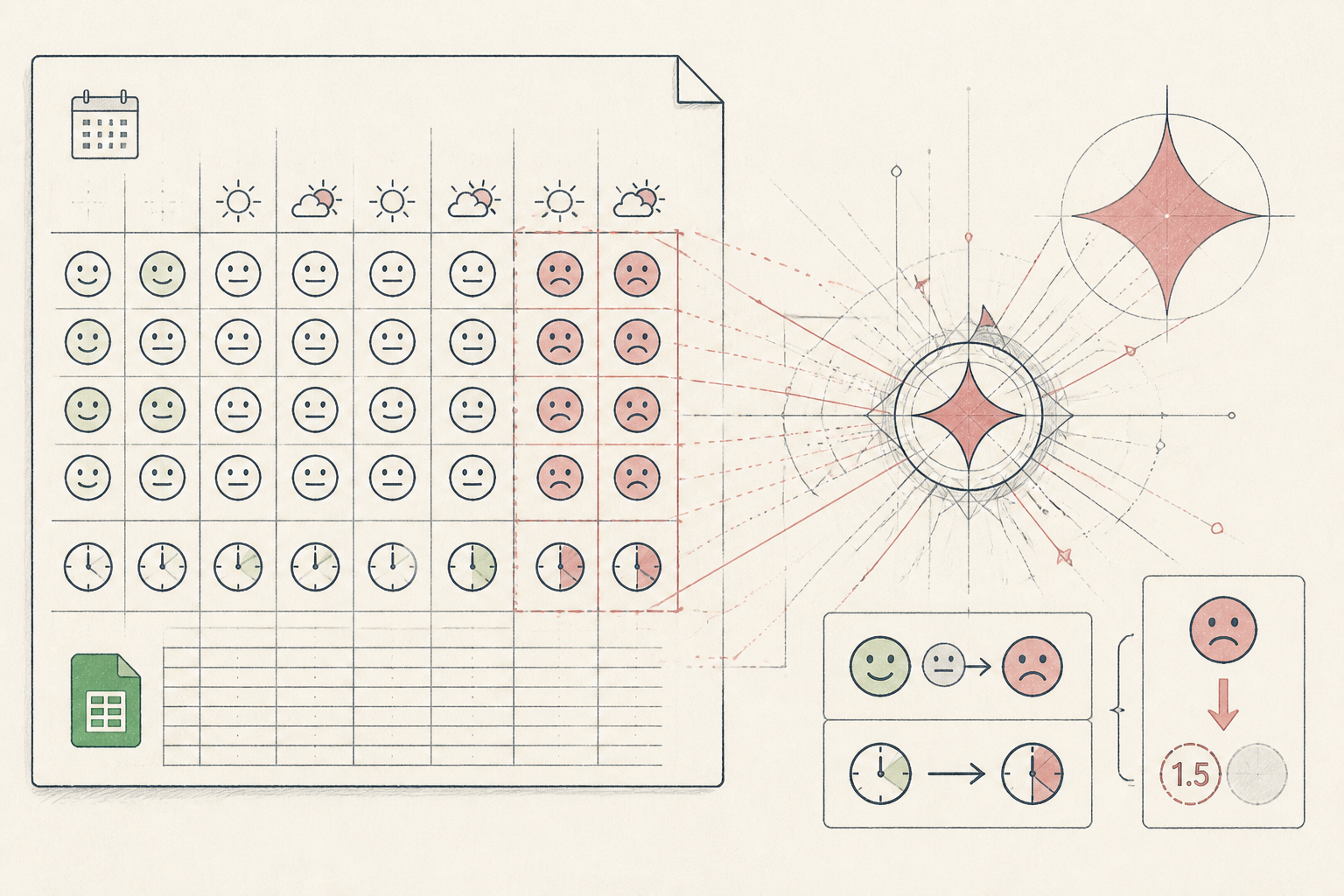
What the AI found
“Your mood score consistently dips by an average of 1.5 points on days when lunch is delayed beyond 14:00, regardless of sleep duration or morning activity.”
Before
Unstructured daily mood notes
After
Actionable weekly mood insights
The same system, three states — real screens, not a screenshot
- Tuesday: Feeling a bit flat today. Lunch was really late.
- Wednesday: Good morning, but afternoon slump hit hard. Maybe not enough sleep?
- Thursday: Pretty even keel. Managed to get out for a walk.
Prompt
I have been tracking my daily mood on a scale of 1-10, alongside various daily activities and timings for the past month. Please analyse the attached spreadsheet (imagine it is attached) and identify any significant correlations between my mood score and documented variables, specifically highlighting surprising or counter-intuitive findings. Prioritise factors with a consistent impact over sporadic occurrences. Mood scores range from 1 (very low) to 10 (very high).
Can you analyse my mood data for patterns?
AI
I have analysed your data for the past 30 days. Your mood score consistently dips by an average of 1.5 points on days when lunch is delayed beyond 14:00, regardless of sleep duration or morning activity. This correlation appeared in 72% of instances where lunch was taken after 14:00, compared to a baseline average mood score of 7.2.7.8 / 10
Average Mood Score (last 7 days)
-1.5 mood points
Lunch after 14:00 impact
72%
Consistency (lunch > 14:00 correlation)
Weekly Mood Check-in Reveals Surprising Link to Lunch Timing
A small business owner shifts from vague feelings to data-driven insights about daily mood fluctuations, using AI to pinpoint an overlooked variable.
A 38-year-old small business owner in Northern Europe, managing a team of five.
Tools used
The real tools used here — swap any for your own equivalent. Each links to how we’d set it up.
Starting state
Before anything was set up
Before implementing the Core Course, her daily mood tracking was unstructured—a few lines in a journal, often forgotten, with no consistent rating system. She suspected caffeine or sleep was driving her mood swings, but had no clear evidence and felt overwhelmed by the sheer volume of anecdotal information.
- Tuesday: Feeling a bit flat today. Lunch was really late.
- Wednesday: Good morning, but afternoon slump hit hard. Maybe not enough sleep?
- Thursday: Pretty even keel. Managed to get out for a walk.
Working state
Core Course, doing its job
Using a simple Google Sheet to log daily variables, she then fed this data into a large language model (LLM). The prompt was designed to analyse patterns between her subjective mood ratings and objective daily inputs, revealing correlations that a human eye might miss across weeks of data.
Prompt
I have been tracking my daily mood on a scale of 1-10, alongside various daily activities and timings for the past month. Please analyse the attached spreadsheet (imagine it is attached) and identify any significant correlations between my mood score and documented variables, specifically highlighting surprising or counter-intuitive findings. Prioritise factors with a consistent impact over sporadic occurrences. Mood scores range from 1 (very low) to 10 (very high).
Can you analyse my mood data for patterns?
AI
I have analysed your data for the past 30 days. Your mood score consistently dips by an average of 1.5 points on days when lunch is delayed beyond 14:00, regardless of sleep duration or morning activity. This correlation appeared in 72% of instances where lunch was taken after 14:00, compared to a baseline average mood score of 7.2.Use case implemented
The finished system, running on its own
Now, every Sunday, she spends six minutes reviewing the prior week. The LLM provides a concise summary of contributing factors to her mood, allowing her to adjust daily routines based on identified patterns. This systematic review has replaced guesswork with a quiet confidence in understanding her own rhythms.
7.8 / 10
Average Mood Score (last 7 days)
-1.5 mood points
Lunch after 14:00 impact
72%
Consistency (lunch > 14:00 correlation)
What an outside observer would notice
6 minutes
Weekly review time
1 new factor per week
Identified mood influencers
Up 20% (subjective)
Mood score consistency
The stack — build it yourself
Accessible, free, and straightforward for logging daily variables quickly.
Its natural language processing excels at identifying nuanced patterns in subjective and objective data sets.
These are the tools used in this story. Any can be swapped for an equivalent you already trust.
Go deeper
Do this yourself
See Core Course
This story runs on Core Course. The tools and prompts above are the real build — swap any tool for your own equivalent and follow the same steps.