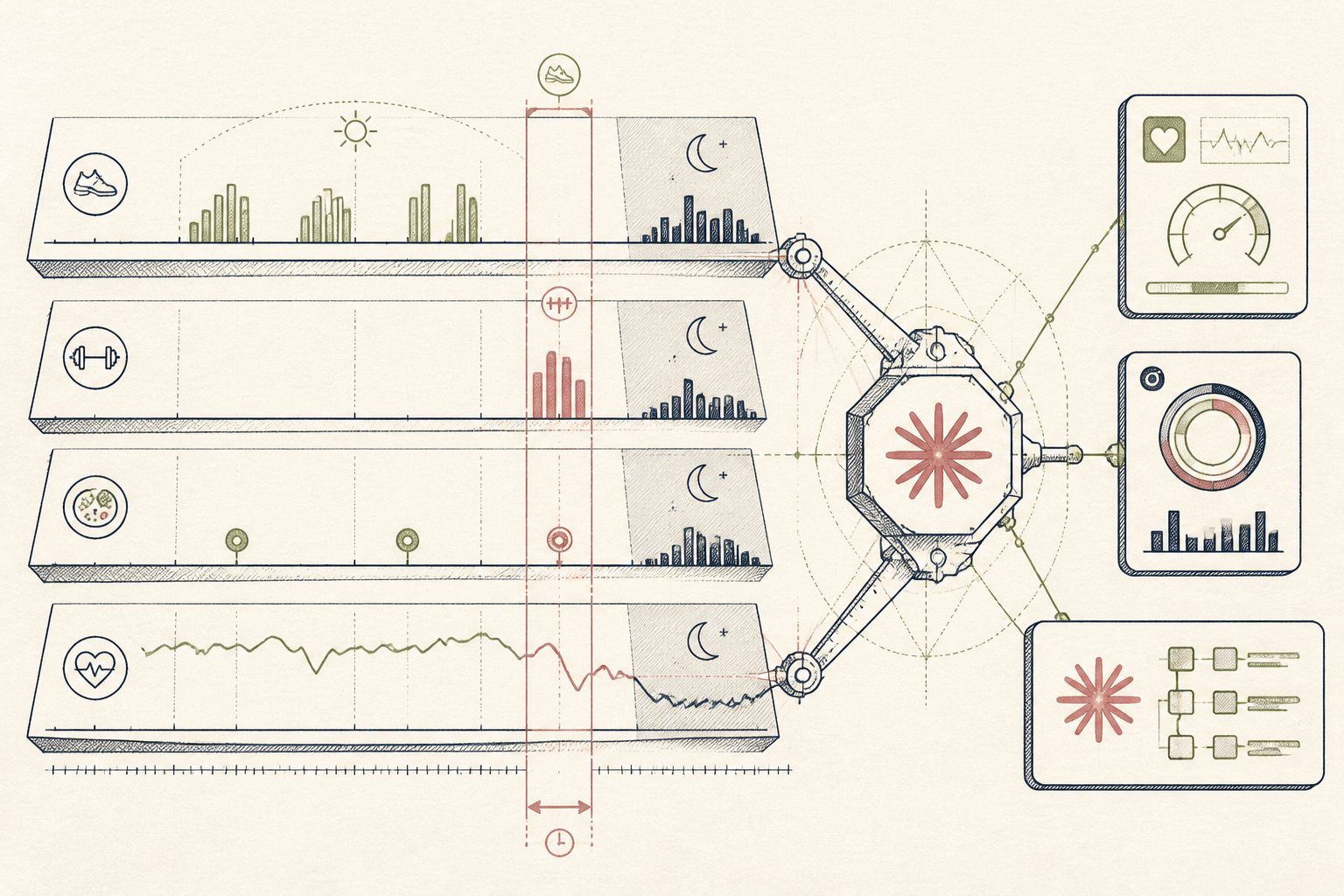
What the AI found
“"Your lowest overnight recovery scores never followed high-mileage runs; they followed heavy bench press sessions scheduled within 4 hours of your evening meal."”
Before
6 months of random foam-rolling and erratic HRV
After
A 90-second log and resting heart rate down 5 bpm
The same system, three states — real screens, not a screenshot
| Tue 14km tempo | RHR 61 bpm |
| Thu Upper weights 19 | 30 — RHR 66 bpm |
| Sat 24km long run | RHR 58 bpm |
| Sun Foam roller 20m | RHR 63 bpm |
Prompt
Here is my CSV export from Garmin Connect and Apple Health for the last 30 days. Correlate my top 5 worst overnight resting heart rate spikes against workout modality, completion time, and distance. Highlight any counter-intuitive patterns.
Here is my CSV export from Garmin Connect and Apple Health for the last 30 days. Correlate my top 5 worst overnight resting heart rate spikes against workout modality, completion time, and distance. Highlight any counter-intuitive patterns.
AI
Your lowest overnight recovery scores never followed high-mileage runs; they followed heavy bench press sessions scheduled within 4 hours of your evening meal. On days with late upper-body lifting, your basal heart rate took 3.2 additional hours to hit its nadir, regardless of sleep duration.54 bpm (-5 bpm)
Avg Resting HR
0 / month
Late Strength Days
High (88%)
Recovery Predictability
Untangling Overnight Recovery With Timestamp Analysis
How structured prompt analysis isolated an evening timing bottleneck across six months of training logs.
A 38-year-old amateur marathoner and software architect, Northern Europe
Tools used
The real tools used here — swap any for your own equivalent. Each links to how we’d set it up.
Starting state
Before anything was set up
His Google Sheet held 180 rows of meticulously recorded metrics: morning resting heart rate, subjective soreness scores, mileage, and evening mobility routines. Despite six months of logging, his overnight recovery remained unpredictable. Some mornings following 28-kilometer trail runs his heart rate was a calm 52 beats per minute; other days, following a rest day and twenty minutes on a massage gun, it hovered stubbornly at 64. He assumed his training volume was simply excessive.
| Tue 14km tempo | RHR 61 bpm |
| Thu Upper weights 19 | 30 — RHR 66 bpm |
| Sat 24km long run | RHR 58 bpm |
| Sun Foam roller 20m | RHR 63 bpm |
Working state
Hacks Pass, doing its job
Instead of reading each metric in isolation, he exported thirty days of raw activity and biometric timestamps into Claude using a tight, comparative prompt. Within seconds, the assistant parsed the disparate data streams. It didn't suggest exotic recovery modalities or supplements. It simply mapped workout finish times against the hours required for his heart rate to reach baseline, isolating a clear physiological friction point he had overlooked for months.
Prompt
Here is my CSV export from Garmin Connect and Apple Health for the last 30 days. Correlate my top 5 worst overnight resting heart rate spikes against workout modality, completion time, and distance. Highlight any counter-intuitive patterns.
Here is my CSV export from Garmin Connect and Apple Health for the last 30 days. Correlate my top 5 worst overnight resting heart rate spikes against workout modality, completion time, and distance. Highlight any counter-intuitive patterns.
AI
Your lowest overnight recovery scores never followed high-mileage runs; they followed heavy bench press sessions scheduled within 4 hours of your evening meal. On days with late upper-body lifting, your basal heart rate took 3.2 additional hours to hit its nadir, regardless of sleep duration.Use case implemented
The finished system, running on its own
The protocol now runs automatically every Friday afternoon. A single shortcut script pulls his weekly training load from Garmin Connect, matches it against his Apple Health resting heart rate logs, and surfaces any timing clashes before he plans weekend volume. He moved upper-body resistance work to 07:30 before work. No expensive gadgets added, no speculative supplements bought. His evening heart rate dip begins eighty minutes earlier on average, and Monday leg sessions feel crisp rather than heavy.
54 bpm (-5 bpm)
Avg Resting HR
0 / month
Late Strength Days
High (88%)
Recovery Predictability
What an outside observer would notice
5 bpm over 6 weeks
Resting heart rate drop
90 seconds
Weekly logging time
Shifted 80 mins earlier
Evening digest delay
The stack — build it yourself
Reliable, native background capture of resting heart rate and sleep duration without manual entry.
Accurate breakdown of workout modality, heart rate intensity zones, and completion times.
Processes multi-column CSV exports and identifies non-linear time-lag correlations across modalities.
These are the tools used in this story. Any can be swapped for an equivalent you already trust.
Go deeper
Do this yourself
Read the recovery walkthrough
This story runs on Hacks Pass. The tools and prompts above are the real build — swap any tool for your own equivalent and follow the same steps.