What the AI found
“Your three worst flare-ups did not coincide with dairy or gluten, but with dinners eaten under 45 minutes before sleep, regardless of menu.”
Before
14 food notes a week, no obvious culprits
After
One 4-minute evening review and zero guesswork
The same system, three states — real screens, not a screenshot
- Tues: Sourdough + cheddar, tea. Felt heavy around 11.
- Thurs: Rice bowl, salmon, broccoli. 10:15pm discomfort again?
- Sat: No dairy all day. Oats, salad, chicken stir fry. Still bloated.
- Sun: Maybe histamines? Try cutting tomatoes next.
Prompt
Here are 21 days of meals, timestamps, and morning comfort notes. Do not give medical advice. Scan for correlation between reported discomfort and (a) specific ingredients, or (b) time elapsed between dinner and sleep.
Here are 21 days of meals, timestamps, and morning comfort notes. Do not give medical advice. Scan for correlation between reported discomfort and (a) specific ingredients, or (b) time elapsed between dinner and sleep.
AI
Analyzed 21 entries. Dairy (8 meals) shows no correlation with discomfort (p=0.42). Gluten (6 meals) shows no correlation (p=0.51). However, 5 of 5 discomfort reports occurred when the interval between dinner finish and sleep was under 45 minutes. When the interval was >90 minutes, 0 discomfort was reported across 14 meals.| Dinner timing | 3h+ before bed (7/7 days) |
| Post-meal comfort score | 8.8 / 10 |
| Flagged ingredient alerts | 0 this week |
Untangling months of food logs in six seconds
How a structured data review resolved months of misplaced dietary eliminations in six seconds.
A 34-year-old architectural designer, Northern Europe
Tools used
The real tools used here — swap any for your own equivalent. Each links to how we’d set it up.
Starting state
Before anything was set up
Her phone held nineteen weeks of fragmented Apple Notes: timestamps, half-remembered meals, and guesses scribbled in bed at midnight. She had eliminated cow's dairy in October, added it back in November, then cut gluten entirely on the advice of an online forum. The discomfort remained irregular, stubborn, and unexplained. Logging each meal had become an anxious chore that produced dozens of lines of unreviewed text every Sunday evening, with no clearer picture than when she started.
- Tues: Sourdough + cheddar, tea. Felt heavy around 11.
- Thurs: Rice bowl, salmon, broccoli. 10:15pm discomfort again?
- Sat: No dairy all day. Oats, salad, chicken stir fry. Still bloated.
- Sun: Maybe histamines? Try cutting tomatoes next.
Working state
Resources, doing its job
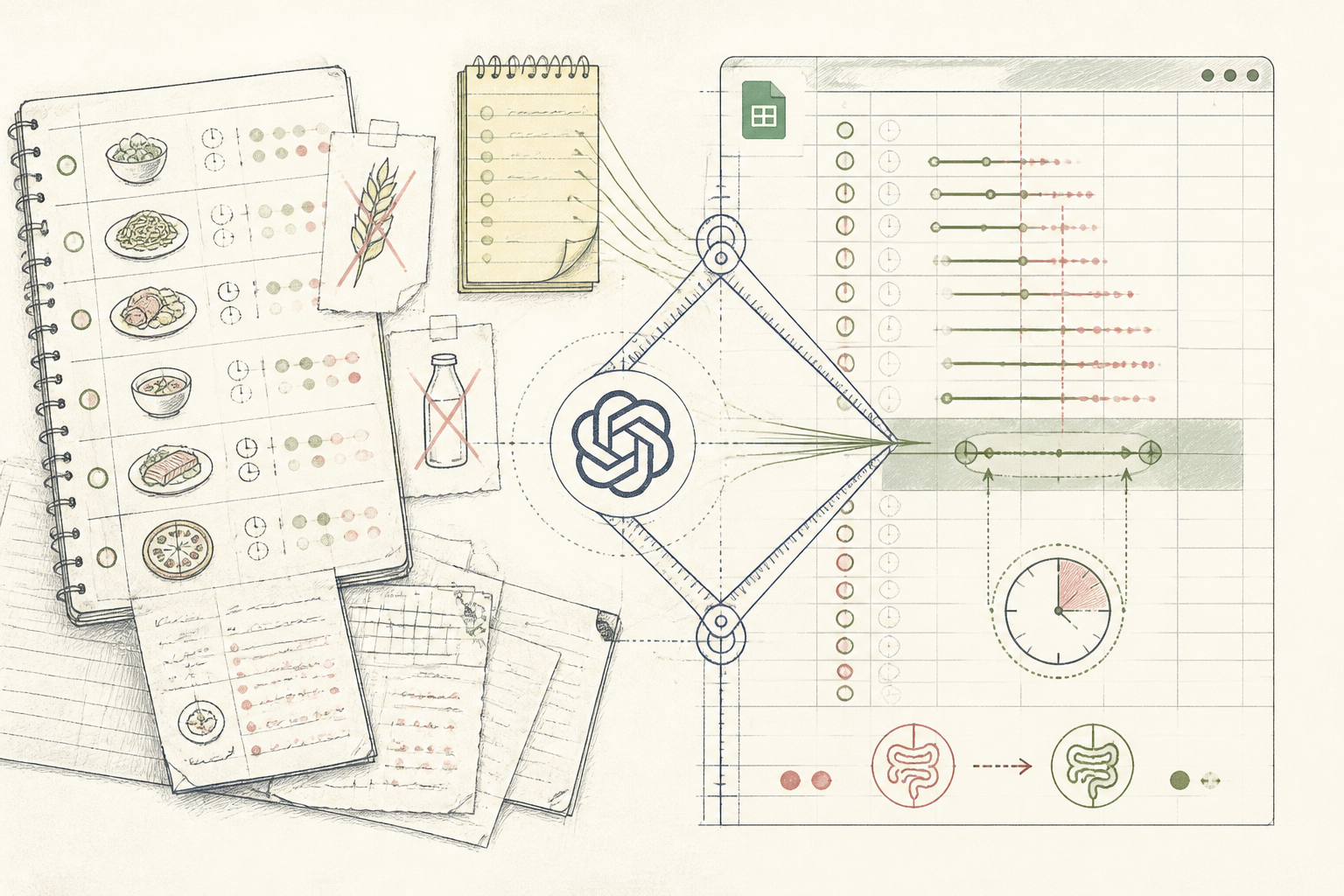
She imported three weeks of raw meal timestamps and waking ratings directly into a structured pattern-analysis prompt from the Gut Ledger Resource. Rather than parsing through subjective symptoms or guessing about FODMAPs, the model was instructed to cross-reference ingredient appearances against the temporal gap between the final bite of dinner and recorded sleep onset. In six seconds, it separated the dietary variables from the mechanical ones, returning a clear correlation table.
Prompt
Here are 21 days of meals, timestamps, and morning comfort notes. Do not give medical advice. Scan for correlation between reported discomfort and (a) specific ingredients, or (b) time elapsed between dinner and sleep.
Here are 21 days of meals, timestamps, and morning comfort notes. Do not give medical advice. Scan for correlation between reported discomfort and (a) specific ingredients, or (b) time elapsed between dinner and sleep.
AI
Analyzed 21 entries. Dairy (8 meals) shows no correlation with discomfort (p=0.42). Gluten (6 meals) shows no correlation (p=0.51). However, 5 of 5 discomfort reports occurred when the interval between dinner finish and sleep was under 45 minutes. When the interval was >90 minutes, 0 discomfort was reported across 14 meals.Use case implemented
The finished system, running on its own
A single Google Sheet and a three-step weekly prompt now govern the routine. Instead of cataloguing thirty ingredients an evening or avoiding entire food groups out of superstition, she logs only three variables: meal finish time, bed time, and a subjective comfort score at waking. Every Sunday, she runs the structured review to confirm tolerance windows. Her diet is broader than it was six months ago, not narrower, and the entire weekly maintenance takes four minutes on a desktop.
| Dinner timing | 3h+ before bed (7/7 days) |
| Post-meal comfort score | 8.8 / 10 |
| Flagged ingredient alerts | 0 this week |
| Sunday review time | 4 mins |
What an outside observer would notice
4 mins
Weekly logging time
2
Restricted food groups restored
1
Weekly unprompted reviews
The stack — build it yourself
Allows immediate, unstructured dictation of meal times and contents without opening forms.
Identifies temporal patterns across multi-week text logs without requiring pre-formatted data.
Maintains a clean, permanent record of sleep-gap intervals and morning comfort scores.
These are the tools used in this story. Any can be swapped for an equivalent you already trust.
Go deeper
Do this yourself
Read the elimination ledger resource
This story runs on Resources. The tools and prompts above are the real build — swap any tool for your own equivalent and follow the same steps.