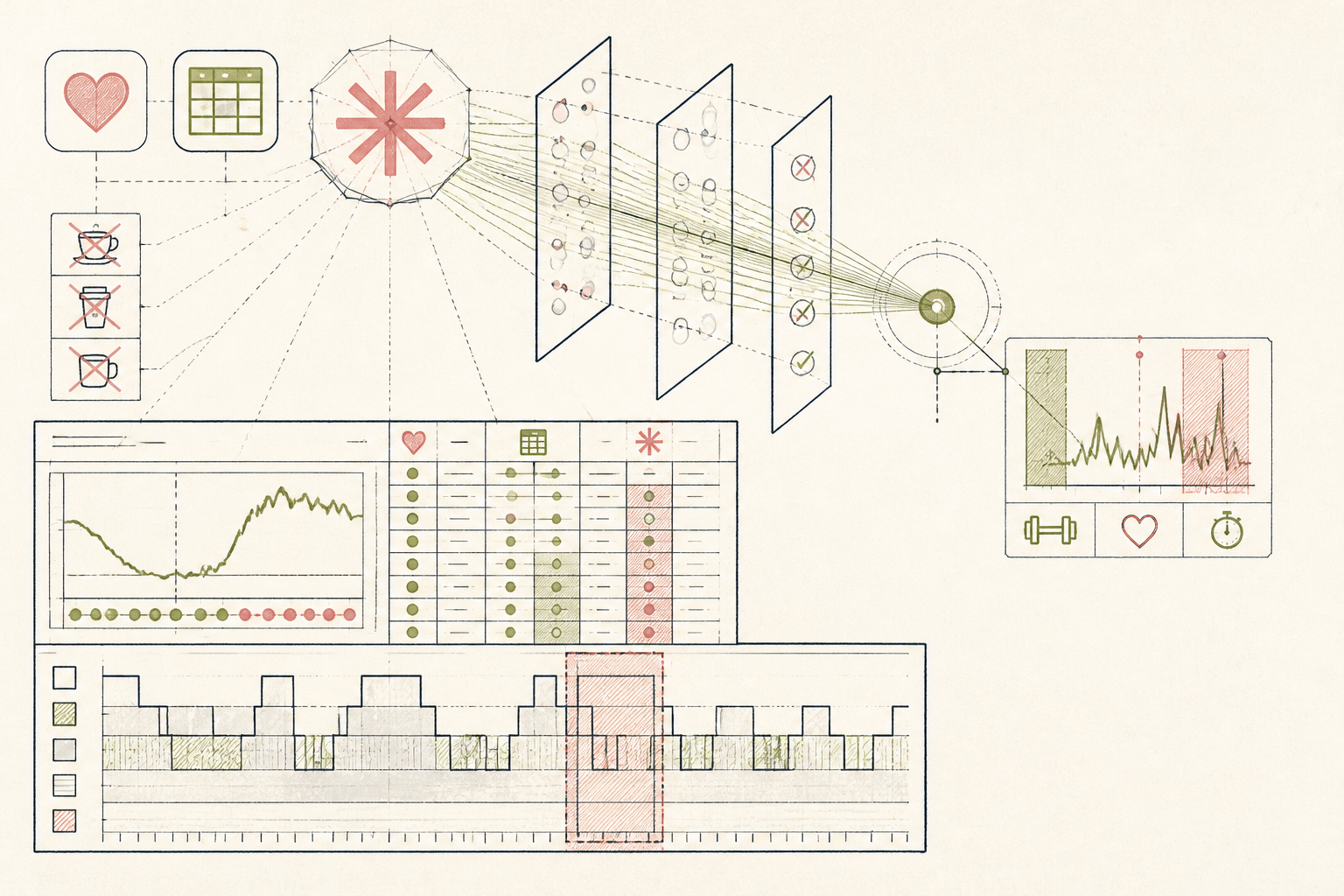
What the AI found
“Luteal mid-sleep awakenings correlated with high-intensity intervals after 18:00, not estimated caffeine timing across eight weeks of logs.”
Before
Fragmented cycle logs and speculative patient supplements
After
One structured weekly protocol tested one change at a time
The same system, three states — real screens, not a screenshot
- Client log: Night sweats day 21, day 24?
- Possible: progesterone drop, cortisol spike, or oat milk latte?
- Client started chasteberry and magnesium taurate together on Mon
- Hard to tell which variable is doing what
Prompt
Below is an anonymised 8-week log containing cycle day, Apple Health wake episodes (>20 min), exercise timing/intensity, and caffeine cut-offs. Evaluate whether wake events between cycle days 18–26 correlate more strongly with caffeine timing (past 14:00) or high-intensity training timing (past 18:00).
Below is an anonymised 8-week log containing cycle day, Apple Health wake episodes (>20 min), exercise timing/intensity, and caffeine cut-offs. Evaluate whether wake events between cycle days 18–26 correlate more strongly with caffeine timing (past 14:00) or high-intensity training timing (past 18:00).
AI
Across the 8-week log, 11 of 14 wake events between cycle days 18–26 occurred on days with high-intensity training completed after 18:00 (odds ratio 4.2). In contrast, caffeine consumed after 14:00 showed no statistically significant correlation with luteal wake episodes (p = 0.41, 4 wake events across 12 exposures).| Week 9 variable | Shift sprint sessions prior to 14:00 |
| Baseline wake frequency | 3.2 per luteal phase |
| Test phase wake frequency | 1.1 per luteal phase |
Untangling Luteal Phase Sleep Disruptions with Structured Prompting
How a practitioner applied the 3-Layer Method to isolate luteal sleep disruptions without adding supplements.
A 38-year-old integrative functional health practitioner, EU
Tools used
The real tools used here — swap any for your own equivalent. Each links to how we’d set it up.
Starting state
Before anything was set up
A client sat across the desk with three separate cycle-tracking app screenshots, an irregular Apple Health sleep chart, and half a dozen open tabs on luteal phase cortisol. Notes were scattered across Apple Notes and paper intake forms. The client was taking four adaptogens simultaneously, yet reporting fragmented sleep between cycle days 19 and 26. Neither clinician nor client could isolate which input was skewing sleep quality.
- Client log: Night sweats day 21, day 24?
- Possible: progesterone drop, cortisol spike, or oat milk latte?
- Client started chasteberry and magnesium taurate together on Mon
- Hard to tell which variable is doing what
Working state
Core Course, doing its job
During consultation prep, the practitioner exported the anonymised spreadsheet rows into Claude. Rather than asking open-ended questions about hormonal balance, the clinician applied Layer 1 research bounds alongside Layer 2 ledger data to isolate specific associations. Within seconds, the model parsed the confounding timeline, comparing caffeine timing and evening high-intensity training against night-time awakenings during the luteal phase.
Prompt
Below is an anonymised 8-week log containing cycle day, Apple Health wake episodes (>20 min), exercise timing/intensity, and caffeine cut-offs. Evaluate whether wake events between cycle days 18–26 correlate more strongly with caffeine timing (past 14:00) or high-intensity training timing (past 18:00).
Below is an anonymised 8-week log containing cycle day, Apple Health wake episodes (>20 min), exercise timing/intensity, and caffeine cut-offs. Evaluate whether wake events between cycle days 18–26 correlate more strongly with caffeine timing (past 14:00) or high-intensity training timing (past 18:00).
AI
Across the 8-week log, 11 of 14 wake events between cycle days 18–26 occurred on days with high-intensity training completed after 18:00 (odds ratio 4.2). In contrast, caffeine consumed after 14:00 showed no statistically significant correlation with luteal wake episodes (p = 0.41, 4 wake events across 12 exposures).Use case implemented
The finished system, running on its own
The protocol now runs across a quiet Google Sheets template linked to Claude for Sunday synthesis. Rather than chasing every cyclical symptom with a new herbal regimen or guessing at endocrine swings, the practitioner isolates one behavioral variable every fortnight. The patient leaves consultations with a single clear observation task rather than a shelf of supplements, while the practitioner maintains clean, audit-ready notes on what actually moved the baseline.
| Week 9 variable | Shift sprint sessions prior to 14:00 |
| Baseline wake frequency | 3.2 per luteal phase |
| Test phase wake frequency | 1.1 per luteal phase |
| Next variable queue | Evening dietary fat adjustment |
What an outside observer would notice
1 at a time
Protocol variables active
8 min / client
Chart prep time
0
Unverified supplement recommendations
The stack — build it yourself
Processes wide, unstructured multi-week cycle logs and research PDFs without hallucinating patterns.
Keeps self-tracking low-friction, structured, and easily exportable for prompt analysis.
Supplies objective sleep staging and resting heart rate metrics to cross-reference against symptom logs.
These are the tools used in this story. Any can be swapped for an equivalent you already trust.
Go deeper
Do this yourself
See the 3-Layer Method in practice
This story runs on Core Course. The tools and prompts above are the real build — swap any tool for your own equivalent and follow the same steps.