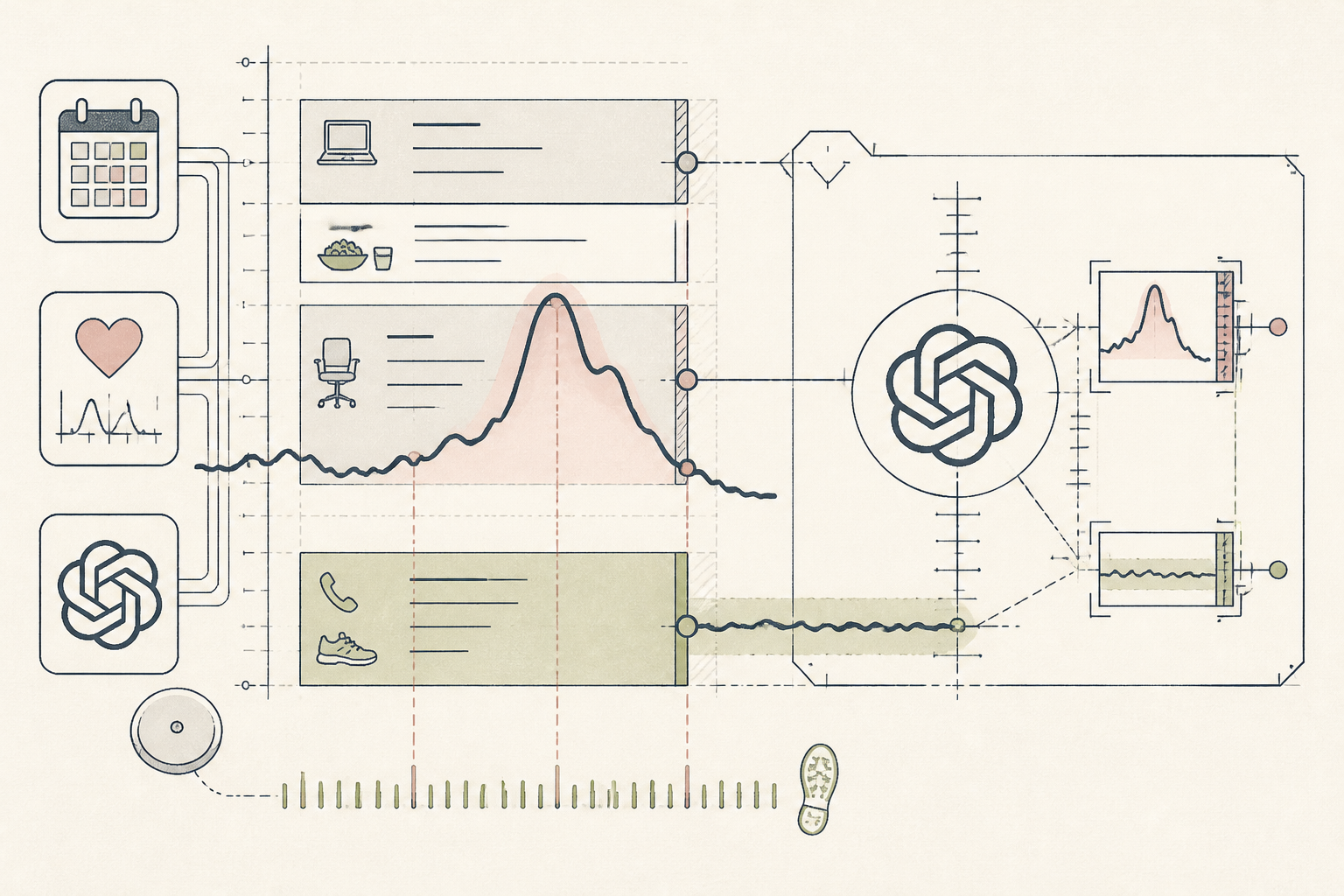
What the AI found
“Your 14:00 glucose spike isn't driven by bread; it disappears entirely when your post-lunch call is taken on foot rather than seated.”
Before
Post-lunch fog blamed on desk work and bad sleep
After
One 4-minute lunch walk that leveled his afternoons
The same system, three states — real screens, not a screenshot
- Tues: 14:15 completely wiped, black coffee did nothing
- Thurs: fine after pasta? makes no sense
- Mon: fell asleep reading draft tender at 15:00
- Maybe cut all carbs before 17:00?
Prompt
Here is my continuous glucose export for the past 14 workdays alongside my Google Calendar event list. Can you identify why my 14:00 post-meal readings vary wildly despite eating the same lunch menu on rotation?
Here is my continuous glucose export for the past 14 workdays alongside my Google Calendar event list. Can you identify why my 14:00 post-meal readings vary wildly despite eating the same lunch menu on rotation?
AI
Looking across all 14 days, meal composition does not correlate with the severity of your post-lunch excursions. Instead, posture does: on the 6 days you took your 13:30 call seated at your desk, peak glucose averaged 7.8 mmol/L with a subsequent sharp trough at 14:20. On the 8 days you took that call while walking outdoors, the peak remained under 6.1 mmol/L and leveled smoothly.19 weekdays
Post-lunch walk streak
4.2 (was 2.1)
Avg 14:30 energy (1-5)
6 min total
Weekly log time
Untangling an afternoon energy slump through calendar correlation
How cross-referencing monitor curves with calendar blocks replaced nutritional guesswork with one postural habit.
A 38-year-old architectural consultant, Western Europe
Tools used
The real tools used here — swap any for your own equivalent. Each links to how we’d set it up.
Starting state
Before anything was set up
Every workday at roughly quarter past two, his concentration collapsed. His temple felt heavy, draft drawings blurred on his monitor, and client revisions took twice as long. He kept erratic notes on his phone, trying to isolate the cause: espresso intake, bread at lunch, poor sleep the evening before. None of the hypotheses held up. Some days a sandwich brought acute lethargy; other days identical meals caused no noticeable slump. The guesswork was becoming its own distraction.
- Tues: 14:15 completely wiped, black coffee did nothing
- Thurs: fine after pasta? makes no sense
- Mon: fell asleep reading draft tender at 15:00
- Maybe cut all carbs before 17:00?
Working state
All-Access, doing its job
Using the All-Access templates, he pulled two weeks of raw sensor readings and exported his Google Calendar meeting history into an anonymised CSV. Instead of asking for generic health advice, he passed both files to ChatGPT with a narrow analytical query. Within seconds, the model isolated the single differentiating variable: it was not what he ate for lunch, but whether his 13:30 client catch-up was taken seated at his desk or on foot around the block.
Prompt
Here is my continuous glucose export for the past 14 workdays alongside my Google Calendar event list. Can you identify why my 14:00 post-meal readings vary wildly despite eating the same lunch menu on rotation?
Here is my continuous glucose export for the past 14 workdays alongside my Google Calendar event list. Can you identify why my 14:00 post-meal readings vary wildly despite eating the same lunch menu on rotation?
AI
Looking across all 14 days, meal composition does not correlate with the severity of your post-lunch excursions. Instead, posture does: on the 6 days you took your 13:30 call seated at your desk, peak glucose averaged 7.8 mmol/L with a subsequent sharp trough at 14:20. On the 8 days you took that call while walking outdoors, the peak remained under 6.1 mmol/L and leveled smoothly.Use case implemented
The finished system, running on its own
He now runs a single automated ritual. At 13:15 each workday, a calendar automation prompts a fifteen-minute walking check-in. The continuous monitor data syncs silently to Apple Health alongside his step count. On Friday afternoon, a single-click shortcut exports the five-day delta into his local spreadsheet. No food logging, no obsessive carb counting, and no mid-afternoon cognitive lull. The instrument runs quietly in the periphery, serving his schedule rather than demanding his attention.
19 weekdays
Post-lunch walk streak
4.2 (was 2.1)
Avg 14:30 energy (1-5)
6 min total
Weekly log time
What an outside observer would notice
+85 min unbroken
Afternoon focus duration
0 minutes manual entry
Daily logging friction
The stack — build it yourself
Parses unstructured notes alongside CSV time-series data without requiring custom scripts.
Aggregates passive step counts and continuous monitor readings privately on-device.
Provides an objective record of stationary versus mobile work blocks.
These are the tools used in this story. Any can be swapped for an equivalent you already trust.
Go deeper
Do this yourself
Explore the setup
This story runs on All-Access. The tools and prompts above are the real build — swap any tool for your own equivalent and follow the same steps.