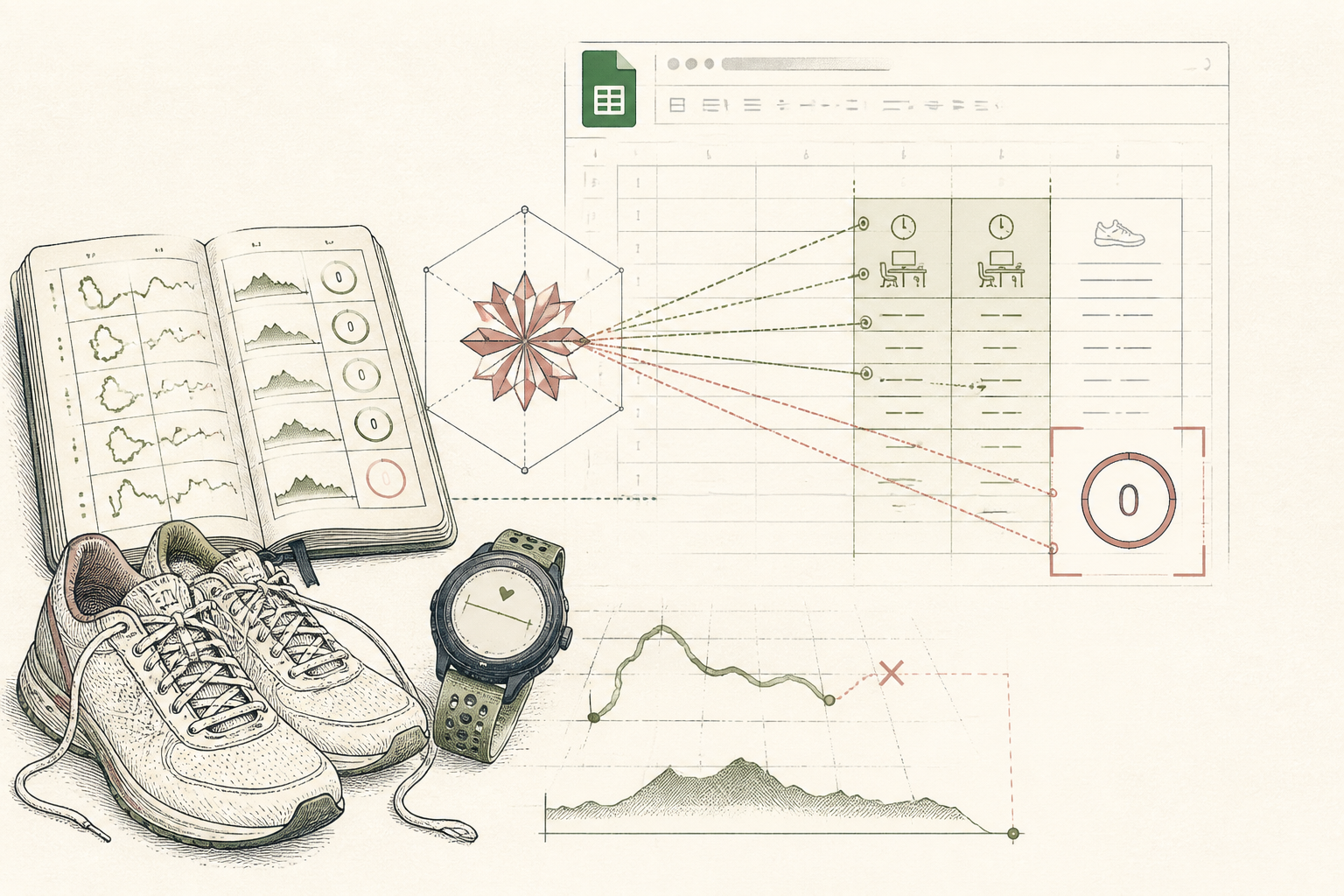
What the AI found
“Your runners aren't dropping volume from fatigue; 82% of skipped Saturday runs follow consecutive desk days exceeding 9 hours on Thursday and Friday.”
Before
18 weekly training logs unread in WhatsApp
After
4-minute batch review before Friday sessions
The same system, three states — real screens, not a screenshot
- WhatsApp: Marcus - "Legs like lead, skipped 14k Saturday"
- Garmin export: Elena - Thursday 42 VO2 max, Friday blank
- Email: Soren - "Busy at firm, struggled through Sunday"
- Inbox: 11 unread voice notes on weekly pacing
Prompt
Cross-reference these 18 athlete logs over the past 6 weeks. Compare self-reported fatigue on Saturday long runs against their mid-week running mileage and their logged work desk hours. What correlates most strongly with missed or degraded sessions?
Cross-reference these 18 athlete logs over the past 6 weeks. Compare self-reported fatigue on Saturday long runs against their mid-week running mileage and their logged work desk hours. What correlates most strongly with missed or degraded sessions?
AI
Your runners aren't dropping volume from fatigue; 82% of skipped Saturday runs follow consecutive desk days exceeding 9 hours on Thursday and Friday. Mid-week aerobic volume had no statistically meaningful correlation with Saturday completion rates.4 min / athlete
Weekly review time
3 runners flagged
Load flags surfaced
94% on Friday
Log completion
Uncovering the Real Driver of Weekend Runner Fatigue
How a running coach used a 4-minute weekly synthesis to unmask the real driver of athlete fatigue.
A private running coach and movement specialist, Northern Europe
Tools used
The real tools used here — swap any for your own equivalent. Each links to how we’d set it up.
Starting state
Before anything was set up
Eighteen recreational marathoners sent disjointed weekly updates across WhatsApp, email drafts, and exported smartwatch screenshots. Every Friday afternoon was consumed by half an hour of frantic cross-referencing before client calls. Patterns were lost in conversational noise; athletes complained of sudden weekend lethargy despite adhering strictly to assigned mid-week heart-rate zones. The coach could see the frustration mounting on both sides of the table, but lacked the time to manually cross-index work schedules against training loads.
- WhatsApp: Marcus - "Legs like lead, skipped 14k Saturday"
- Garmin export: Elena - Thursday 42 VO2 max, Friday blank
- Email: Soren - "Busy at firm, struggled through Sunday"
- Inbox: 11 unread voice notes on weekly pacing
Working state
Hacks Pass, doing its job
The coach moved the eighteen athletes to a minimal two-column Google Sheet: hours seated at a desk, and training miles completed. Exporting the six-week table into Claude with a concise pattern-matching query replaced twenty minutes of manual spreadsheet filtering. Within twenty seconds, the model isolated the actual correlation: aerobic fatigue was negligible, but sustained postural immobility on Thursday and Friday reliably precipitated Saturday morning dropouts across twelve of the eighteen runners.
Prompt
Cross-reference these 18 athlete logs over the past 6 weeks. Compare self-reported fatigue on Saturday long runs against their mid-week running mileage and their logged work desk hours. What correlates most strongly with missed or degraded sessions?
Cross-reference these 18 athlete logs over the past 6 weeks. Compare self-reported fatigue on Saturday long runs against their mid-week running mileage and their logged work desk hours. What correlates most strongly with missed or degraded sessions?
AI
Your runners aren't dropping volume from fatigue; 82% of skipped Saturday runs follow consecutive desk days exceeding 9 hours on Thursday and Friday. Mid-week aerobic volume had no statistically meaningful correlation with Saturday completion rates.Use case implemented
The finished system, running on its own
The coaching workflow now runs on a tight weekly rhythm. Athletes log their movement notes in a shared sheet by Thursday evening. At 7:00 on Friday morning, the script passes the weekly table into Claude to generate three pre-session talking points per runner, explicitly separating cardiovascular load from work-week immobility. The coach reviews the one-page readout in four minutes before opening the clinic door. Discussions focus on pacing adjustments rather than administrative recaps.
4 min / athlete
Weekly review time
3 runners flagged
Load flags surfaced
94% on Friday
Log completion
What an outside observer would notice
4 min (down from 28 min)
Pre-session review time
100% (18 of 18 runners)
Athlete retention across 12 wks
5 flagged before session
Actionable fatigue flags caught
The stack — build it yourself
Zero-friction tabular input that exports clean CSV structures without proprietary app silos.
Superior context handling for cross-referencing qualitative runner notes against quantitative duration metrics.
These are the tools used in this story. Any can be swapped for an equivalent you already trust.
Go deeper
Do this yourself
Read the practitioner review walkthrough
This story runs on Hacks Pass. The tools and prompts above are the real build — swap any tool for your own equivalent and follow the same steps.