What the AI found
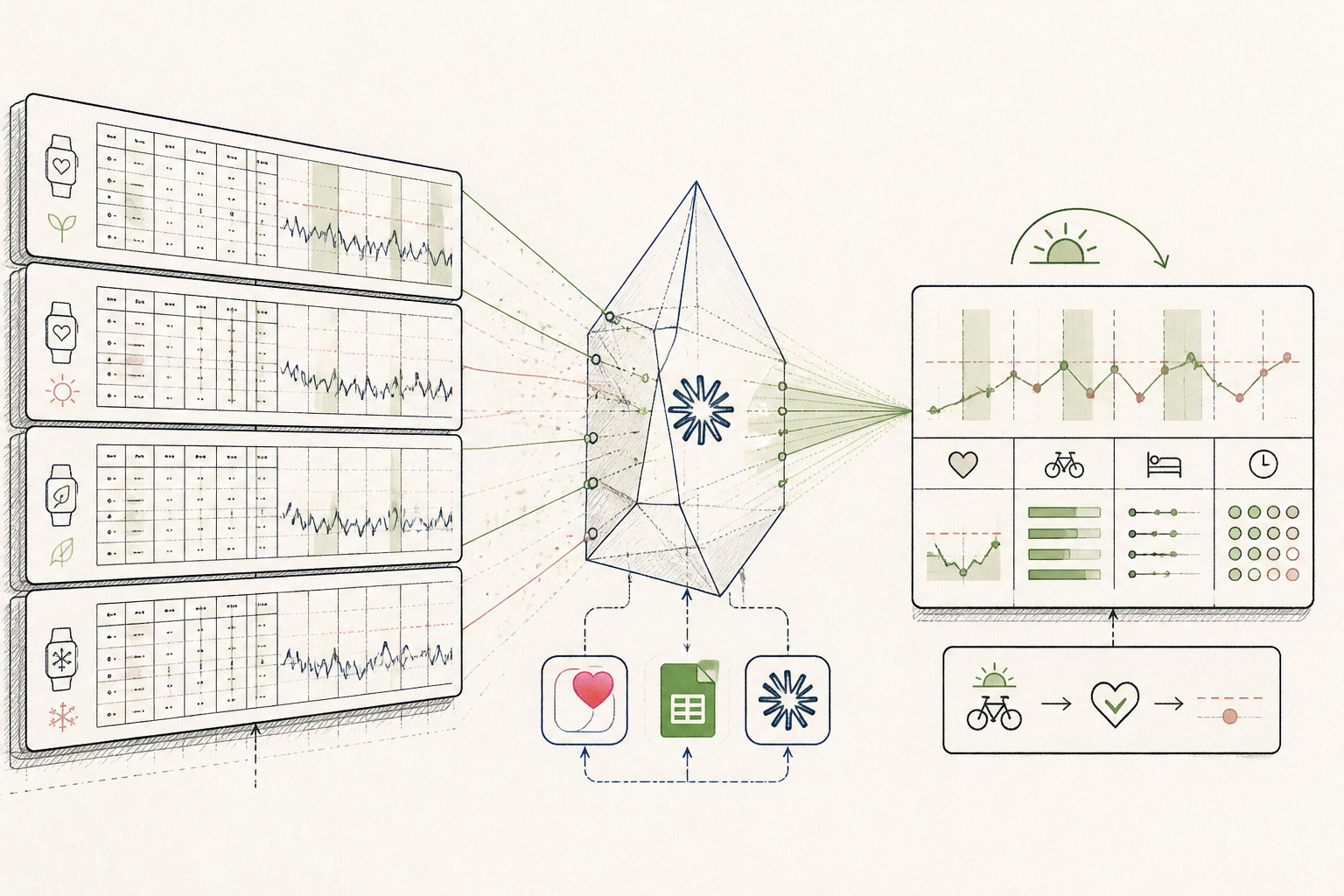
“Your resting heart rate only drops below 52 bpm on weeks where Zone 2 sessions happen before noon, regardless of sleep duration.”
Before
four siloed dashboards, zero cross-trend insight
After
one 4-minute Sunday check, zero manual logging
The same system, three states — real screens, not a screenshot
- Oura score: 78 (why down?)
- Garmin training load: 412 (optimal?)
- HRV 42ms vs 51ms last Tuesday
- Need to check if evening runs wreck deep sleep
Prompt
Here is my 90-day export covering resting heart rate, sleep duration, and workout timestamps. Identify which specific training variables correlate with nights where RHR drops below my rolling baseline of 54 bpm.
Here is my 90-day export covering resting heart rate, sleep duration, and workout timestamps. Identify which specific training variables correlate with nights where RHR drops below my rolling baseline of 54 bpm.
AI
Analyzing 90 days (132 sessions). Sleep duration shows zero statistically significant impact on your RHR dips (p=0.41). However, session timing is decisive: your resting heart rate only drops below 52 bpm on weeks where Zone 2 sessions happen before noon (median 50.8 bpm vs 55.4 bpm for evening sessions).4 mins
Weekly review time
86%
Morning Zone 2 ratio
-3.4 bpm
RHR baseline variance
Turning years of fragmented longevity metrics into a quiet weekly review
How a one-time setup linked four years of wearable telemetry to surface the single variable driving cardiovascular recovery.
A 48-year-old software architect and runner, EU
Tools used
The real tools used here — swap any for your own equivalent. Each links to how we’d set it up.
Starting state
Before anything was set up
Four tabs stayed permanently pinned on his secondary monitor: Garmin Connect, an Oura web portal, a spreadsheet of blood panels, and Apple Health. He had accumulated five years of clean biometric data, but every Sunday afternoon dissolved into twenty minutes of cross-referencing CSV exports to answer a basic question: did this week's training support long-term recovery, or just generate exhaustion? The information existed, but the connective tissue was entirely missing.
- Oura score: 78 (why down?)
- Garmin training load: 412 (optimal?)
- HRV 42ms vs 51ms last Tuesday
- Need to check if evening runs wreck deep sleep
Working state
Setup, doing its job
During the setup, he exported a tidy 90-day CSV combining workout start times and overnight recovery figures. Instead of asking for broad health advice, he pasted the clean schema into Claude with a constrained analytical prompt. Within twelve seconds, the model cut past his assumptions about sleep duration and isolated an unconsidered variable: the precise circadian timing of his aerobic sessions.
Prompt
Here is my 90-day export covering resting heart rate, sleep duration, and workout timestamps. Identify which specific training variables correlate with nights where RHR drops below my rolling baseline of 54 bpm.
Here is my 90-day export covering resting heart rate, sleep duration, and workout timestamps. Identify which specific training variables correlate with nights where RHR drops below my rolling baseline of 54 bpm.
AI
Analyzing 90 days (132 sessions). Sleep duration shows zero statistically significant impact on your RHR dips (p=0.41). However, session timing is decisive: your resting heart rate only drops below 52 bpm on weeks where Zone 2 sessions happen before noon (median 50.8 bpm vs 55.4 bpm for evening sessions).Use case implemented
The finished system, running on its own
The system now runs unattended. Every Sunday at 6pm, an automated export drops his week of wearable metrics into Claude via an API relay. By 6:04pm, a three-line summary arrives in his inbox, highlighting recovery trade-offs and scheduling constraints for the coming five days. He spends four minutes reviewing it with an espresso, notes two calendar adjustments, and closes the tab. The tracking serves the week, rather than the week serving the tracking.
4 mins
Weekly review time
86%
Morning Zone 2 ratio
-3.4 bpm
RHR baseline variance
What an outside observer would notice
4 minutes (down from 45)
Weekly triage time
3 morning slots protected
Training shifts
The stack — build it yourself
Aggregates disparate wearable feeds locally without subscription lock-in.
Handles dense tabular exports with nuanced reasoning and neutral, non-alarmist summaries.
Maintains an owned, plain-text backup of weekly biometric summaries.
These are the tools used in this story. Any can be swapped for an equivalent you already trust.
Go deeper
Do this yourself
Build your own longevity review
This story runs on Setup. The tools and prompts above are the real build — swap any tool for your own equivalent and follow the same steps.