What the AI found
“Every missed weekend run followed a Thursday cadence drop below 162 spm, regardless of pace, sleep score, or subjective soreness.”
Before
14 months of Garmin logs, never reviewed
After
one 4-minute Friday plan based on cadence
The same system, three states — real screens, not a screenshot
- Sat: skipped trail run, legs felt like lead
- Sun: 8k easy instead of 22k
- Garmin load ratio: 1.4 (optimal?)
- Sleep score 82, no obvious reason for fatigue
Prompt
Attached is 14 months of weekly run dynamics alongside my training log notes. Look specifically at the 11 weekends where I marked 'skipped' or 'cut short due to heavy legs.' What common mechanical or workload signal occurred in the preceding 72 hours that did not occur before successful long runs?
Attached is 14 months of weekly run dynamics alongside my training log notes. Look specifically at the 11 weekends where I marked 'skipped' or 'cut short due to heavy legs.' What common mechanical or workload signal occurred in the preceding 72 hours that did not occur before successful long runs?
AI
In 11 out of 11 skipped weekend sessions, your average run cadence on Thursday evening fell below 162 spm (mean: 158 spm), compared to 168 spm before successful runs. Heart rate, total weekly mileage, and sleep scores showed no statistically meaningful divergence. You overstride when tired on Thursdays, overloading your calves 36 hours before your long run.164 spm
Thursday cadence floor
-15% duration
Friday workload adjustment
8 of 8 weeks
Weekend runs completed
Turning fourteen months of unread running metrics into dependable weekly execution
How an automated telemetry audit turned 14 months of unread running metrics into a dependable weekly rule.
A 38-year-old software architect and trail runner, EU
Tools used
The real tools used here — swap any for your own equivalent. Each links to how we’d set it up.
Starting state
Before anything was set up
Fourteen months of GPS tracks, vertical oscillation numbers, and heart rate readings accumulated quietly in Garmin Connect. The logs were pristine, but the training was erratic. Every third Saturday, planned two-hour mountain runs dissolved into heavy legs, skipped sessions, and vague self-reproach. The runner checked resting heart rate and sleep duration religiously, yet found no discernible pattern explaining why endurance evaporated on specific weekends while peaking on others.
- Sat: skipped trail run, legs felt like lead
- Sun: 8k easy instead of 22k
- Garmin load ratio: 1.4 (optimal?)
- Sleep score 82, no obvious reason for fatigue
Working state
Done-for-you, doing its job
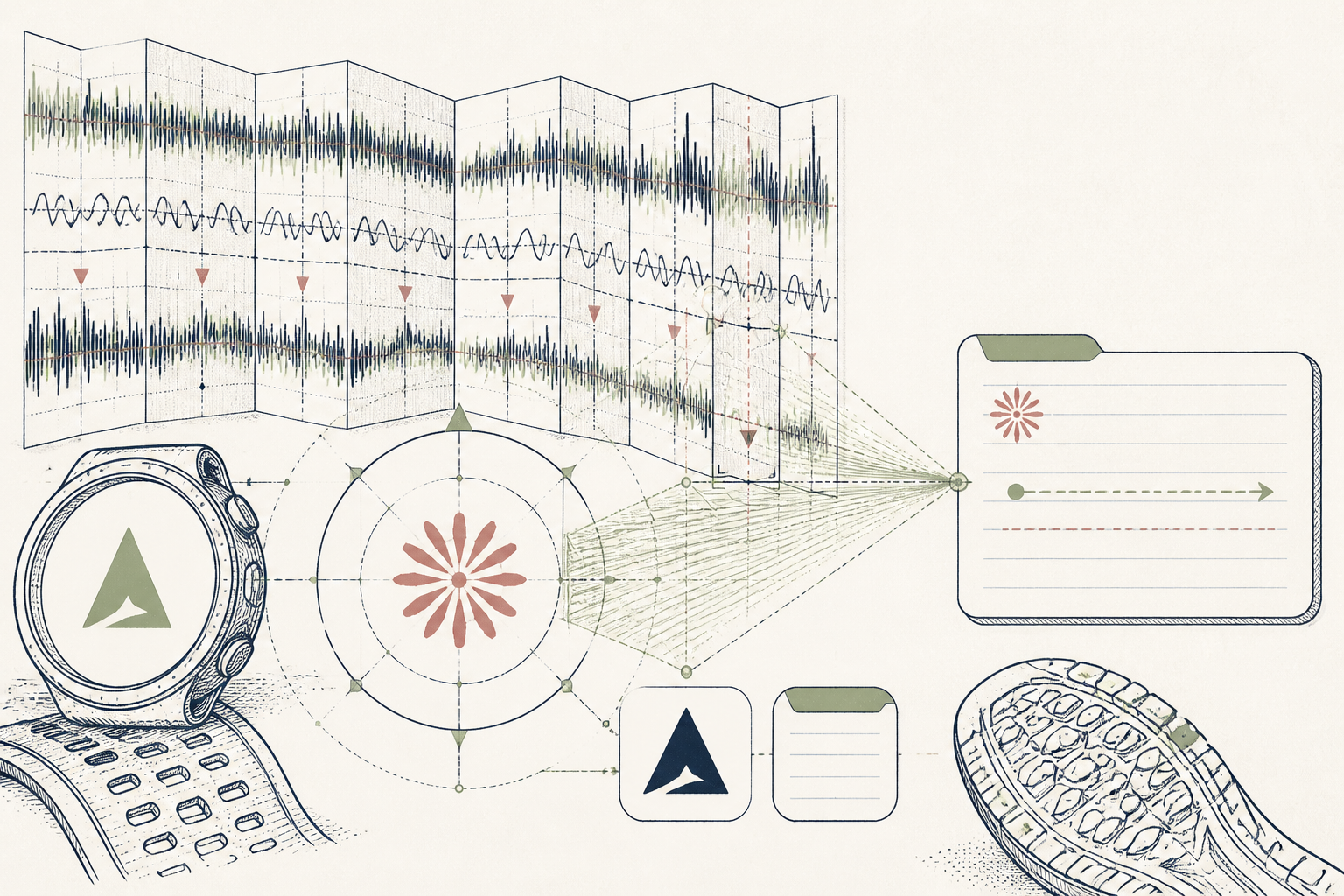
During the system setup, fourteen months of raw activity tables were exported and fed into Claude with a focused cross-tabulation query. Rather than asking generic coaching questions, the prompt isolated eleven specific failed weekend runs against the mechanical markers of the preceding 72 hours. Within seconds, the assistant revealed that heart rate and subjective exhaustion were red herrings: cadence degradation during Thursday intervals was the sole invariant predictor of weekend breakdown.
Prompt
Attached is 14 months of weekly run dynamics alongside my training log notes. Look specifically at the 11 weekends where I marked 'skipped' or 'cut short due to heavy legs.' What common mechanical or workload signal occurred in the preceding 72 hours that did not occur before successful long runs?
Attached is 14 months of weekly run dynamics alongside my training log notes. Look specifically at the 11 weekends where I marked 'skipped' or 'cut short due to heavy legs.' What common mechanical or workload signal occurred in the preceding 72 hours that did not occur before successful long runs?
AI
In 11 out of 11 skipped weekend sessions, your average run cadence on Thursday evening fell below 162 spm (mean: 158 spm), compared to 168 spm before successful runs. Heart rate, total weekly mileage, and sleep scores showed no statistically meaningful divergence. You overstride when tired on Thursdays, overloading your calves 36 hours before your long run.Use case implemented
The finished system, running on its own
The handover system now runs unattended. Every Friday morning, a scripted webhook exports the preceding five days of stride telemetry into a single structured summary. If Thursday evening cadence dipped below the 162-stride threshold, calendar blocks for Saturday shift automatically from tempo intervals to low-intensity trail volume. The runner conducts a four-minute review over coffee, confirms the adjustment, and laces up on Saturday morning without the nagging calf tightness that previously derailed every third training block.
164 spm
Thursday cadence floor
-15% duration
Friday workload adjustment
8 of 8 weeks
Weekend runs completed
What an outside observer would notice
100% across 8 wks
Training consistency
4 minutes
Weekly review time
0 missed runs
Weekend skip rate
The stack — build it yourself
Captures reliable second-by-second cadence and ground contact metrics during weekly runs.
Handles multi-month CSV tables with large context windows without truncating run dynamics.
Clean, low-friction surface for the four-minute Friday decision before weekend volume.
These are the tools used in this story. Any can be swapped for an equivalent you already trust.
Go deeper
Do this yourself
See the handover setup
This story runs on Done-for-you. The tools and prompts above are the real build — swap any tool for your own equivalent and follow the same steps.