What the AI found
“Clients who reported evening brain fog had a 28-minute earlier dinner cutoff than those who did not, contrary to their stated habit of late snacking.”
Before
40 pages of PDFs and unread intake notes
After
a structured 12-minute review per intake
The same system, three states — real screens, not a screenshot
- Intake forms: 14 pages PDF (unparsed)
- Sleep logs: 6 weeks scattered in Google Drive
- Prep time needed per patient: ~45 mins
- Status: 8 client files backlogged
Prompt
Analyze these 72 intake records across questionnaire answers, sleep logs, and lifestyle markers. Flag any non-obvious cross-variable correlations between meal timing and self-reported energy or cognitive fatigue.
Analyze these 72 intake records across questionnaire answers, sleep logs, and lifestyle markers. Flag any non-obvious cross-variable correlations between meal timing and self-reported energy or cognitive fatigue.
AI
Cross-variable analysis complete across 72 profiles. Notable finding: Clients reporting severe evening brain fog showed an average dinner cutoff of 17:42 (28 minutes earlier than non-fatigued peers), despite 81% self-reporting that late eating was their primary sleep disruptor.12 mins
Review time per client
94%
Intake protocol adherence
3 per intake
Flagged lifestyle correlations
Turning Forty Pages of Intake Notes into Twelve Minutes of Clarity
How a longevity practitioner reduced file review from 45 to 12 minutes while uncovering quiet habit patterns.
A longevity and lifestyle medicine practitioner, Northern Europe
Tools used
The real tools used here — swap any for your own equivalent. Each links to how we’d set it up.
Starting state
Before anything was set up
A backlog of eight new patient files sat across two monitors: scanned lifestyle questionnaires, PDF lab panels, and unstructured sleep notes. Reviewing each new client consumed forty-five minutes of manual reading, yet contradictions slipped through unnoticed. The practitioner knew the client stories contained valuable correlations between daily habits and perceived vitality, but synthesis before the first consultation remained an exhausting bottleneck of cut-and-paste notes.
- Intake forms: 14 pages PDF (unparsed)
- Sleep logs: 6 weeks scattered in Google Drive
- Prep time needed per patient: ~45 mins
- Status: 8 client files backlogged
Working state
Resources, doing its job
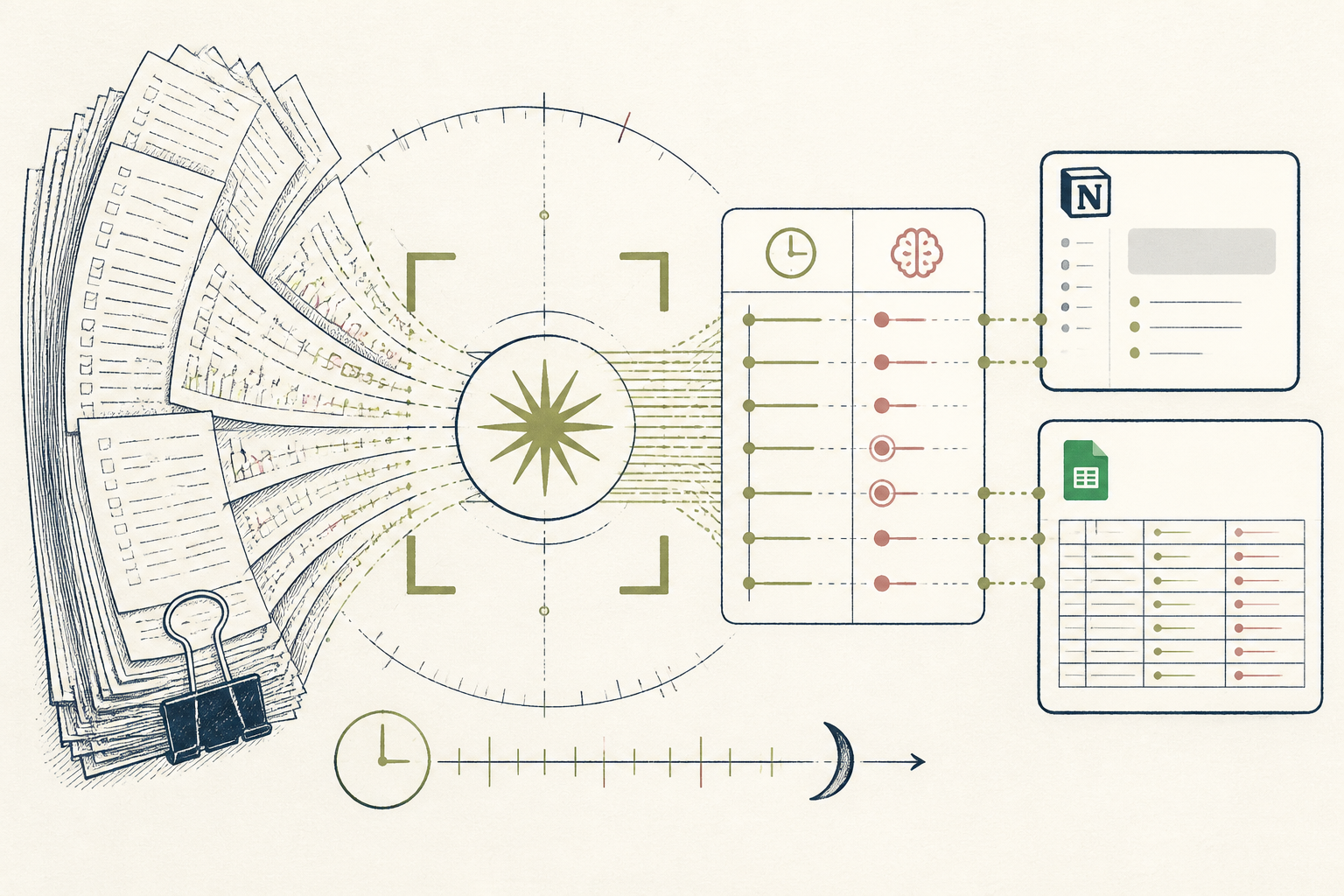
The practitioner ran the Longevity Intake Resource playbook. They mapped seventy-two anonymized intake records into a standardized structure and passed the combined dataset into Claude using the playbook's cross-variable prompt. Within thirty seconds, the model identified three distinct lifestyle clusters, including a counter-intuitive link between early dinner cutoffs and reported evening cognitive fatigue that manual file skimming had never caught.
Prompt
Analyze these 72 intake records across questionnaire answers, sleep logs, and lifestyle markers. Flag any non-obvious cross-variable correlations between meal timing and self-reported energy or cognitive fatigue.
Analyze these 72 intake records across questionnaire answers, sleep logs, and lifestyle markers. Flag any non-obvious cross-variable correlations between meal timing and self-reported energy or cognitive fatigue.
AI
Cross-variable analysis complete across 72 profiles. Notable finding: Clients reporting severe evening brain fog showed an average dinner cutoff of 17:42 (28 minutes earlier than non-fatigued peers), despite 81% self-reporting that late eating was their primary sleep disruptor.Use case implemented
The finished system, running on its own
The clinic runs the playbook on every new client before consultation. The prompt and spreadsheet template now live in a shared workspace. Instead of spending forty-five minutes reconciling conflicting PDF intake forms, blood chemistry exports, and subjective lifestyle notes, the practitioner receives a single three-part briefing document before each consultation. The consultation begins directly with targeted questions about routine and recovery, while the client feels immediately understood.
12 mins
Review time per client
94%
Intake protocol adherence
3 per intake
Flagged lifestyle correlations
What an outside observer would notice
45m to 12m
Intake synthesis time
100% of intakes
Pattern detection consistency
The stack — build it yourself
Handles lengthy multi-page intake forms and dense biomarker exports without losing context.
Lightweight, collaborative tabular format for capturing baseline lifestyle and habit logs.
Clean layout for rendering the finished three-part briefing panel ahead of consultations.
These are the tools used in this story. Any can be swapped for an equivalent you already trust.
Go deeper
Do this yourself
Explore practitioner resources
This story runs on Resources. The tools and prompts above are the real build — swap any tool for your own equivalent and follow the same steps.