What the AI found
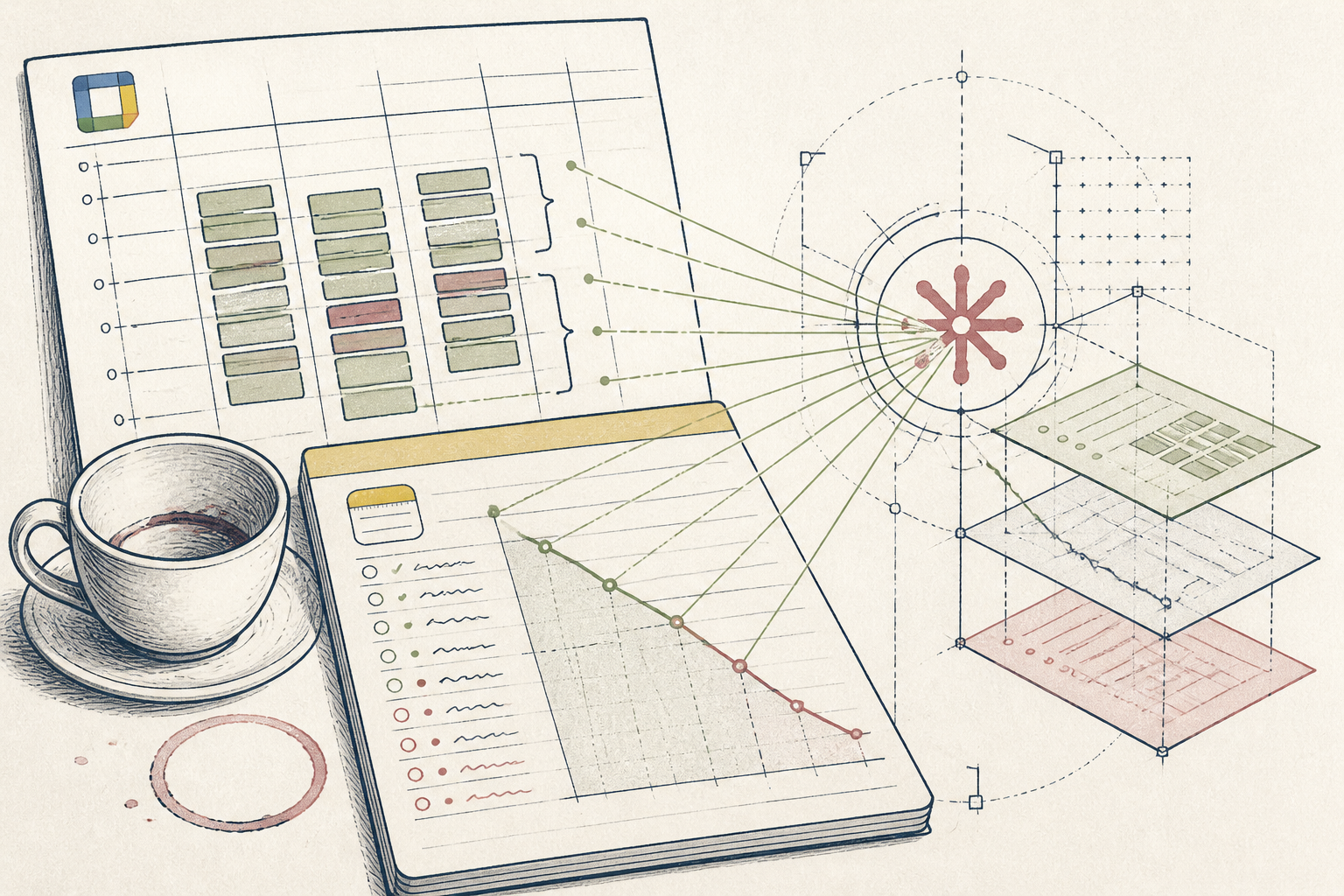
“Your low-energy afternoons correlated with morning meeting density, not caffeine intake; days with 3+ pre-noon calls saw energy drop 42% faster.”
Before
Vague afternoon slumps, blamed entirely on caffeine
After
A single Friday review showing the real variable
The same system, three states — real screens, not a screenshot
- Tuesday: Crashed hard at 2:45pm. Cut second espresso?
- Thursday: Head heavy again around 3:15pm. Slept 7.5 hrs though.
- Friday: Felt okay today. Had oat flat white instead of drip?
- Monday: Exhausted by 3pm. Maybe carbs at lunch.
Prompt
Here are 21 days of daily notes (with 3 PM energy ratings 1-5 and caffeine timestamps) paired with my Google Calendar meeting counts. Cross-reference the days with energy <=2 against caffeine timing and meeting schedules. Identify any non-obvious correlations.
Here are 21 days of daily notes (with 3 PM energy ratings 1-5 and caffeine timestamps) paired with my Google Calendar meeting counts. Cross-reference the days with energy <=2 against caffeine timing and meeting schedules. Identify any non-obvious correlations.
AI
Your 3 PM energy rating shows no statistically meaningful link to caffeine timing (r = -0.08). However, it correlates strongly with morning call volume (r = -0.74). On the 8 days with >=3 meetings before 12:00 PM, afternoon energy dropped to an average of 1.8 out of 5—a 42% steeper decline than on days with single morning syncs, regardless of when you drank coffee.18.5 hrs (+4.2)
Weekly Focus Hours
1 / 5 (down from 4)
Afternoon Slump Days
91%
Meeting Buffer Adherence
Tracking Afternoon Slumps to Calendar Friction Instead of Caffeine
How a three-layer personal ledger separated calendar fatigue from caffeine habits.
A 38-year-old remote software architect, EU
Tools used
The real tools used here — swap any for your own equivalent. Each links to how we’d set it up.
Starting state
Before anything was set up
For six months, every workday followed the same unraveling pattern: alert until lunch, then a pervasive cognitive fog by 3:00 PM. Blame cycled through usual suspects: dark roast coffee, sourdough sandwiches, or insufficient hydration. Scrappy Apple Notes entries tracked supplement dosages and cup counts, but without structural synthesis, the notes became an anxious graveyard of contradictory hypotheses. Nothing changed, and work evenings remained depleted.
- Tuesday: Crashed hard at 2:45pm. Cut second espresso?
- Thursday: Head heavy again around 3:15pm. Slept 7.5 hrs though.
- Friday: Felt okay today. Had oat flat white instead of drip?
- Monday: Exhausted by 3pm. Maybe carbs at lunch.
Working state
Core Course, doing its job
Following Module 2 of the Core Course, the subject exported three weeks of calendar exports alongside raw Apple Notes entries containing a single midday rating and caffeine intake logs. Instead of asking for generic health advice, the prompt instructed Claude to act strictly as an analytical auditor cross-referencing two columns: external cognitive load and subjective energy. Within seconds, the machine isolated the actual driver that six months of guessing had missed.
Prompt
Here are 21 days of daily notes (with 3 PM energy ratings 1-5 and caffeine timestamps) paired with my Google Calendar meeting counts. Cross-reference the days with energy <=2 against caffeine timing and meeting schedules. Identify any non-obvious correlations.
Here are 21 days of daily notes (with 3 PM energy ratings 1-5 and caffeine timestamps) paired with my Google Calendar meeting counts. Cross-reference the days with energy <=2 against caffeine timing and meeting schedules. Identify any non-obvious correlations.
AI
Your 3 PM energy rating shows no statistically meaningful link to caffeine timing (r = -0.08). However, it correlates strongly with morning call volume (r = -0.74). On the 8 days with >=3 meetings before 12:00 PM, afternoon energy dropped to an average of 1.8 out of 5—a 42% steeper decline than on days with single morning syncs, regardless of when you drank coffee.Use case implemented
The finished system, running on its own
The system now runs quietly in the background. Every morning, calendar blocks are color-coded in Google Calendar, while a single daily log entry in Apple Notes captures a simple 1-to-5 energy score at 3 PM. On Fridays, the four-line script cross-references meeting duration against self-reported fatigue. The individual no longer cuts coffee arbitrarily; instead, two protected ninety-minute deep work blocks before lunch prevent the dip before it begins.
18.5 hrs (+4.2)
Weekly Focus Hours
1 / 5 (down from 4)
Afternoon Slump Days
91%
Meeting Buffer Adherence
What an outside observer would notice
1 day/week (was 4)
Afternoon dip frequency
7 minutes
Weekly review duration
4 protected mornings
Pre-noon focus blocks
The stack — build it yourself
Zero-latency input prevents log fatigue; simple timestamped lines keep daily friction negligible.
Excels at long-context structured reasoning across semi-structured calendar exports and qualitative notes.
Provides verifiable, timestamped behavioral data that does not rely on subjective recall.
These are the tools used in this story. Any can be swapped for an equivalent you already trust.
Go deeper
Do this yourself
Read the 3-Layer Method field guide
This story runs on Core Course. The tools and prompts above are the real build — swap any tool for your own equivalent and follow the same steps.