What the AI found
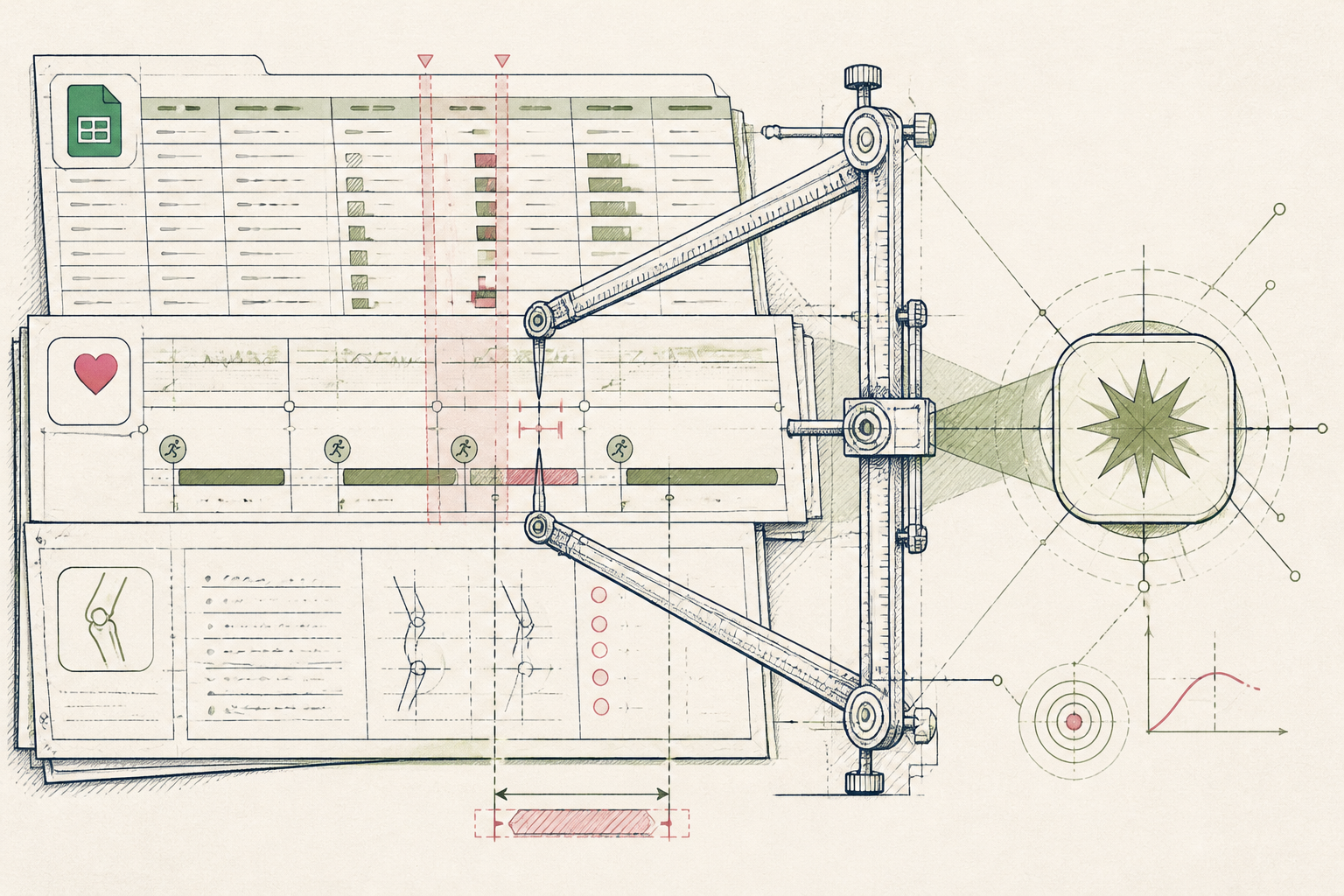
“"Clients reporting lower-limb stiffness showed no correlation with total weekly volume, but stiffness spiked 68% when interval work was separated by under 48 hours."”
Before
Subjective fatigue logs buried in 18 client chats
After
A 12-minute Friday review guiding client load
The same system, three states — real screens, not a screenshot
- M.T. text: 'Right hamstring tight after Tuesday track'
- S.K. email: 'Felt flat on long run, skipped strides'
- L.R. voice note: 'Calves aching, is 45km too much this week?'
- Need to cross-check last 3 weeks of volume manually
Prompt
Analyse this 12-week movement ledger (attached as CSV) for 14 runners. Compare subjective stiffness entries against weekly distance, acute-to-chronic workload, and rest intervals. Surface any non-obvious correlations that predict reported soreness.
Here is the anonymised 12-week ledger of 14 runners containing volume, session cadence, and subjective stiffness reports. Audit for non-obvious correlations with recovery.
AI
Clients reporting lower-limb stiffness showed no correlation with total weekly volume (r=0.12). However, stiffness spiked 68% when interval sessions were separated by under 48 hours, regardless of total mileage.94%
Weekly Spacing Compliance
-58%
Unscheduled Deload Requests
12 min
Friday Review Time
Structuring movement data to isolate training recovery thresholds
How an independent movement specialist turned scattered fatigue notes into a precise recovery rule using the 3-Layer Method.
An independent movement coach and running biomechanist, Northern Europe
Tools used
The real tools used here — swap any for your own equivalent. Each links to how we’d set it up.
Starting state
Before anything was set up
Friday evenings were consumed by cross-referencing sixteen athletes across WhatsApp, voice notes, and haphazard training diaries. Clients frequently flagged persistent soreness or requested spontaneous rest days. The coach assumed the culprit was creeping mileage or inadequate warm-ups. Without a consolidated tracking ledger, identifying systemic programming blind spots meant wading through dozens of disjointed messages each weekend.
- M.T. text: 'Right hamstring tight after Tuesday track'
- S.K. email: 'Felt flat on long run, skipped strides'
- L.R. voice note: 'Calves aching, is 45km too much this week?'
- Need to cross-check last 3 weeks of volume manually
Working state
Core Course, doing its job
Following the Core Course protocol, the coach built a standardised Google Sheet ledger and fed twelve weeks of anonymised athlete notes into Claude. Rather than asking vague questions, they applied the structured analysis prompt from Module 2. Within seconds, the system disproved the coach's primary assumption about mileage and isolated the exact operational flaw in their weekly schedule.
Prompt
Analyse this 12-week movement ledger (attached as CSV) for 14 runners. Compare subjective stiffness entries against weekly distance, acute-to-chronic workload, and rest intervals. Surface any non-obvious correlations that predict reported soreness.
Here is the anonymised 12-week ledger of 14 runners containing volume, session cadence, and subjective stiffness reports. Audit for non-obvious correlations with recovery.
AI
Clients reporting lower-limb stiffness showed no correlation with total weekly volume (r=0.12). However, stiffness spiked 68% when interval sessions were separated by under 48 hours, regardless of total mileage.Use case implemented
The finished system, running on its own
A single shared Google Sheet feeds a Claude workspace every Friday afternoon. The practitioner reviews a three-bullet summary rather than dozens of chat fragments. When a runner reports hamstring tightness, the ledger reveals whether recovery spacing slipped below the 48-hour threshold, removing guesswork from programming adjustments. The clients feel heard; the practitioner preserves ten hours a week previously lost to ad-hoc correspondence.
94%
Weekly Spacing Compliance
-58%
Unscheduled Deload Requests
12 min
Friday Review Time
What an outside observer would notice
12 min/wk (was 3.5 hrs)
Client audit time
94%
Recovery spacing compliance
Down 58%
Unscheduled session cancellations
The stack — build it yourself
Handles large multi-client text exports cleanly without losing nuance in client notes.
Low-friction, lightweight data capture that clients can update from any mobile device.
Collects background cadence, steps, and resting heart rate data without active compliance burden.
These are the tools used in this story. Any can be swapped for an equivalent you already trust.
Go deeper
Do this yourself
Explore the Core Course
This story runs on Core Course. The tools and prompts above are the real build — swap any tool for your own equivalent and follow the same steps.