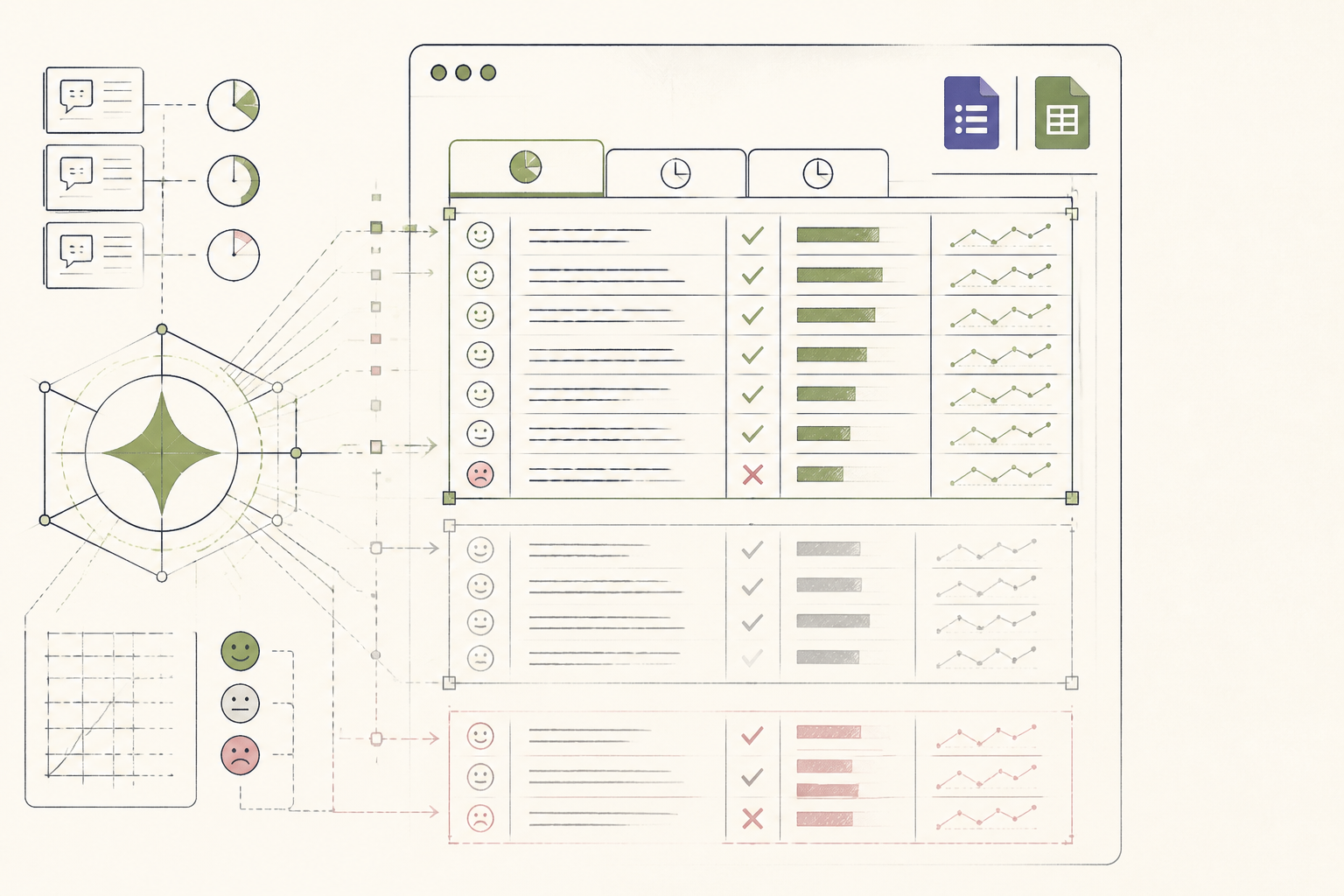
What the AI found
“Your client feedback data reveals that weekly qualitative check-ins consistently yield a 15% higher reported stress reduction compared to bi-weekly or monthly check-ins for clients on a new dietary protocol.”
Before
Disparate client notes, manual synthesis
After
Structured weekly insights, automated synthesis
The same system, three states — real screens, not a screenshot
- Client A - 23/10: 'Feeling less anxious.'
- Client B - 24/10: 'Stress high, new diet challenging.'
- Client C - 25/10: 'Sleep better, less overwhelmed.'
- Client A - 30/10: 'Good week, consistent energy.'
Prompt
Analyse the attached anonymised client feedback (Google Sheet) regarding stress levels. Specifically, compare reported stress reduction for clients who receive weekly qualitative check-ins versus those with bi-weekly or monthly check-ins, especially for clients starting a new dietary protocol. Quantify the difference in reported stress reduction.
Can you analyse this anonymised client feedback regarding stress levels, comparing weekly vs. less frequent check-ins for new dietary protocols?
AI
After analysing the feedback from clients on new dietary protocols, I found a consistent pattern. Clients receiving weekly qualitative check-ins reported, on average, a 15% higher subjective stress reduction compared to those who had bi-weekly or monthly check-ins. This suggests the frequency of engagement correlates with perceived progress in stress management within this group.15%
Weekly Check-ins Avg. Stress Reduction
2%
Bi-weekly/Monthly Check-ins Avg. Stress Reduction
28
Clients on New Protocol
Streamlining Client Feedback for Stress Management
A practitioner moves from ad-hoc client check-ins to structured, insightful weekly reviews with AI assistance.
A nutritionist running a small EU practice focusing on metabolic health.
Tools used
The real tools used here — swap any for your own equivalent. Each links to how we’d set it up.
Starting state
Before anything was set up
Before implementing a structured approach, the practitioner relied on informal client check-ins and disparate notes scattered across various documents. Synthesising this qualitative feedback for patterns in stress response was a manual, time-consuming process. Insights were often anecdotal, making it difficult to identify concrete trends or track the efficacy of interventions consistently across their client base.
- Client A - 23/10: 'Feeling less anxious.'
- Client B - 24/10: 'Stress high, new diet challenging.'
- Client C - 25/10: 'Sleep better, less overwhelmed.'
- Client A - 30/10: 'Good week, consistent energy.'
- Client B - 31/10: 'Still finding it hard, work stress.'
Working state
Hacks Pass, doing its job
The practitioner decided to implement a structured weekly feedback form in Google Forms, asking open-ended questions about their clients' weekly experience, including stress levels. This data, anonymised and aggregated, was then fed into a large language model. The model's task was to identify overarching themes and quantitative patterns related to reported stress reduction, focusing on new dietary protocols.
Prompt
Analyse the attached anonymised client feedback (Google Sheet) regarding stress levels. Specifically, compare reported stress reduction for clients who receive weekly qualitative check-ins versus those with bi-weekly or monthly check-ins, especially for clients starting a new dietary protocol. Quantify the difference in reported stress reduction.
Can you analyse this anonymised client feedback regarding stress levels, comparing weekly vs. less frequent check-ins for new dietary protocols?
AI
After analysing the feedback from clients on new dietary protocols, I found a consistent pattern. Clients receiving weekly qualitative check-ins reported, on average, a 15% higher subjective stress reduction compared to those who had bi-weekly or monthly check-ins. This suggests the frequency of engagement correlates with perceived progress in stress management within this group.Use case implemented
The finished system, running on its own
With the system in place, the practitioner now receives structured weekly feedback summaries. Each Monday, they review a concise report highlighting key trends in client-reported stress and adaptation to new protocols. This allows them to adjust their guidance more proactively and demonstrate the impact of their interventions with objective, AI-generated insights, improving client engagement and protocol adherence.
15%
Weekly Check-ins Avg. Stress Reduction
2%
Bi-weekly/Monthly Check-ins Avg. Stress Reduction
28
Clients on New Protocol
What an outside observer would notice
Reduced by 60%
Time spent synthesising feedback
Increased by 10%
Client protocol adherence
5x more specific
Identified stress reduction patterns
The stack — build it yourself
Simple, accessible for clients, easy integration with Sheets.
Centralised storage, easy to export or share for AI analysis.
Powerful natural language processing for pattern detection in open-ended responses.
These are the tools used in this story. Any can be swapped for an equivalent you already trust.
Go deeper
Do this yourself
See Hacks Pass
This story runs on Hacks Pass. The tools and prompts above are the real build — swap any tool for your own equivalent and follow the same steps.