What the AI found
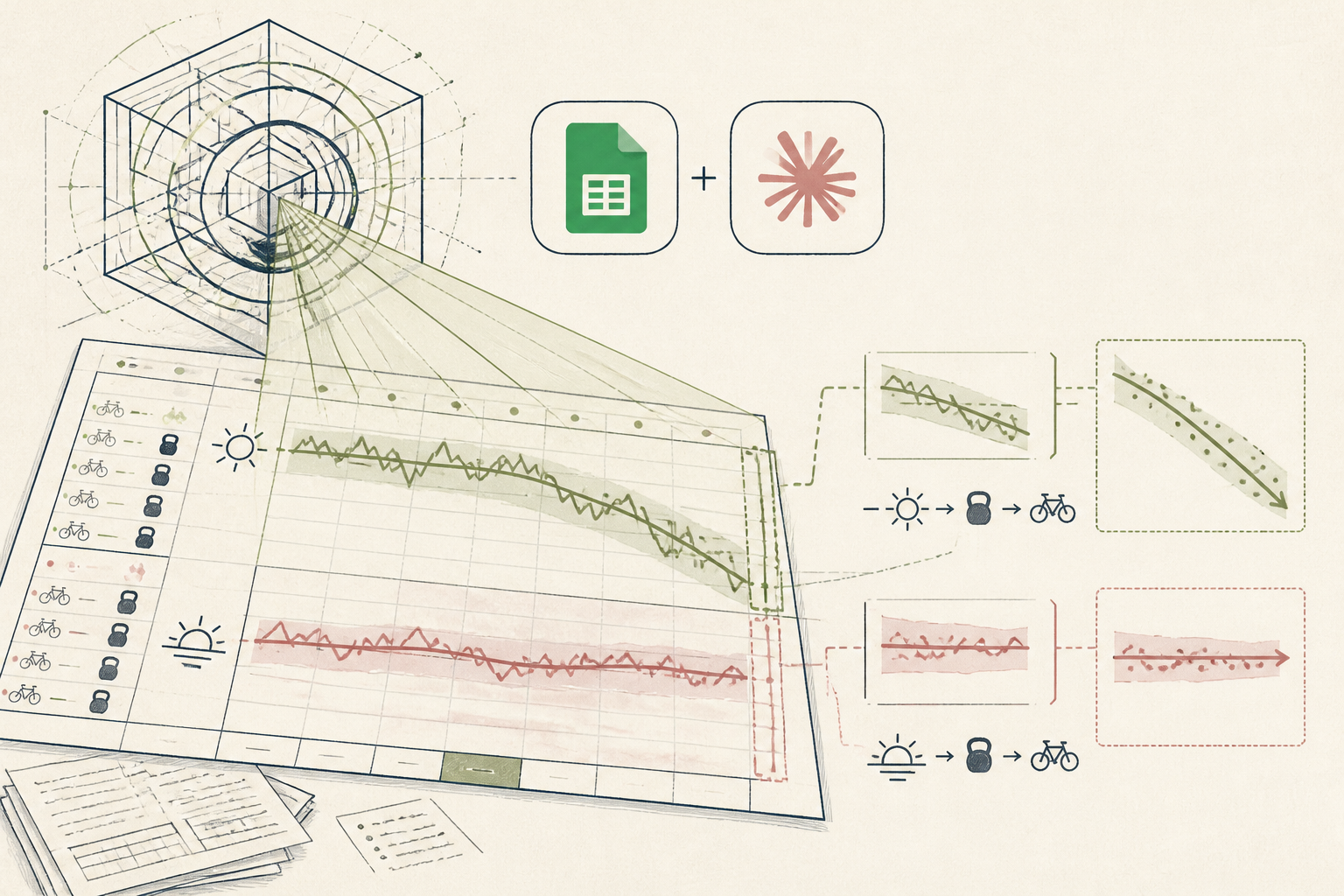
“Over 18 weeks, zone-2 compliance dropped 44% in patients who added morning strength sessions, while afternoon sessions showed zero friction.”
Before
14 client spreadsheets, none cross-referenced
After
one 8-minute Friday brief per patient
The same system, three states — real screens, not a screenshot
- Client 04: low zone 2 again (claimed fatigue)
- Client 09: missed Saturday long ride, lift was Friday AM
- Need to cross-check zone-2 vs strength days
- Sunday prep running over 2.5 hours total
Prompt
Analyze these 14 anonymized 18-week logs. Do not evaluate biomarkers. Identify only systemic timing conflicts where aerobic target compliance falls below 70% following specific resistance training slots.
Analyze these 14 anonymized 18-week logs. Do not evaluate biomarkers. Identify only systemic timing conflicts where aerobic target compliance falls below 70% following specific resistance training slots.
AI
Across 18 weeks, zone-2 aerobic compliance dropped 44% in patients who scheduled strength sessions before 09:00 (compliance: 51%). Patients scheduling resistance training after 14:00 showed 95% aerobic target compliance. The drop is absent on weekends.8 min / Friday
Cross-cohort review
100% locally saved
Prompt consistency
0
Data leaks outside sheet
Spotting Protocol Friction Across Fourteen Longevity Clients
How an independent practitioner turned scattered client logs into cohort-level longevity insights without bespoke software.
A preventive health practitioner with a solo clinic, Northern Europe
Tools used
The real tools used here — swap any for your own equivalent. Each links to how we’d set it up.
Starting state
Before anything was set up
Fourteen client tabs open in Google Chrome on a Sunday night. Each client logged resting heart rate, zone-2 minutes, sleep quality, and strength volume across individual sheets. The practitioner had plenty of longitudinal records, but finding patterns across the cohort required manual squinting and mental arithmetic. She could see individual compliance dips, but she could not tell if three clients failing their aerobic targets in the same fortnight shared an environmental trigger or a scheduling clash. Sunday prep routinely took three unpaid hours.
- Client 04: low zone 2 again (claimed fatigue)
- Client 09: missed Saturday long ride, lift was Friday AM
- Need to cross-check zone-2 vs strength days
- Sunday prep running over 2.5 hours total
Working state
Membership, doing its job
She stripped identifiers, leaving only patient ID, session timestamps, and target completion percentages. Using a structured prompt template maintained in her clinic manual, she pasted the anonymized data into Claude. Instead of asking for general health advice or protocol rewrites, she tasked the model strictly with comparative operational analysis: look for schedule friction where completion rates dropped below seventy percent across the entire cohort.
Prompt
Analyze these 14 anonymized 18-week logs. Do not evaluate biomarkers. Identify only systemic timing conflicts where aerobic target compliance falls below 70% following specific resistance training slots.
Analyze these 14 anonymized 18-week logs. Do not evaluate biomarkers. Identify only systemic timing conflicts where aerobic target compliance falls below 70% following specific resistance training slots.
AI
Across 18 weeks, zone-2 aerobic compliance dropped 44% in patients who scheduled strength sessions before 09:00 (compliance: 51%). Patients scheduling resistance training after 14:00 showed 95% aerobic target compliance. The drop is absent on weekends.Use case implemented
The finished system, running on its own
Every Friday at 16:00, the practitioner runs one local script within their private Google Workspace. It pulls the week's de-identified compliance figures, sends the standardized template to Claude, and appends a single comparative row to each client's tab. No third-party longevity portal, no monthly export shuffle. She reviews fourteen patients in under forty minutes, spotting systemic timing frictions before clients bring them up in monthly check-ins. The prompts stay in her own files, private and intact.
8 min / Friday
Cross-cohort review
100% locally saved
Prompt consistency
0
Data leaks outside sheet
What an outside observer would notice
38 min to 8 min
Prep time per consult
3 recurring timing conflicts
Cohort patterns surfaced
+28% on aerobic blocks
Patient adherence over 90 days
The stack — build it yourself
Familiar, privately hosted, and allows full data ownership without third-party platform lock-in.
Handles dense, multi-table context windows without losing precision on chronological details.
These are the tools used in this story. Any can be swapped for an equivalent you already trust.
Go deeper
Do this yourself
Explore Membership
This story runs on Membership. The tools and prompts above are the real build — swap any tool for your own equivalent and follow the same steps.