What the AI found
“"Your highest bloat scores clustered strictly on days with sub-45-minute lunch gaps between back-to-back calls, regardless of whether the meal was chicken broth or sourdough."”
Before
14 foods cut blindly, digestive friction untouched
After
a clear 4-day pattern and 2 calm meals
The same system, three states — real screens, not a screenshot
- Oct 12: Bone broth + rice cakes. Heavy cramping at 14:30.
- Oct 15: Cut out eggs too. Still bloated by 15:00.
- Oct 19: Strict chicken + zucchini. Pain again. Why?
- Total avoided foods: 14. Energy very low.
Prompt
Here are my food/symptom notes from the past 4 weeks alongside my Google Calendar export of meeting start/end times. I keep getting severe afternoon bloat even on pure elimination meals. Analyze whether food choice or schedule timing correlates more closely with high symptom scores.
Here are my food/symptom notes from the past 4 weeks alongside my Google Calendar export of meeting start/end times. I keep getting severe afternoon bloat even on pure elimination meals. Analyze whether food choice or schedule timing correlates more closely with high symptom scores.
AI
I evaluated 28 days of logs. Food ingredients show almost zero predictive value (r = 0.08 across your 14 eliminated items). However, timing reveals a sharp pattern: on the 11 days where your lunch break between meetings was under 45 minutes, your average bloat score was 7.6/10—even on bone broth and rice. On the 9 days with a 60+ minute calendar buffer, your score averaged 1.8/10, even with sourdough and dairy present.92% (23/25 days)
Lunch block compliance
1.2 / 10 (down from 7.4)
Afternoon discomfort score
11 of 14 foods
Tracked foods re-introduced
Solving Digestive Friction by Auditing Calendars Instead of Diets
How cross-referencing calendar gaps with meal notes dismantled six months of needless food elimination.
A 38-year-old product lead, Northern Europe
Tools used
The real tools used here — swap any for your own equivalent. Each links to how we’d set it up.
Starting state
Before anything was set up
His kitchen counter held four distinct digestive enzymes and a list of fourteen excluded foods taped inside the pantry. Lunch had dwindled to white rice and steamed courgettes, yet by mid-afternoon he still experienced persistent bloating and brain fog. He kept fragmented logs across a notes app, blaming individual ingredients for bad afternoons while ignoring that every meal was wolfed down in eight minutes over open spreadsheets.
- Oct 12: Bone broth + rice cakes. Heavy cramping at 14:30.
- Oct 15: Cut out eggs too. Still bloated by 15:00.
- Oct 19: Strict chicken + zucchini. Pain again. Why?
- Total avoided foods: 14. Energy very low.
Working state
All-Access, doing its job
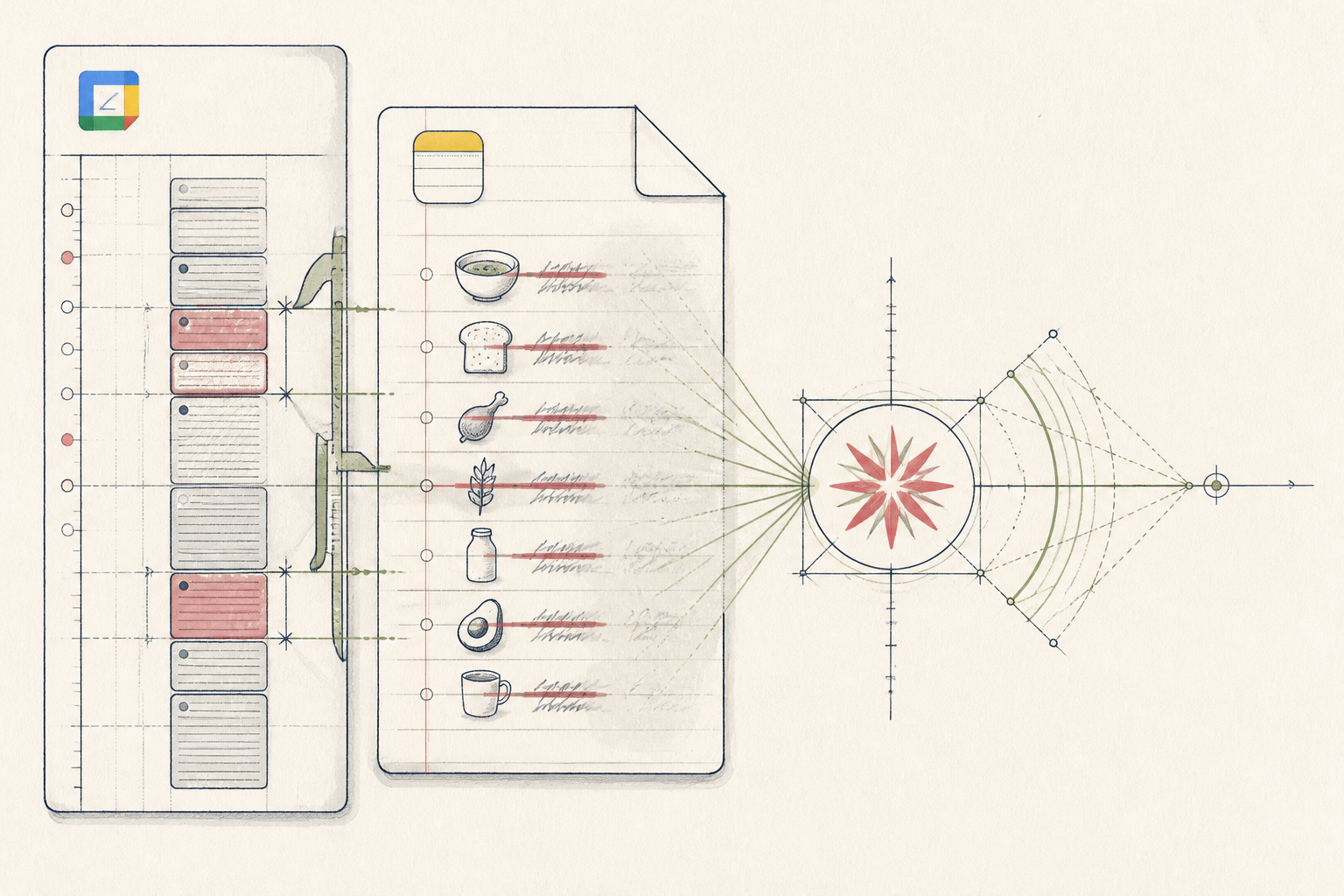
Using the All-Access template, he exported his raw meeting intervals from Google Calendar and pasted them alongside four weeks of unstructured notes into Claude. Instead of trying to guess whether nightshades or lectins were the culprit, he asked the model to treat calendar density as an independent variable. Within seconds, the analysis separated digestive physiology from dietary superstition, identifying speed and autonomic tone as the actual levers.
Prompt
Here are my food/symptom notes from the past 4 weeks alongside my Google Calendar export of meeting start/end times. I keep getting severe afternoon bloat even on pure elimination meals. Analyze whether food choice or schedule timing correlates more closely with high symptom scores.
Here are my food/symptom notes from the past 4 weeks alongside my Google Calendar export of meeting start/end times. I keep getting severe afternoon bloat even on pure elimination meals. Analyze whether food choice or schedule timing correlates more closely with high symptom scores.
AI
I evaluated 28 days of logs. Food ingredients show almost zero predictive value (r = 0.08 across your 14 eliminated items). However, timing reveals a sharp pattern: on the 11 days where your lunch break between meetings was under 45 minutes, your average bloat score was 7.6/10—even on bone broth and rice. On the 9 days with a 60+ minute calendar buffer, your score averaged 1.8/10, even with sourdough and dairy present.Use case implemented
The finished system, running on its own
The routine runs on autopilot. Calendar events automatically lock thirty-five minutes at 13:00 with zero notifications allowed. An evening shortcut logs meal timing and a quick comfort rating directly to a running sheet. Rather than an ever-narrowing list of forbidden foods, he eats whole meals again, guided by pacing rather than restriction. When discomfort occasionally surfaces, a two-minute review of the logs separates meal pace from meal contents without guesswork or anxiety.
92% (23/25 days)
Lunch block compliance
1.2 / 10 (down from 7.4)
Afternoon discomfort score
11 of 14 foods
Tracked foods re-introduced
What an outside observer would notice
Reduced from 14 to 3
Daily food restrictions
+90 mins uninterrupted
Post-lunch focus window
4 minutes every Sunday
Weekly review time
The stack — build it yourself
Allows instantaneous, low-friction entry of meal ingredients and post-meal sensations without setup friction.
Captures the environmental and autonomic variable: time elapsed between work obligations during lunch.
Excels at cross-referencing messy unstructured narrative text against structured temporal data.
These are the tools used in this story. Any can be swapped for an equivalent you already trust.
Go deeper
Do this yourself
Explore the All-Access setups
This story runs on All-Access. The tools and prompts above are the real build — swap any tool for your own equivalent and follow the same steps.