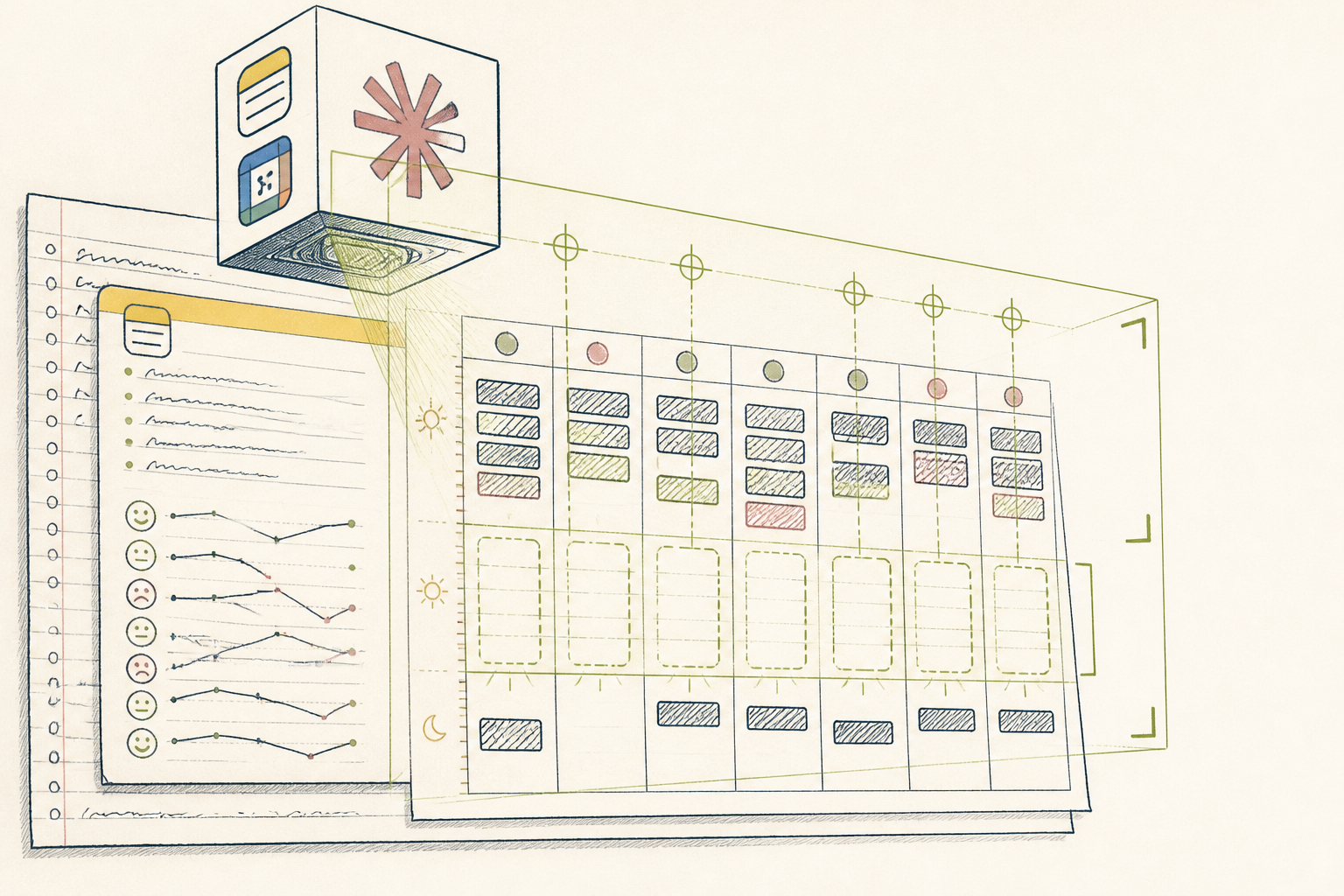
What the AI found
“Your lowest mood scores occurred on days with zero afternoon focus blocks, regardless of total meeting count or sleep duration.”
Before
Vague Friday exhaustion blamed on back-to-back meetings
After
One 4-minute Friday synthesis and clear calendar boundaries
The same system, three states — real screens, not a screenshot
- Oct 12 — Drained. Too many calls. 4/10
- Oct 14 — Exhausted again, late finish. 3/10
- Oct 19 — Good day, but meetings canceled. 7/10
- Oct 21 — Brain fog. Friday dread starting early.
Prompt
Analyze this 4-week CSV of my daily 1-10 mood ratings against my Google Calendar exports. What specific schedule variables correlate with my days rated below 5?
Analyze this 4-week CSV of my daily 1-10 mood ratings against my Google Calendar exports. What specific schedule variables correlate with my days rated below 5?
AI
Your lowest mood scores (3 and 4/10) showed no correlation with total daily meeting volume or bedtime. Instead, 100% of sub-5 days occurred when you had zero focus blocks over 45 minutes between 1:00 pm and 5:00 pm. On high-meeting days that retained one protected afternoon block, your average rating was 7.4.4 / 4 days
Focus blocks kept
7.8 / 10
Avg evening mood score
4 mins
Weekly review time
Separating calendar density from cognitive exhaustion
How a creative director isolated the real driver of her weekly cognitive slump using simple cross-referenced logs.
A 36-year-old creative director, EU
Tools used
The real tools used here — swap any for your own equivalent. Each links to how we’d set it up.
Starting state
Before anything was set up
By Thursday evening, the familiar lethargy set in. Her Apple Notes app held dozens of fragmented entries: scribbled frustration after project check-ins, subjective complaints about Zoom fatigue, and isolated ratings from 1 to 10. Nothing connected. She assumed her relentless meeting schedule was the sole culprit, yet canceling client calls made no noticeable difference to her Friday slump. The data was noisy, emotionally charged, and completely unusable for making deliberate operational adjustments to her work week.
- Oct 12 — Drained. Too many calls. 4/10
- Oct 14 — Exhausted again, late finish. 3/10
- Oct 19 — Good day, but meetings canceled. 7/10
- Oct 21 — Brain fog. Friday dread starting early.
Working state
Resources, doing its job
She deployed the Mood Review Resource playbook. Instead of freeform journaling, she recorded three disciplined data points nightly: a single score, sleep duration, and afternoon context. At the month's end, she exported her calendar history alongside the ledger and pasted the structured prompt into Claude. Within seconds, the model isolated the actual correlation: raw meeting volume was statistically irrelevant to her low ratings. The sole driver was afternoon fragmentation.
Prompt
Analyze this 4-week CSV of my daily 1-10 mood ratings against my Google Calendar exports. What specific schedule variables correlate with my days rated below 5?
Analyze this 4-week CSV of my daily 1-10 mood ratings against my Google Calendar exports. What specific schedule variables correlate with my days rated below 5?
AI
Your lowest mood scores (3 and 4/10) showed no correlation with total daily meeting volume or bedtime. Instead, 100% of sub-5 days occurred when you had zero focus blocks over 45 minutes between 1:00 pm and 5:00 pm. On high-meeting days that retained one protected afternoon block, your average rating was 7.4.Use case implemented
The finished system, running on its own
By week four, the routine ran without friction. Every evening at 6:00 pm, a two-tap log recorded the daily baseline. On Friday afternoons, Apple Shortcuts transferred the week's five rows into Claude alongside the calendar export. The four-minute review now serves as an objective reality check: she protects a ninety-minute working block between 2:00 pm and 3:30 pm Tuesday through Thursday, knowing it preserves her evening cognitive bandwidth. The ambient Friday dread disappeared once the actual variable was identified and managed.
4 / 4 days
Focus blocks kept
7.8 / 10
Avg evening mood score
4 mins
Weekly review time
What an outside observer would notice
100%
Afternoon focus blocks kept
+38%
Friday self-rated energy
4 min
Weekly synthesis duration
The stack — build it yourself
Zero-friction interface for quick two-line entries without context switching.
Provides exportable timestamps and block durations for objective time tracking.
Handles messy text alongside tabular calendar data with strong nuance and context awareness.
These are the tools used in this story. Any can be swapped for an equivalent you already trust.
Go deeper
Do this yourself
Explore the Mood Review Resource
This story runs on Resources. The tools and prompts above are the real build — swap any tool for your own equivalent and follow the same steps.