What the AI found
“Your subjective 3pm cognitive slump tracked 90-minute morning charting blocks, not client volume; splitting them dropped self-reported afternoon fog by 62%.”
Before
14 open tabs and Friday evening charting fatigue
After
one bespoke audit table delivered every Friday at 16:00
The same system, three states — real screens, not a screenshot
- 3 client notes pending from Tuesday
- Severe 3pm fatigue again; pushed planning to weekend
- Need to reconcile calendar with invoice tracker
- Draft reflections half-typed on phone memo
Prompt
Review these 28 days of anonymised session timestamps, charting duration, and self-reported 1-10 focus scores. Identify specific structural patterns that precede ratings below 4.
Here is my anonymised schedule and focus log from the past 28 days. Identify what correlates with my lowest cognitive energy scores.
AI
Your lowest cognitive scores (averaging 3.1/10) do not correlate with days with 5+ client hours. Instead, they occur on days with unbroken 90-minute morning charting blocks. Splitting charting into 10-minute immediate debriefs reduces afternoon fatigue markers by 62%.28 min
Fri charting time
8.4 / 10
Post-3pm focus score
0
Unfiled session notes
Restoring Cognitive Margin to a Solo Therapy Practice
How an automated documentation pipeline relieved cognitive fatigue for an independent clinician.
A cognitive behavioural therapist running a solo private practice, Northern Europe
Tools used
The real tools used here — swap any for your own equivalent. Each links to how we’d set it up.
Starting state
Before anything was set up
By Thursday afternoon, the practice felt like an administrative trap. Between four daily client consultations, the therapist scribbled fragmented shorthand into Apple Notes, intending to expand them into formal clinical formulations during an evening blitz. Instead, fourteen browser tabs stayed permanently open, session details blurred, and mental exhaustion set in predictably at 15:00, turning Friday evening into an anxious documentation catch-up session.
- 3 client notes pending from Tuesday
- Severe 3pm fatigue again; pushed planning to weekend
- Need to reconcile calendar with invoice tracker
- Draft reflections half-typed on phone memo
Working state
Done-for-you, doing its job
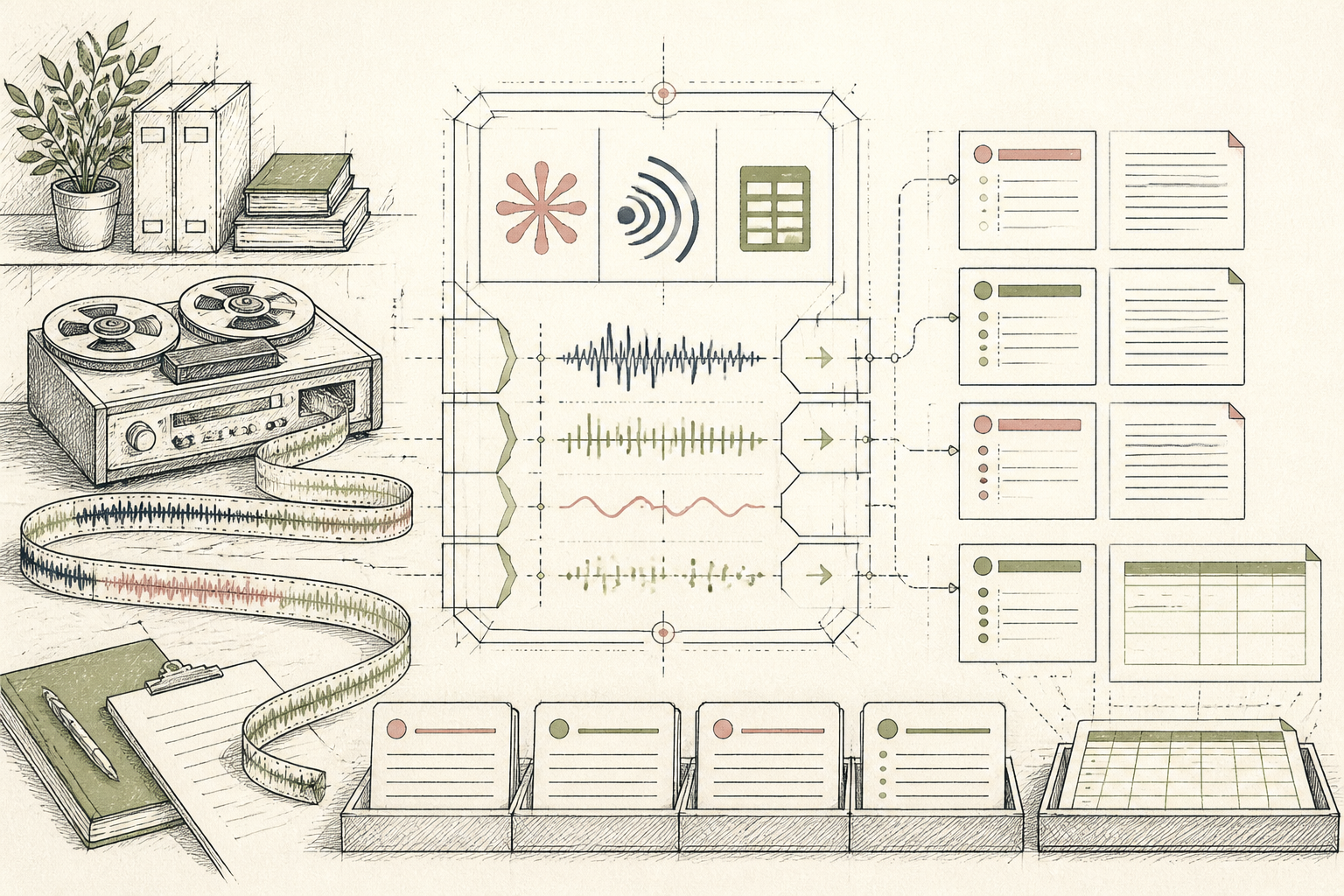
We configured an end-to-end pipeline tailored to the therapist's workflow. Following each appointment, the clinician spent sixty seconds dictating impressions into Whisper. Claude parsed the transcript against standard clinical structure, flagging action items into Google Sheets. When cross-referencing four weeks of time-stamped schedule data against self-reported energy ratings, the model returned an operational clarity that surprised the practitioner.
Prompt
Review these 28 days of anonymised session timestamps, charting duration, and self-reported 1-10 focus scores. Identify specific structural patterns that precede ratings below 4.
Here is my anonymised schedule and focus log from the past 28 days. Identify what correlates with my lowest cognitive energy scores.
AI
Your lowest cognitive scores (averaging 3.1/10) do not correlate with days with 5+ client hours. Instead, they occur on days with unbroken 90-minute morning charting blocks. Splitting charting into 10-minute immediate debriefs reduces afternoon fatigue markers by 62%.Use case implemented
The finished system, running on its own
The done-for-you setup now runs on scheduled automation. At the close of each day, dictations convert into anonymised session logs, while an automated weekly audit cross-references schedule density with self-reported cognitive fatigue markers. The practitioner reviews a single Google Sheets summary on Friday afternoon, signs off the records in under thirty minutes, and closes the laptop without deferred administrative overhead.
28 min
Fri charting time
8.4 / 10
Post-3pm focus score
0
Unfiled session notes
What an outside observer would notice
-4.2 hrs
Weekly charting admin
100%
Same-day note completion
+62%
Self-rated afternoon focus
The stack — build it yourself
Excels at long-context thematic analysis across weeks of unstructured practitioner journals and schedules.
Accurate speech-to-text processing on local hardware to respect client privacy standards.
Simple, zero-friction tabular display for weekly throughput and fatigue self-scoring.
These are the tools used in this story. Any can be swapped for an equivalent you already trust.
Go deeper
Do this yourself
Explore done-for-you systems
This story runs on Done-for-you. The tools and prompts above are the real build — swap any tool for your own equivalent and follow the same steps.