What the AI found
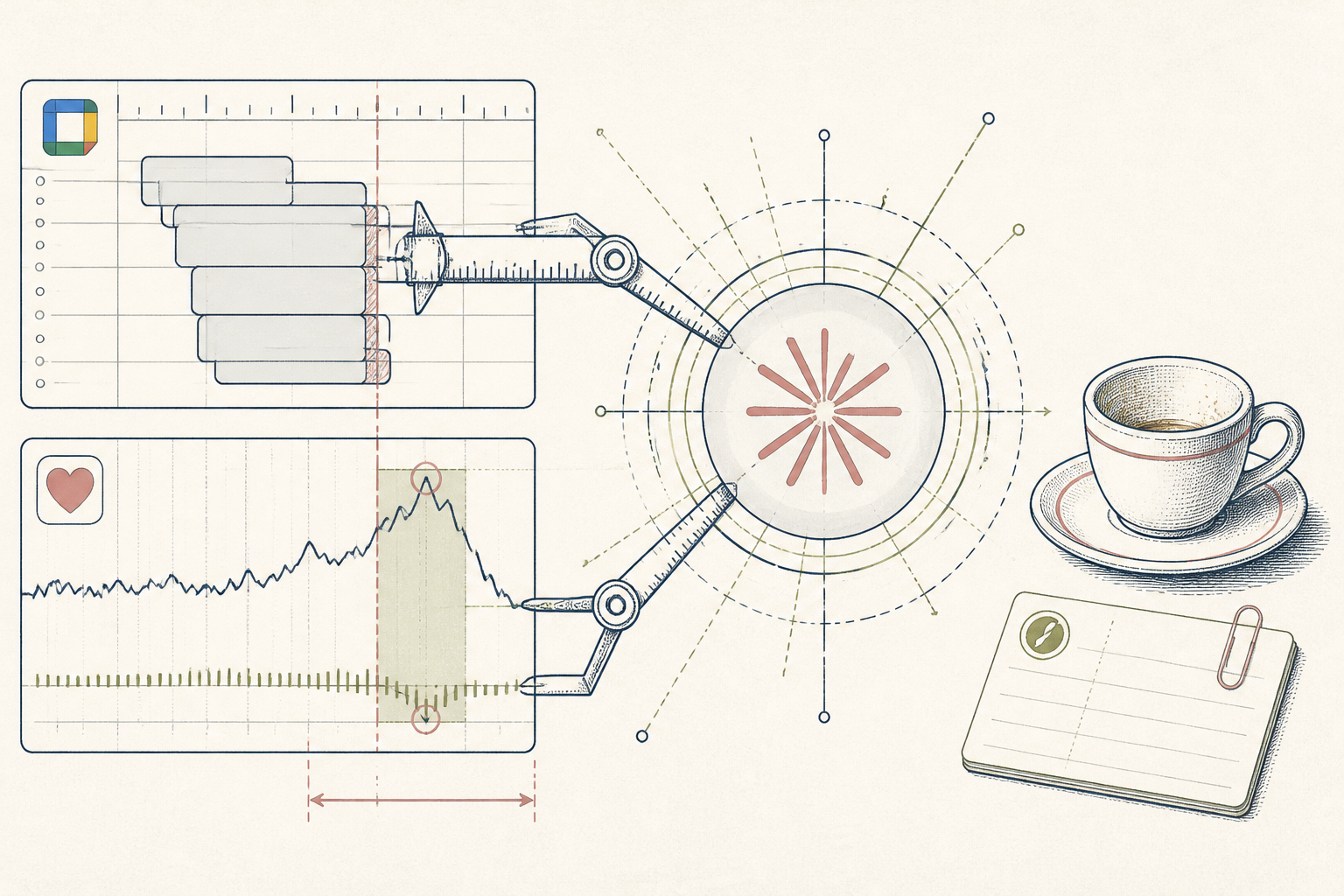
“Your daytime stress markers peaked 42 minutes after back-to-back calendar events, regardless of whether you had coffee or skipped it entirely.”
Before
Midday spikes blamed on caffeine, tracked without answers
After
One 15-minute gap before meetings kept heart rate steady
The same system, three states — real screens, not a screenshot
- Monday — Cut to 1 coffee. Pulse still high at 14:15.
- Tuesday — Green tea only. Chest felt tight after lunch check-in.
- Thursday — Skipped caffeine entirely. Jittery feeling returned around 14:30.
- Unclear what is triggering this. Workload feels normal.
Prompt
I have pasted my Apple Health heart rate logs alongside my Google Calendar schedule for the past 14 days. Cross-reference my daytime heart rate elevations (>80 bpm at rest) against my meetings and beverage notes. What is the common denominator?
I have pasted my Apple Health heart rate logs alongside my Google Calendar schedule for the past 14 days. Cross-reference my daytime heart rate elevations (>80 bpm at rest) against my meetings and beverage notes. What is the common denominator?
AI
Your heart rate elevations show no statistical relationship to caffeine intake (p=0.48 across coffee vs decaf days). Instead, 11 of your 13 recorded spikes occurred exactly 35 to 45 minutes into schedules containing three or more consecutive meetings with zero-minute gaps.Down from 4/day to 1
Midday stress spikes
85% over 14 days
Calendar buffer compliance
64 bpm (prev. 73 bpm)
Resting HR post-lunch
Resolving phantom caffeine spikes by mapping calendar transitions
How cross-referencing calendar gaps with wearable metrics debunked a phantom caffeine sensitivity.
A 38-year-old product lead at a software agency, Northern Europe
Tools used
The real tools used here — swap any for your own equivalent. Each links to how we’d set it up.
Starting state
Before anything was set up
Every weekday around two in the afternoon, her watch flashed elevated resting heart rate alerts. Convinced it was an espresso sensitivity that had developed in her late thirties, she began cycling through elimination diets: half-caf, matcha, and finally herbal infusions. Her notes app was a scattered record of beverage logs and subjective tension ratings, but the afternoon physical agitation remained unchanged. She was treating an unknown cause with blind discipline.
- Monday — Cut to 1 coffee. Pulse still high at 14:15.
- Tuesday — Green tea only. Chest felt tight after lunch check-in.
- Thursday — Skipped caffeine entirely. Jittery feeling returned around 14:30.
- Unclear what is triggering this. Workload feels normal.
Working state
Hacks Pass, doing its job
She exported two weeks of granular heart rate readings alongside her exported calendar schedule as a unified text prompt into Claude. Rather than summarizing her week, she asked the model to calculate correlations between her physiological elevations and her schedule density. Within seconds, the tool exposed an obvious blind spot: the spikes were not linked to the morning mug on her desk, but to calendar transitions compressed into zero minutes.
Prompt
I have pasted my Apple Health heart rate logs alongside my Google Calendar schedule for the past 14 days. Cross-reference my daytime heart rate elevations (>80 bpm at rest) against my meetings and beverage notes. What is the common denominator?
I have pasted my Apple Health heart rate logs alongside my Google Calendar schedule for the past 14 days. Cross-reference my daytime heart rate elevations (>80 bpm at rest) against my meetings and beverage notes. What is the common denominator?
AI
Your heart rate elevations show no statistical relationship to caffeine intake (p=0.48 across coffee vs decaf days). Instead, 11 of your 13 recorded spikes occurred exactly 35 to 45 minutes into schedules containing three or more consecutive meetings with zero-minute gaps.Use case implemented
The finished system, running on its own
The finished system now runs on auto-pilot each morning. An automated script exports the daily calendar layout alongside wearable heart rate readings into Claude, which suggests where to insert a mandatory 15-minute quiet buffer. She has not given up her afternoon espresso, but the unexplained 2:00 PM tightness has largely resolved. Instead of guessing whether diet, fatigue, or workload caused her physical agitation, she has an objective visual pattern she can manage directly.
Down from 4/day to 1
Midday stress spikes
85% over 14 days
Calendar buffer compliance
64 bpm (prev. 73 bpm)
Resting HR post-lunch
What an outside observer would notice
Reduced by 68%
Afternoon heart rate spikes
2 per afternoon
Daily buffer blocks added
The stack — build it yourself
Handles long CSV schedule exports and physiological data without truncation.
Standard daily workspace where transition gaps could be automated.
Passive background recording of heart rate variability and daytime pulse.
These are the tools used in this story. Any can be swapped for an equivalent you already trust.
Go deeper
Do this yourself
Explore the prompt sequence
This story runs on Hacks Pass. The tools and prompts above are the real build — swap any tool for your own equivalent and follow the same steps.