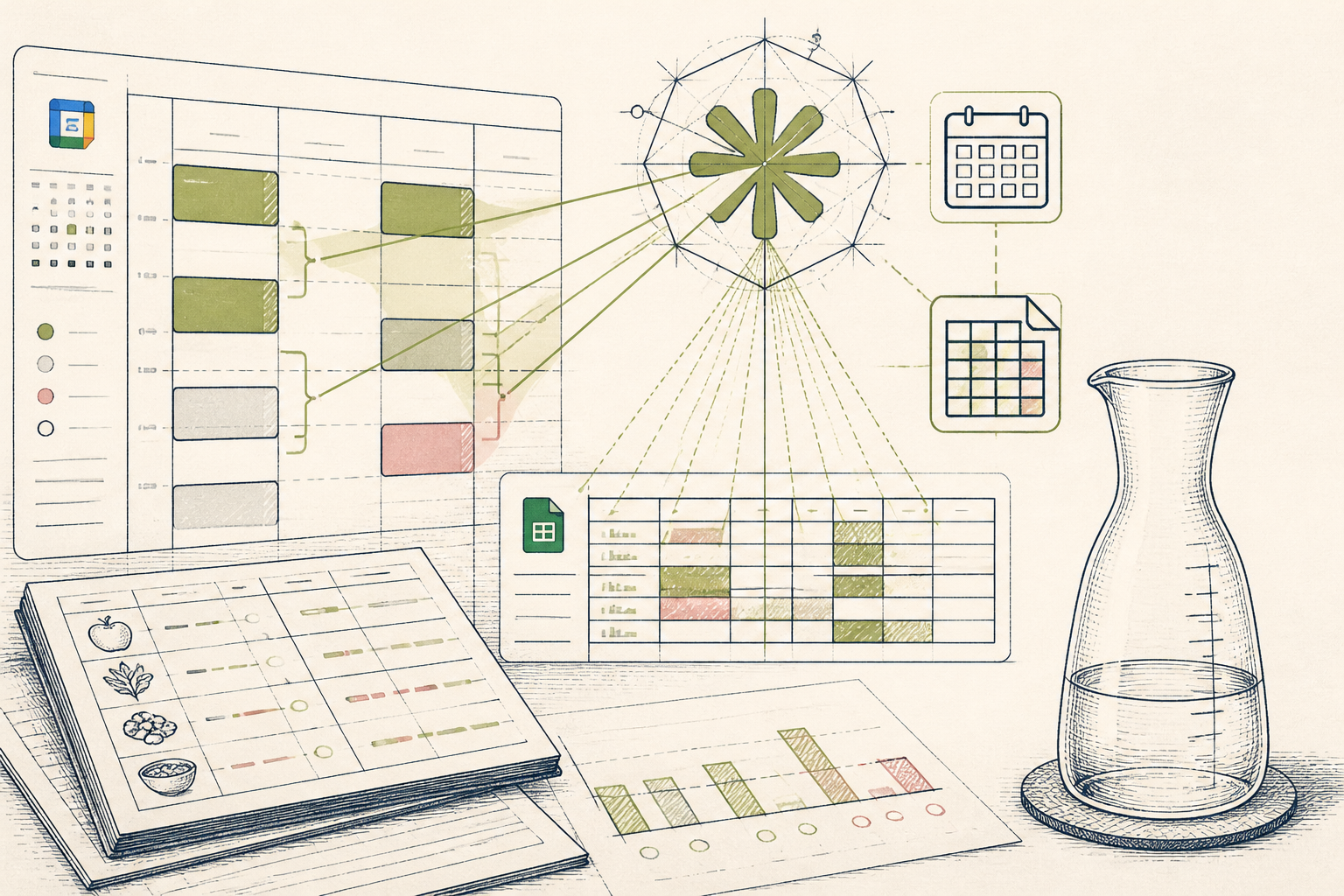
What the AI found
“Your afternoon energy crashes cluster after 45-minute consultations, not 60-minute ones; you squeeze prep notes into the shorter gap and skip water entirely.”
Before
scattered client notes, mid-afternoon cognitive fatigue
After
one 8-minute Friday audit protecting afternoon focus
The same system, three states — real screens, not a screenshot
- Tuesday 15:30 — brain fog heavy, two consults remaining
- Thursday 14:15 — skipped lunch again, charting backing up
- Client load feels unsustainable, need to cut active days?
- Headache after short review calls
Prompt
Attached is my anonymised schedule from the last six weeks alongside my 1-10 energy ratings recorded at 13:00 and 17:00. Identify what variable correlates most strongly with my afternoon rating dropping below 4.
Attached is my anonymised schedule from the last six weeks alongside my 1-10 energy ratings recorded at 13:00 and 17:00. Identify what variable correlates most strongly with my afternoon rating dropping below 4.
AI
Your sharpest energy drops (sub-4 ratings on 14 of 18 clinic days) do not correlate with total client hours or initial assessments. They cluster specifically after blocks containing two or more 45-minute follow-ups: on those days, your average transition interval was 2.1 minutes versus 14.8 minutes on 60-minute days, eliminating hydration and note-clearing intervals.8.4 / 10
Post-14:00 Focus Score
0 per week
Unbuffered Sessions
0 min
Weekly Note Lag
Reclaiming Clinical Energy by Auditing Session Transitions with AI
How an integrative dietitian mapped six weeks of appointment patterns to protect her cognitive reserve.
A 39-year-old integrative dietitian running a solo virtual practice, Northern Europe
Tools used
The real tools used here — swap any for your own equivalent. Each links to how we’d set it up.
Starting state
Before anything was set up
By 14:30 on clinic days, her attention felt frayed. She kept water on her desk that stayed untouched while session summaries spilled into her evenings. She assumed her caseload of twenty-four weekly consultations was simply too demanding for her temperament, but reducing client slots meant lowering clinic revenue. Her logs were fragmented across calendar entries, stray desktop notes, and subjective frustration.
- Tuesday 15:30 — brain fog heavy, two consults remaining
- Thursday 14:15 — skipped lunch again, charting backing up
- Client load feels unsustainable, need to cut active days?
- Headache after short review calls
Working state
All-Access, doing its job
She exported six weeks of booking records into Google Sheets, stripped all identifiers, and tagged each session with duration and her logged afternoon energy score. Pasting the table into Claude, she asked for an unsparing pattern analysis across appointment spacing, total volume, and session types to locate where her cognitive capacity leaked.
Prompt
Attached is my anonymised schedule from the last six weeks alongside my 1-10 energy ratings recorded at 13:00 and 17:00. Identify what variable correlates most strongly with my afternoon rating dropping below 4.
Attached is my anonymised schedule from the last six weeks alongside my 1-10 energy ratings recorded at 13:00 and 17:00. Identify what variable correlates most strongly with my afternoon rating dropping below 4.
AI
Your sharpest energy drops (sub-4 ratings on 14 of 18 clinic days) do not correlate with total client hours or initial assessments. They cluster specifically after blocks containing two or more 45-minute follow-ups: on those days, your average transition interval was 2.1 minutes versus 14.8 minutes on 60-minute days, eliminating hydration and note-clearing intervals.Use case implemented
The finished system, running on its own
The entire routine now runs on an eight-minute Friday ritual. Claude ingests the week's anonymised consult timestamps, self-reported fatigue tags, and calendar blocks, flagging boundary drift before fatigue compounds. Google Calendar enforces hard fifteen-minute transition buffers automatically. She enters her final consultations with clear cognitive reserves, while her session reflections are filed cleanly before evening without overtime work.
8.4 / 10
Post-14:00 Focus Score
0 per week
Unbuffered Sessions
0 min
Weekly Note Lag
What an outside observer would notice
-42 min
Friday admin time
-61%
Afternoon slump score
15 min fixed
Between-client buffer
The stack — build it yourself
High context window for cross-referencing multi-week appointment exports against subjective fatigue logs.
Native API scheduling controls to lock hard recovery gaps between patient touchpoints.
Zero-friction data aggregation without exposing patient identifying details to language models.
These are the tools used in this story. Any can be swapped for an equivalent you already trust.
Go deeper
Do this yourself
Assemble your own practice audit
This story runs on All-Access. The tools and prompts above are the real build — swap any tool for your own equivalent and follow the same steps.