What the AI found
“Over the past month, client A's early morning awakenings decreased by an average of 27 minutes on days they consumed their last meal at least 3 hours before sleep, compared to less than 2 hours. This suggests a notable correlation between meal timing and sleep continuity.”
Before
Generic sleep advice, anecdotal client reports
After
Actionable, data-backed client sleep protocols
The same system, three states — real screens, not a screenshot
| Date | Sleep Duration (h) — Awakenings — Last Meal Time |
| 2023-10-26 | 6.8 — 3 — 21:30 |
| 2023-10-27 | 7.1 — 2 — 19:00 |
| 2023-10-28 | 6.5 — 4 — 22:00 |
Prompt
Analyse the provided sleep and meal timing data for patterns. Specifically, look for correlations between the time of the last meal and metrics like sleep duration, latency, and especially early morning awakenings. Provide concrete, numeric findings if a significant pattern is observed over the past month.
Analyse the provided sleep and meal timing data for patterns. Specifically, look for correlations between the time of the last meal and metrics like sleep duration, latency, and especially early morning awakenings. Provide concrete, numeric findings if a significant pattern is observed over the past month.
AI
Reviewing Client A's data for the past month, a notable pattern emerges concerning early morning awakenings. On days when the last meal was consumed less than 2 hours before sleep, average early morning awakenings lasted 48 minutes. When the last meal was consumed 3 hours or more before sleep, this average dropped to 21 minutes. This represents a 27-minute average reduction in early morning awakenings, suggesting a strong correlation with increased meal-to-sleep interval.18 min
Avg. Awakenings (Last 7 Days)
3h 15m
Avg. Last Meal-to-Sleep Gap
Improved morning clarity
Client Feedback
Precision Sleep Insights for Nutrition Coaches
Moving from generic sleep advice to data-driven, individualised recommendations for clients.
A nutritionist running a small practice, EU
Tools used
The real tools used here — swap any for your own equivalent. Each links to how we’d set it up.
Starting state
Before anything was set up
A nutritionist found herself relying on general advice for client sleep issues, often piecing together anecdotal evidence from disparate sources. Client reports were qualitative, making it difficult to identify specific, actionable patterns. Without concrete data, interventions felt more like guesswork than precision adjustments.
| Date | Sleep Duration (h) — Awakenings — Last Meal Time |
| 2023-10-26 | 6.8 — 3 — 21:30 |
| 2023-10-27 | 7.1 — 2 — 19:00 |
| 2023-10-28 | 6.5 — 4 — 22:00 |
| 2023-10-29 | 7.5 — 1 — 18:30 |
Working state
Done-for-you, doing its job
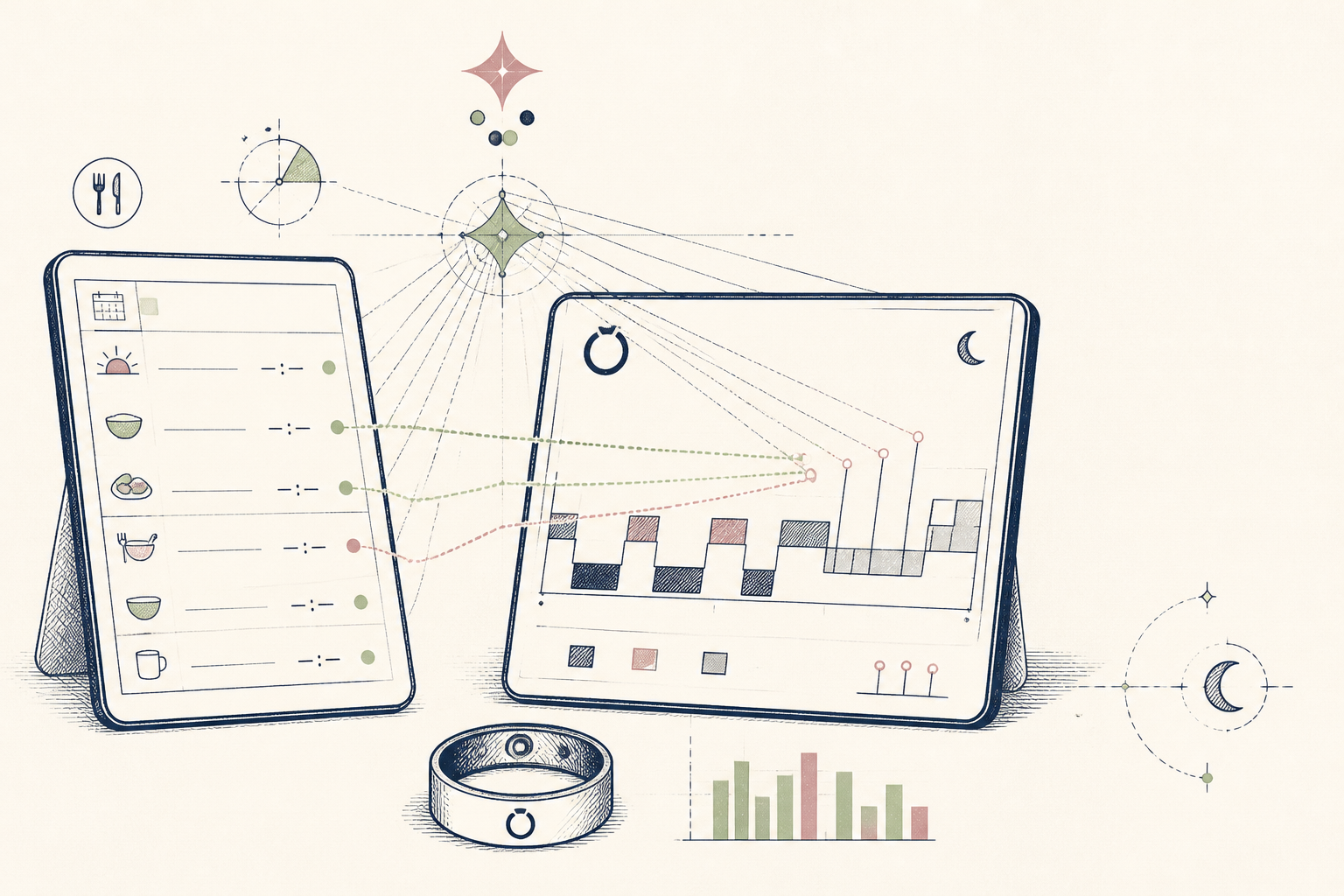
To gain clarity, she began collecting structured sleep data via her clients' Oura rings and food logs in Google Sheets. With a 'done-for-you' service, this data was then ingested by a large language model. The team crafted a specific prompt, asking the AI to correlate sleep metrics with dietary timing.
Prompt
Analyse the provided sleep and meal timing data for patterns. Specifically, look for correlations between the time of the last meal and metrics like sleep duration, latency, and especially early morning awakenings. Provide concrete, numeric findings if a significant pattern is observed over the past month.
Analyse the provided sleep and meal timing data for patterns. Specifically, look for correlations between the time of the last meal and metrics like sleep duration, latency, and especially early morning awakenings. Provide concrete, numeric findings if a significant pattern is observed over the past month.
AI
Reviewing Client A's data for the past month, a notable pattern emerges concerning early morning awakenings. On days when the last meal was consumed less than 2 hours before sleep, average early morning awakenings lasted 48 minutes. When the last meal was consumed 3 hours or more before sleep, this average dropped to 21 minutes. This represents a 27-minute average reduction in early morning awakenings, suggesting a strong correlation with increased meal-to-sleep interval.Use case implemented
The finished system, running on its own
The system now runs weekly, providing the nutritionist with concise, data-driven insights for each client. This allows her to refine dietary recommendations with confidence, moving beyond general guidelines to precisely tailored protocols based on individual response. Her clients receive clearer, more effective guidance.
18 min
Avg. Awakenings (Last 7 Days)
3h 15m
Avg. Last Meal-to-Sleep Gap
Improved morning clarity
Client Feedback
What an outside observer would notice
48 mins
Avg. Early Morning Awakenings (Initial)
21 mins
Avg. Early Morning Awakenings (Current)
Increased by 60%
Client Protocol Precision
The stack — build it yourself
Reliable, validated sleep stages and readiness metrics.
Flexible for combining data from various client sources (food logs, sleep).
Advanced natural language processing for pattern recognition across complex datasets.
These are the tools used in this story. Any can be swapped for an equivalent you already trust.
Go deeper
Do this yourself
Explore precision insights for your practice
This story runs on Done-for-you. The tools and prompts above are the real build — swap any tool for your own equivalent and follow the same steps.