What the AI found
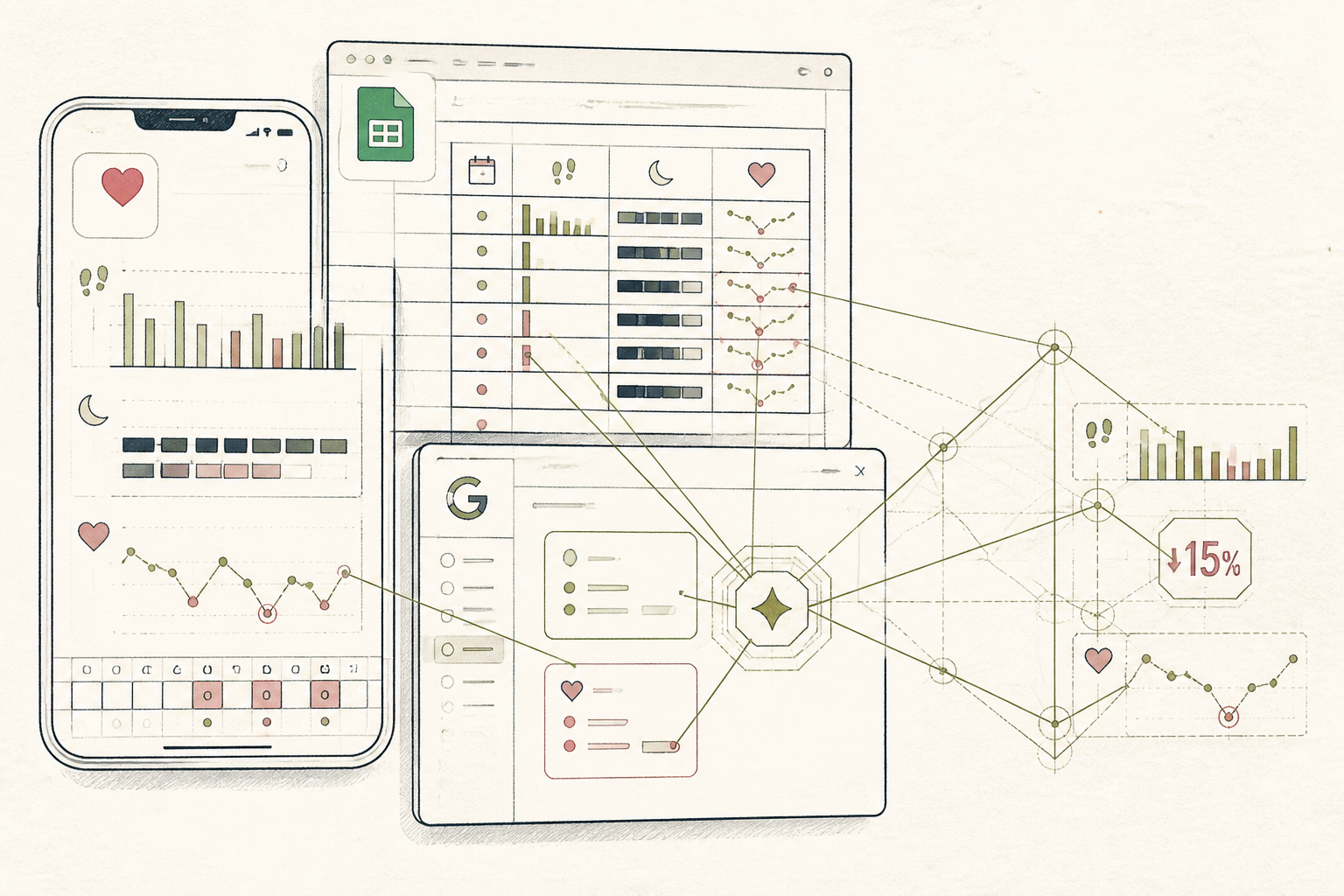
“Your most sedentary days consistently correlated with a 15% drop in heart rate variability (HRV) — not just steps, which you assumed was the primary impact metric.”
Before
Assumptions about activity impact
After
Validated insight, targeted movement
The same system, three states — real screens, not a screenshot
| Average Daily Steps | 7,800 |
| Average Resting Heart Rate | 59 bpm |
| Average Sleep Duration | 7h 15m |
| HRV (SDNN) Range | 28-58 ms |
Prompt
Here is two months of daily Apple Health data, including steps, active calories, sleep duration, and heart rate variability (HRV SDNN). Identify any non-obvious correlations between sedentary periods (low steps/active calories) and key recovery metrics like HRV. Focus on patterns that might indicate a physiological impact beyond just missed movement.
Here is two months of daily Apple Health data...
AI
I found a notable pattern: on days where your total steps were below 4,000 and active calories under 300, your average heart rate variability (HRV SDNN) decreased by approximately 15% the following night, dropping from an average of 48ms to 41ms. This specific dip was more pronounced than on days with similar steps but higher active calories from structured activity.47 ms (+2%)
HRV SDNN (7-day avg)
reduced by 8% (avg)
Sedentary Day HRV Dip
improved (no <300 kcal days)
Active Calorie Consistency
One Unexpected Metric Shaped Daily Movement
How a carefully curated AI Resource shifted daily movement habits by revealing a hidden correlation.
A 38-year-old marketing manager in Northern Europe, cycling commuter.
Tools used
The real tools used here — swap any for your own equivalent. Each links to how we’d set it up.
Starting state
Before anything was set up
Before implementing the Movement Resource, our subject relied on general activity metrics from their smartwatch. They knew they "should" move more on days spent at a desk, but lacked specific insights into how their sedentary hours genuinely impacted their physiological markers beyond a simple step count. The raw data was there, but it was undigested and unprioritised.
| Average Daily Steps | 7,800 |
| Average Resting Heart Rate | 59 bpm |
| Average Sleep Duration | 7h 15m |
| HRV (SDNN) Range | 28-58 ms |
| Workout Minutes/Week | 180 |
Working state
Resources, doing its job
The Movement Resource provided a structured approach for analysing existing biometric data. The subject connected their Apple Health data to Google Sheets, then used a pre-written prompt from the resource to query Gemini. This step focused on identifying deeper correlations between activity levels and recovery metrics, revealing patterns that simple step counting couldn't.
Prompt
Here is two months of daily Apple Health data, including steps, active calories, sleep duration, and heart rate variability (HRV SDNN). Identify any non-obvious correlations between sedentary periods (low steps/active calories) and key recovery metrics like HRV. Focus on patterns that might indicate a physiological impact beyond just missed movement.
Here is two months of daily Apple Health data...
AI
I found a notable pattern: on days where your total steps were below 4,000 and active calories under 300, your average heart rate variability (HRV SDNN) decreased by approximately 15% the following night, dropping from an average of 48ms to 41ms. This specific dip was more pronounced than on days with similar steps but higher active calories from structured activity.Use case implemented
The finished system, running on its own
With the correlation identified, the subject now has a clear, actionable feedback loop. They integrate short movement breaks on days prone to lower HRV, not just to hit step targets. The Resource helped transform a vague intention into a data-driven, personalised movement strategy, fostering a more responsive and less prescriptive approach to daily activity.
47 ms (+2%)
HRV SDNN (7-day avg)
reduced by 8% (avg)
Sedentary Day HRV Dip
improved (no <300 kcal days)
Active Calorie Consistency
What an outside observer would notice
+12% variance reduction
HRV SDNN consistency
-8% reduction in dip magnitude
Sedentary day HRV dip
4-5/week
Conscious movement breaks
The stack — build it yourself
Native to iPhone, captures comprehensive biometric data automatically.
Accessible, flexible for data export, cleansing, and basic organisation before AI analysis.
Powerful natural language processing for identifying complex correlations in structured data.
These are the tools used in this story. Any can be swapped for an equivalent you already trust.
Go deeper
Do this yourself
See Resources
This story runs on Resources. The tools and prompts above are the real build — swap any tool for your own equivalent and follow the same steps.