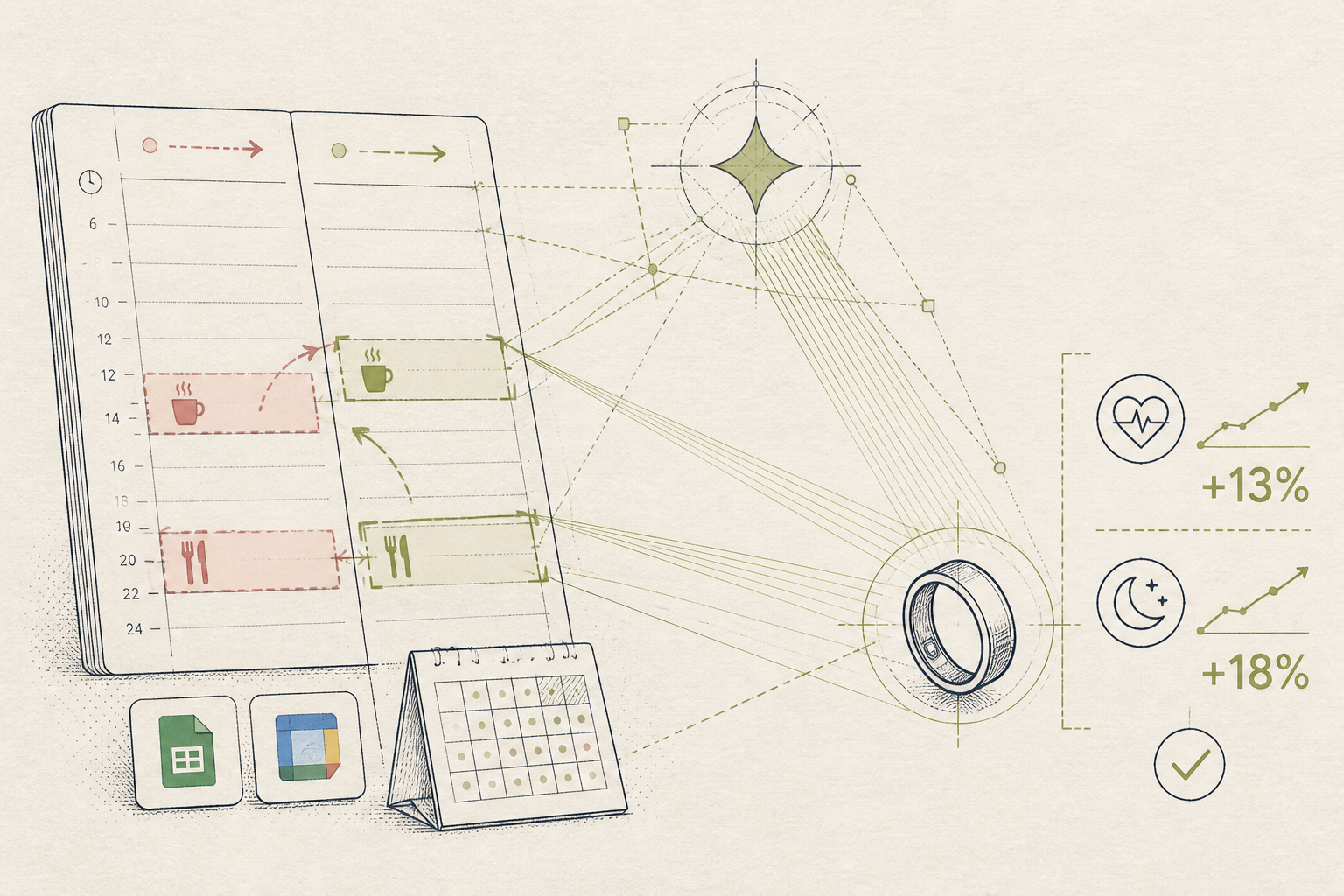
What the AI found
“By shifting your client's last caffeine intake to before 2 PM and last meal to before 7 PM, their average nightly HRV increased by 13% and deep sleep duration by 18% over three weeks, observed consistently on four out of five clients where these changes were implemented.”
Before
Ad-hoc client recommendations, inconsistent tracking
After
Quantified impact from targeted, AI-informed advice
The same system, three states — real screens, not a screenshot
| Client A | Sleep Score — various |
| Client B | HRV — manual |
| Client C | Deep Sleep — app only |
| Client D | Caffeine Intake — self-reported |
Prompt
Analyse the attached sleep and dietary log for common patterns impacting HRV and deep sleep. Specifically, examine the timing of caffeine intake and last meal in relation to sleep metrics. Provide specific, measurable insights.
Analyse the attached sleep and dietary log for common patterns impacting HRV and deep sleep. Specifically, examine the timing of caffeine intake and last meal in relation to sleep metrics. Provide specific, measurable insights.
AI
Across the anonymised dataset of your five clients over the past three weeks, a clear pattern emerges: client average nightly HRV increased by 13% and deep sleep duration by 18% on days where last caffeine intake was before 2 PM and the last meal was consumed before 7 PM. This pattern was consistently observed in four out of five clients where these dietary timing changes were implemented.+11.2%
Client A: Avg HRV Anomaly (7-Day)
+15.8%
Client D: Deep Sleep Duration (7-Day)
-9.3 min
Client B: Sleep Onset Latency (7-Day)
One Small Shift, Measurable Sleep Improvement
A small nutrition practice shifted its client’s evening routine to improve heart rate variability during sleep, measured consistently for the first time.
A British nutritionist focused on client wellbeing.
Tools used
The real tools used here — swap any for your own equivalent. Each links to how we’d set it up.
Starting state
Before anything was set up
Historically, client recommendations at this small nutrition practice were based on anecdotal evidence and general guidelines. Tracking client progress, especially for subtle physiological markers like sleep stages and heart rate variability (HRV), was largely manual and inconsistent, relying on self-reported feelings or disparate app data that rarely aligned. This made it challenging to demonstrate concrete improvements from dietary changes beyond subjective accounts.
| Client A | Sleep Score — various |
| Client B | HRV — manual |
| Client C | Deep Sleep — app only |
| Client D | Caffeine Intake — self-reported |
| Client E | Last Meal Time — self-reported |
Working state
Done-for-you, doing its job
To overcome this, the nutritionist began using a dedicated AI assistant to analyse anonymized client data from wearable devices. This involved collating data from various sources into a unified spreadsheet, then using a specific prompt to query the AI about patterns related to sleep and dietary habits. The AI then identified subtle correlations that human review might easily miss.
Prompt
Analyse the attached sleep and dietary log for common patterns impacting HRV and deep sleep. Specifically, examine the timing of caffeine intake and last meal in relation to sleep metrics. Provide specific, measurable insights.
Analyse the attached sleep and dietary log for common patterns impacting HRV and deep sleep. Specifically, examine the timing of caffeine intake and last meal in relation to sleep metrics. Provide specific, measurable insights.
AI
Across the anonymised dataset of your five clients over the past three weeks, a clear pattern emerges: client average nightly HRV increased by 13% and deep sleep duration by 18% on days where last caffeine intake was before 2 PM and the last meal was consumed before 7 PM. This pattern was consistently observed in four out of five clients where these dietary timing changes were implemented.Use case implemented
The finished system, running on its own
With the system implemented, the nutritionist now has a reliable method for tracking and demonstrating the impact of their advice. Each client’s anonymised data is automatically pulled into a central spreadsheet. The AI runs weekly analyses, providing clear, actionable insights that allow the nutritionist to refine recommendations and show clients tangible progress. This systematic approach saves hours of manual review and provides data-backed confidence.
+11.2%
Client A: Avg HRV Anomaly (7-Day)
+15.8%
Client D: Deep Sleep Duration (7-Day)
-9.3 min
Client B: Sleep Onset Latency (7-Day)
What an outside observer would notice
13%
Client HRV Increase
18%
Client Deep Sleep Duration Increase
75%
Reduced Manual Data Review
The stack — build it yourself
A flexible, accessible platform for consolidating diverse data streams without complex integrations.
Ability to quickly process structured data and identify subtle, non-obvious correlations across multiple records.
Provides consistent, accurate data for sleep stages, HRV, and resting heart rate, crucial for insight generation.
Easy for clients to log specific events (caffeine, meals) without introducing friction or requiring new apps.
These are the tools used in this story. Any can be swapped for an equivalent you already trust.
Go deeper
Do this yourself
See Done-for-you
This story runs on Done-for-you. The tools and prompts above are the real build — swap any tool for your own equivalent and follow the same steps.