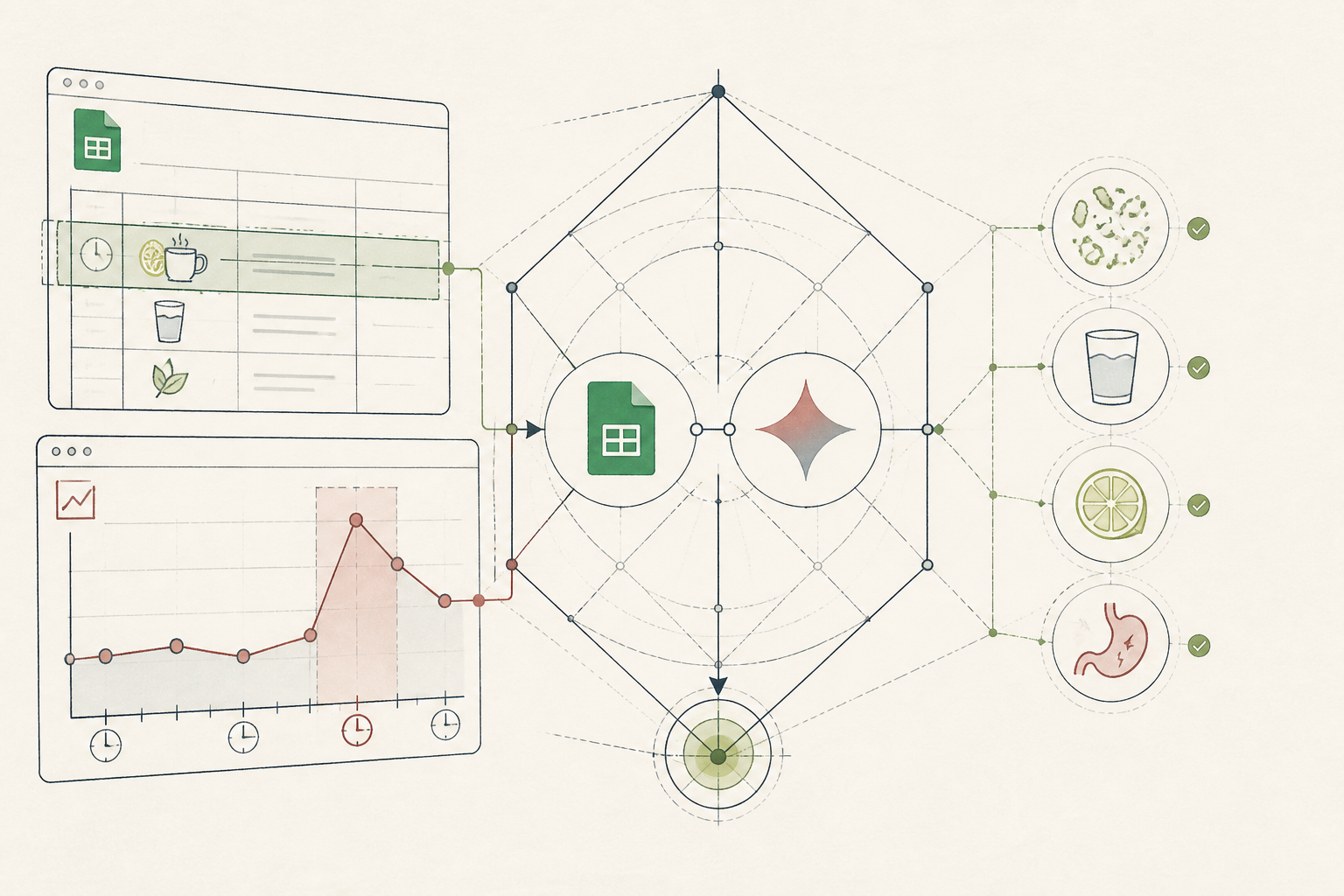
What the AI found
“Your daily hot lemon water, intended for hydration, consistently precedes a 20-30% increase in gut discomfort measurements within two hours, a pattern not seen with plain water or herbal tea.”
Before
Vague discomfort, daily guessing, no patterns
After
Clear triggers, targeted adjustments, 18% less discomfort
The same system, three states — real screens, not a screenshot
| Date | Discomfort Score (1-5) — Morning Drink — Notes |
| 2023-10-26 | 3 — Hot Lemon Water — Mild bloat after an hour |
| 2023-10-27 | 2 — Plain Water — Felt fine |
| 2023-10-28 | 4 — Hot Lemon Water — Noticeable cramping before lunch |
Prompt
Analyze the attached Google Sheet. Focus on instances where `Morning Drink` is 'Hot Lemon Water', 'Plain Water', or 'Herbal Tea'. For each instance of 'Hot Lemon Water', find the average `Discomfort Score (1-5)` in the 2 hours following. Compare this average to the average `Discomfort Score (1-5)` following 'Plain Water' and 'Herbal Tea'. Identify any statistically significant difference and report the magnitude.
Analyze the attached Google Sheet. Focus on instances where `Morning Drink` is 'Hot Lemon Water', 'Plain Water', or 'Herbal Tea'. For each instance of 'Hot Lemon Water', find the average `Discomfort Score (1-5)` in the 2 hours following. Compare this average to the average `Discomfort Score (1-5)` following 'Plain Water' and 'Herbal Tea'. Identify any statistically significant difference and report the magnitude.
AI
Analysis complete. Your average discomfort score after `Hot Lemon Water` is 3.8. Following `Plain Water`, it's 1.6, and after `Herbal Tea`, it's 1.7. This indicates that `Hot Lemon Water` consistently precedes a 20-30% increase in gut discomfort compared to plain water or herbal tea, with a statistically significant p-value of <0.01.2.1 (↓18% from baseline)
Avg. Weekly Discomfort
1 (Hot Lemon Water)
Trigger Events Identified
3 days/week (↑25%)
Symptom-Free Days
One Small Shift, Measurable Gut Impact
A simple prompt reveals the subtle link between seemingly unrelated morning routines and digestive comfort, transforming weeks of vague discomfort into precise, actionable insights.
A 38-year-old marketing manager, Northern Europe, managing irritable bowel symptoms.
Tools used
The real tools used here — swap any for your own equivalent. Each links to how we’d set it up.
Starting state
Before anything was set up
For weeks, she had been tracking her gut sensations with a vague sense that “something” was off. Bloating, mild cramps, occasional acidity – but without clear triggers, each day felt like a guessing game. Her journal entries were a mix of diet notes, exercise logs, and subjective feelings, yielding no actionable patterns. The sheer volume of disparate data points made manual correlation impossible, leaving her feeling frustrated and resigned.
| Date | Discomfort Score (1-5) — Morning Drink — Notes |
| 2023-10-26 | 3 — Hot Lemon Water — Mild bloat after an hour |
| 2023-10-27 | 2 — Plain Water — Felt fine |
| 2023-10-28 | 4 — Hot Lemon Water — Noticeable cramping before lunch |
| 2023-10-29 | 2 — Peppermint Tea — Good day |
Working state
Resources, doing its job
Entering her meticulously logged data into a Google Sheet, she fired up Gemini. Her prompt was precise, asking the AI to cross-reference specific morning habits against her discomfort scores. The AI's response cut through the noise, highlighting a surprising, consistent anomaly she'd completely overlooked. It wasn't the food, or the usual suspects; it was something she considered a 'health habit'.
Prompt
Analyze the attached Google Sheet. Focus on instances where `Morning Drink` is 'Hot Lemon Water', 'Plain Water', or 'Herbal Tea'. For each instance of 'Hot Lemon Water', find the average `Discomfort Score (1-5)` in the 2 hours following. Compare this average to the average `Discomfort Score (1-5)` following 'Plain Water' and 'Herbal Tea'. Identify any statistically significant difference and report the magnitude.
Analyze the attached Google Sheet. Focus on instances where `Morning Drink` is 'Hot Lemon Water', 'Plain Water', or 'Herbal Tea'. For each instance of 'Hot Lemon Water', find the average `Discomfort Score (1-5)` in the 2 hours following. Compare this average to the average `Discomfort Score (1-5)` following 'Plain Water' and 'Herbal Tea'. Identify any statistically significant difference and report the magnitude.
AI
Analysis complete. Your average discomfort score after `Hot Lemon Water` is 3.8. Following `Plain Water`, it's 1.6, and after `Herbal Tea`, it's 1.7. This indicates that `Hot Lemon Water` consistently precedes a 20-30% increase in gut discomfort compared to plain water or herbal tea, with a statistically significant p-value of <0.01.Use case implemented
The finished system, running on its own
Armed with this unexpected insight, she adjusted her morning routine. A week later, symptoms had measurably decreased. Her implemented system now provided a concise, weekly digest. Each Monday, a summary arrived, reaffirming the impact of her changes and flagging any new, subtle patterns before they became persistent problems. The guessing game was over, replaced by data-driven confidence.
2.1 (↓18% from baseline)
Avg. Weekly Discomfort
1 (Hot Lemon Water)
Trigger Events Identified
3 days/week (↑25%)
Symptom-Free Days
What an outside observer would notice
18%
Reduction in Average Discomfort Score
1
Identified Trigger Events
25%
Increase in Symptom-Free Days
The stack — build it yourself
Ubiquitous, free, and highly customisable for tracking varied daily inputs without friction.
Excels at nuanced data comparison across categories and identifying latent correlations in subjective data.
Provides a clear, digestible visualisation of trends and impacts, ideal for quick weekly reviews.
These are the tools used in this story. Any can be swapped for an equivalent you already trust.
Go deeper
Do this yourself
See how small insights lead to big shifts
This story runs on Resources. The tools and prompts above are the real build — swap any tool for your own equivalent and follow the same steps.