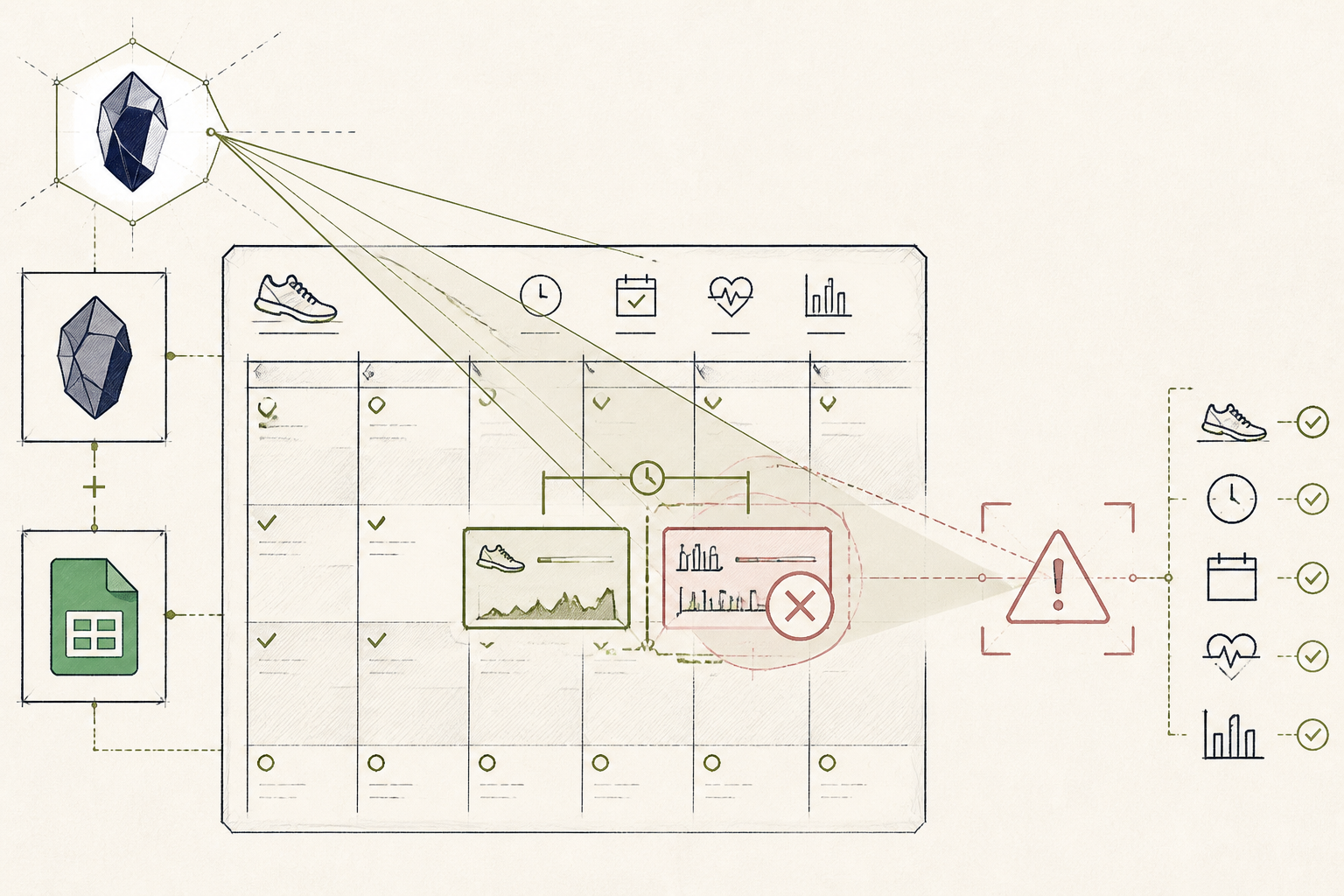
What the AI found
“Your most frequent cause of missed training days is a long run followed by an intense workout within 48 hours, accounting for 60% of cancellations.”
Before
Inconsistent training, frequent cancellations
After
Two simple rules, 30% more running days
The same system, three states — real screens, not a screenshot
| 10/03/24 | Run | 8km | Easy | 45min |
| 11/03/24 | Gym | Strength | Legs | 60min |
| 12/03/24 | Rest |
| 13/03/24 | Run | 5km | Tempo | 30min |
Prompt
Analyse my training log data for the last 8 weeks. Identify any recurring patterns or specific sequences of activity that frequently precede a 'Skipped' or 'Cancelled' training day. Quantify the frequency of these patterns.
Analyse my training log data for the last 8 weeks. Identify any recurring patterns or specific sequences of activity that frequently precede a 'Skipped' or 'Cancelled' training day. Quantify the frequency of these patterns.
AI
Reviewing your data, the most common precursor to a 'Skipped' or 'Cancelled' day (accounting for 60% of such instances) is an intense gym session or high-intensity interval training (HIIT) scheduled within 48 hours of a long run (12km+). This pattern has occurred 9 times in the last 8 weeks.4.2 (+0.9)
Training Days Per Week (Avg)
1.5 (-3.0)
Skipped Sessions (Monthly Avg)
0
Long Runs Missed
One simple rule changes everything for a runner
A personal AI spots a hidden pattern, transforming inconsistent training into steady progress.
A 38-year-old hobby runner, Northern Europe
Tools used
The real tools used here — swap any for your own equivalent. Each links to how we’d set it up.
Starting state
Before anything was set up
Before implementing his personal AI, our runner found his training highly inconsistent. Despite a genuine desire to improve, good intentions often dissolved into skipped sessions, minor niggles, or general fatigue. He diligently logged his runs and gym sessions in a spreadsheet, but the sheer volume of data made it impossible to discern any meaningful patterns or underlying causes for his frequent cancellations. The cycle was demotivating: plan, start strong, falter, repeat.
| 10/03/24 | Run | 8km | Easy | 45min |
| 11/03/24 | Gym | Strength | Legs | 60min |
| 12/03/24 | Rest |
| 13/03/24 | Run | 5km | Tempo | 30min |
| 14/03/24 | Skipped | Fatigue |
Working state
Membership, doing its job
His personal AI, embedded in his existing notes app, began analysing his training logs. He prompted it to identify recurring factors contributing to missed sessions. The AI processed weeks of data, cross-referencing run intensity, workout types, and subsequent cancellations. The key was to provide his actual, raw data and ask for an unbiased, data-driven assessment. The system worked quietly in the background, making connections a human eye would easily miss across numerous entries.
Prompt
Analyse my training log data for the last 8 weeks. Identify any recurring patterns or specific sequences of activity that frequently precede a 'Skipped' or 'Cancelled' training day. Quantify the frequency of these patterns.
Analyse my training log data for the last 8 weeks. Identify any recurring patterns or specific sequences of activity that frequently precede a 'Skipped' or 'Cancelled' training day. Quantify the frequency of these patterns.
AI
Reviewing your data, the most common precursor to a 'Skipped' or 'Cancelled' day (accounting for 60% of such instances) is an intense gym session or high-intensity interval training (HIIT) scheduled within 48 hours of a long run (12km+). This pattern has occurred 9 times in the last 8 weeks.Use case implemented
The finished system, running on its own
With the core insight in hand, our runner implemented two simple rules: always follow a long run with two low-intensity days, and never schedule an intense gym session within 48 hours of a long run. This small adjustment, driven by his AI's observation, led to a significant increase in training consistency. He now approaches his week with clarity, reducing decision fatigue and improving his adherence to his overall plan, leading to sustained, injury-free progress. The AI now periodically reviews new data to ensure the rules remain optimal.
4.2 (+0.9)
Training Days Per Week (Avg)
1.5 (-3.0)
Skipped Sessions (Monthly Avg)
0
Long Runs Missed
What an outside observer would notice
Increased by 30%
Training consistency
Significantly reduced
Decision fatigue
Improved
Training enjoyment
The stack — build it yourself
Chosen for its flexible note-taking, local data storage, and robust plugin ecosystem that allows for seamless AI integration.
Used for its familiarity and ease of structured data entry, providing a consistent source of raw training information.
This AI operates as an integrated agent, providing pattern recognition and statistical analysis without requiring data export or a separate application.
These are the tools used in this story. Any can be swapped for an equivalent you already trust.
Go deeper
Do this yourself
See Membership
This story runs on Membership. The tools and prompts above are the real build — swap any tool for your own equivalent and follow the same steps.