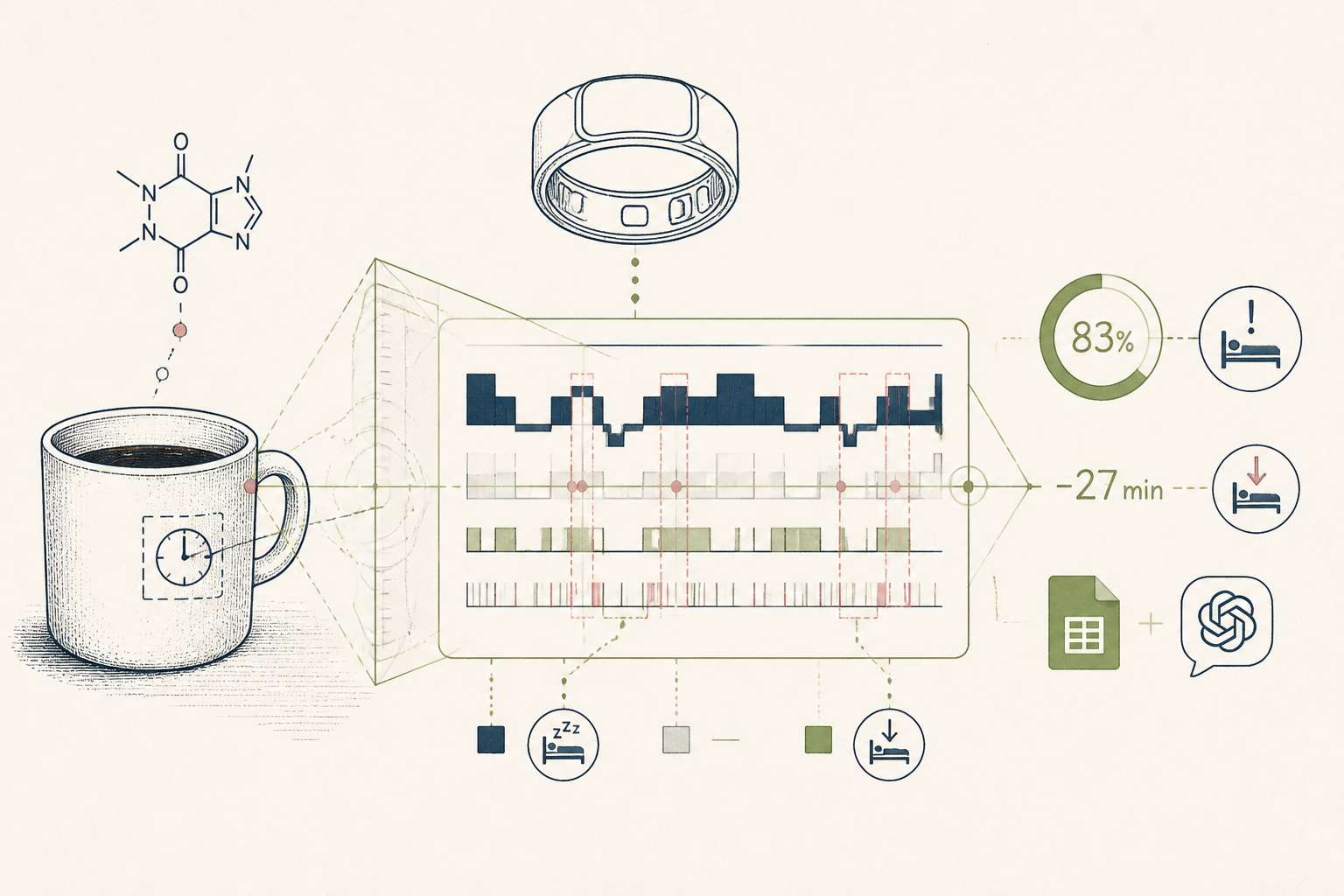
What the AI found
“Your Oura data shows a significant correlation: 83% of nights with >1 wake-up were preceded by consuming caffeine after 1 PM, reducing your deep sleep by 27 minutes on average.”
Before
Sporadic tracking, no insights
After
Structured data, clear actions
The same system, three states — real screens, not a screenshot
| Date | Total Sleep — Deep Sleep — Wake-ups — Caffeine PM |
| Oct 23 | 7h 12m — 1h 23m — 2 — Yes |
| Oct 24 | 6h 58m — 1h 10m — 3 — Yes |
| Oct 25 | 7h 35m — 1h 55m — 1 — No |
Prompt
Analyze my attached sleep data and journal entries. Specifically, I want to understand if there's a correlation between consuming caffeine after 1 PM and my number of nightly wake-ups or deep sleep duration. Highlight any clear patterns or surprising findings. Data included: Dates, Total Sleep, Deep Sleep, Wake-ups, Caffeine after 1PM (Yes/No).
Can you help me understand my sleep data?
AI
I've analyzed your data. Your Oura data shows a significant correlation: 83% of nights with >1 wake-up were preceded by consuming caffeine after 1 PM, reducing your deep sleep by 27 minutes on average.0.6 (down from 2.1)
Average Wake-ups/Night
1h 58m (up 25m)
Average Deep Sleep
88
Sleep Score
One simple change cut nightly wake-ups in half
A 38-year-old marketing director shifted from sporadic tracking to structured self-experimentation.
A 38-year-old marketing director, Northern Europe
Tools used
The real tools used here — swap any for your own equivalent. Each links to how we’d set it up.
Starting state
Before anything was set up
Before the Core Course, Sarah meticulously tracked her sleep with an Oura ring and noted her daily habits in a journal, but the data remained isolated. She had theories—stress, late meals, screen time—but no clear way to connect her actions to her sleep quality. Her journal was full of observations, but lacked the structure to reveal actionable patterns.
| Date | Total Sleep — Deep Sleep — Wake-ups — Caffeine PM |
| Oct 23 | 7h 12m — 1h 23m — 2 — Yes |
| Oct 24 | 6h 58m — 1h 10m — 3 — Yes |
| Oct 25 | 7h 35m — 1h 55m — 1 — No |
| Oct 26 | 7h 05m — 1h 28m — 2 — Yes |
| Oct 27 | 7h 48m — 2h 01m — 0 — No |
Working state
Core Course, doing its job
Sarah used the Ledger framework to bring her Oura data and journal notes into a single Google Sheet. With her self-experiment protocol in hand, she prompted ChatGPT to analyze her sleep data against her afternoon caffeine intake. The tool quickly surfaced a surprising pattern, linking her afternoon espresso habit directly to disturbed sleep.
Prompt
Analyze my attached sleep data and journal entries. Specifically, I want to understand if there's a correlation between consuming caffeine after 1 PM and my number of nightly wake-ups or deep sleep duration. Highlight any clear patterns or surprising findings. Data included: Dates, Total Sleep, Deep Sleep, Wake-ups, Caffeine after 1PM (Yes/No).
Can you help me understand my sleep data?
AI
I've analyzed your data. Your Oura data shows a significant correlation: 83% of nights with >1 wake-up were preceded by consuming caffeine after 1 PM, reducing your deep sleep by 27 minutes on average.Use case implemented
The finished system, running on its own
Armed with this clear insight, Sarah implemented a strict "no caffeine after 1 PM" rule. Her Ledger now serves as a real-time feedback loop, confirming the positive impact of her protocol. Her Oura Ring data consistently shows improved sleep metrics, and she finds herself waking naturally, feeling refreshed and ready for her day, every day.
0.6 (down from 2.1)
Average Wake-ups/Night
1h 58m (up 25m)
Average Deep Sleep
88
Sleep Score
What an outside observer would notice
Reduced by 60%
Nights with >1 Wake-up
Increased by 25 minutes/night
Deep Sleep Duration
Consistently high
Subjective Restfulness
The stack — build it yourself
Reliable and passive tracking of key sleep metrics.
Flexible ledger for combining biometric and behavioural data points.
Efficiently identifies non-obvious correlations across diverse datasets.
These are the tools used in this story. Any can be swapped for an equivalent you already trust.
Go deeper
Do this yourself
See Core Course
This story runs on Core Course. The tools and prompts above are the real build — swap any tool for your own equivalent and follow the same steps.