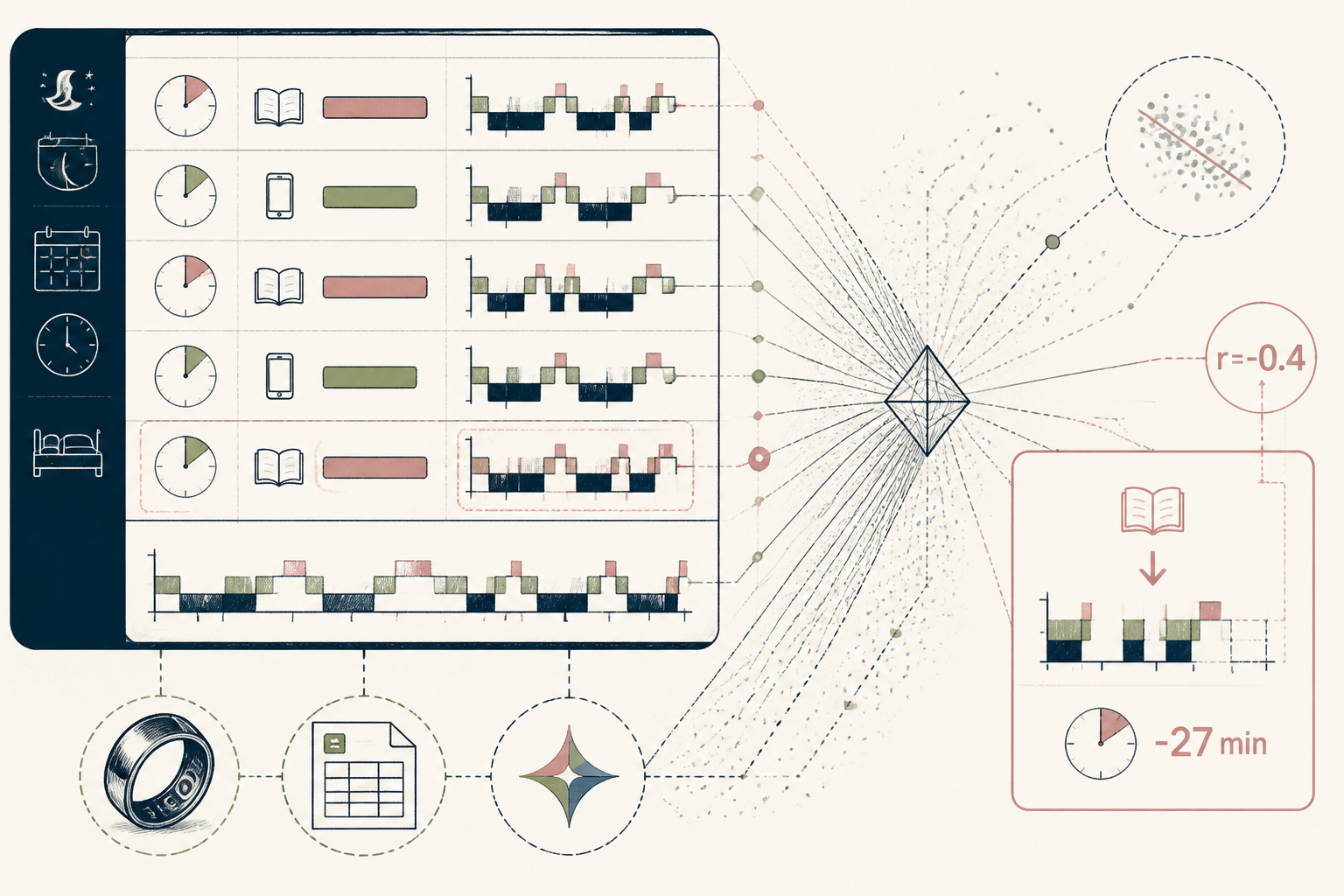
What the AI found
“AI: 'Your deep sleep correlation with evening screen time is unexpectedly low (r=0.15). Instead, a moderate inverse correlation (r=-0.4) exists with active reading post-21:00, reducing deep sleep by an average of 27 minutes.'”
Before
Assumed screen time was the sleep thief
After
Optimised wind-down for deeper rest
The same system, three states — real screens, not a screenshot
| Date | Deep Sleep (min) — Evening Activity |
| 01/10 | 78 — Reading (late) |
| 02/10 | 92 — Screen (TV) |
| 03/10 | 85 — Gentle walk |
Prompt
Analyse the attached sleep and activity data. Specifically, examine the correlation between "deep sleep (minutes)" and evening activities: "screen time (phone/TV)", "reading (post-21:00)", and "light exercise (pre-20:00)". Identify any surprising or counter-intuitive relationships with deep sleep duration and quantify the impact.
Analyse the attached sleep and activity data. Specifically, examine the correlation between "deep sleep (minutes)" and evening activities: "screen time (phone/TV)", "reading (post-21:00)", and "light exercise (pre-20:00)". Identify any surprising or counter-intuitive relationships with deep sleep duration and quantify the impact.
AI
Your deep sleep correlation with evening screen time is unexpectedly low (r=0.15). Instead, a moderate inverse correlation (r=-0.4) exists with active reading post-21:00, reducing deep sleep by an average of 27 minutes. Light exercise showed a slight positive correlation (r=0.2) when completed before 20:00.118 min
Avg. Deep Sleep (last 7 days)
91 min
Avg. Deep Sleep (prev. 7 days)
0 nights
Reading post-21:00
One Simple Change: A Daily Habit Shift for Deeper Sleep
A 53-year-old EU executive re-prioritised her evening routine, boosting deep sleep by 27 minutes on average.
A 53-year-old executive and avid reader, EU
Tools used
The real tools used here — swap any for your own equivalent. Each links to how we’d set it up.
Starting state
Before anything was set up
Eleanor suspected her phone was disrupting her sleep. She'd track her sleep with her Oura ring, noting the fluctuating deep sleep numbers, but couldn't pinpoint a clear cause. She tried to limit screen time before bed, but felt it made little difference. The real culprits remained hidden, lost in weeks of disparate data points spread across her Oura app and a mental log of evening activities. She needed a clearer picture, something beyond gut feeling or anecdotal evidence, to make a meaningful change.
| Date | Deep Sleep (min) — Evening Activity |
| 01/10 | 78 — Reading (late) |
| 02/10 | 92 — Screen (TV) |
| 03/10 | 85 — Gentle walk |
| 04/10 | 60 — Reading (late) |
| 05/10 | 95 — Screen (phone) |
Working state
Setup, doing its job
Eleanor exported two months of Oura sleep data and her evening activity notes into a Google Sheet. She then prompted Gemini with a specific query, asking it to cross-reference her deep sleep metrics with various evening habits she’d tracked – screen time, reading, light exercise. She provided the raw data, allowing the AI to identify non-obvious correlations that a manual review would almost certainly miss, or misinterpret.
Prompt
Analyse the attached sleep and activity data. Specifically, examine the correlation between "deep sleep (minutes)" and evening activities: "screen time (phone/TV)", "reading (post-21:00)", and "light exercise (pre-20:00)". Identify any surprising or counter-intuitive relationships with deep sleep duration and quantify the impact.
Analyse the attached sleep and activity data. Specifically, examine the correlation between "deep sleep (minutes)" and evening activities: "screen time (phone/TV)", "reading (post-21:00)", and "light exercise (pre-20:00)". Identify any surprising or counter-intuitive relationships with deep sleep duration and quantify the impact.
AI
Your deep sleep correlation with evening screen time is unexpectedly low (r=0.15). Instead, a moderate inverse correlation (r=-0.4) exists with active reading post-21:00, reducing deep sleep by an average of 27 minutes. Light exercise showed a slight positive correlation (r=0.2) when completed before 20:00.Use case implemented
The finished system, running on its own
Based on Gemini's insights, Eleanor shifted her evening reading earlier and introduced a short, reflective journaling practice post-21:00. Her Oura ring data now consistently shows an increase in deep sleep duration. A weekly check-in with a simplified dashboard in Google Sheets confirms the sustained positive trend, turning a vague suspicion into a data-driven, actionable habit that enhances her restorative sleep.
118 min
Avg. Deep Sleep (last 7 days)
91 min
Avg. Deep Sleep (prev. 7 days)
0 nights
Reading post-21:00
What an outside observer would notice
27 minutes
Increase in average deep sleep
80%
Reduced late-night reading
12 minutes faster
Improved sleep onset latency
The stack — build it yourself
Provides accurate, passive deep sleep data without daily interaction.
Accessible, free, and robust enough for simple data aggregation and dashboarding.
Its ability to identify non-obvious correlations in textual and numerical data was crucial.
These are the tools used in this story. Any can be swapped for an equivalent you already trust.
Go deeper
Do this yourself
Read the full story: One Simple Change
This story runs on Setup. The tools and prompts above are the real build — swap any tool for your own equivalent and follow the same steps.