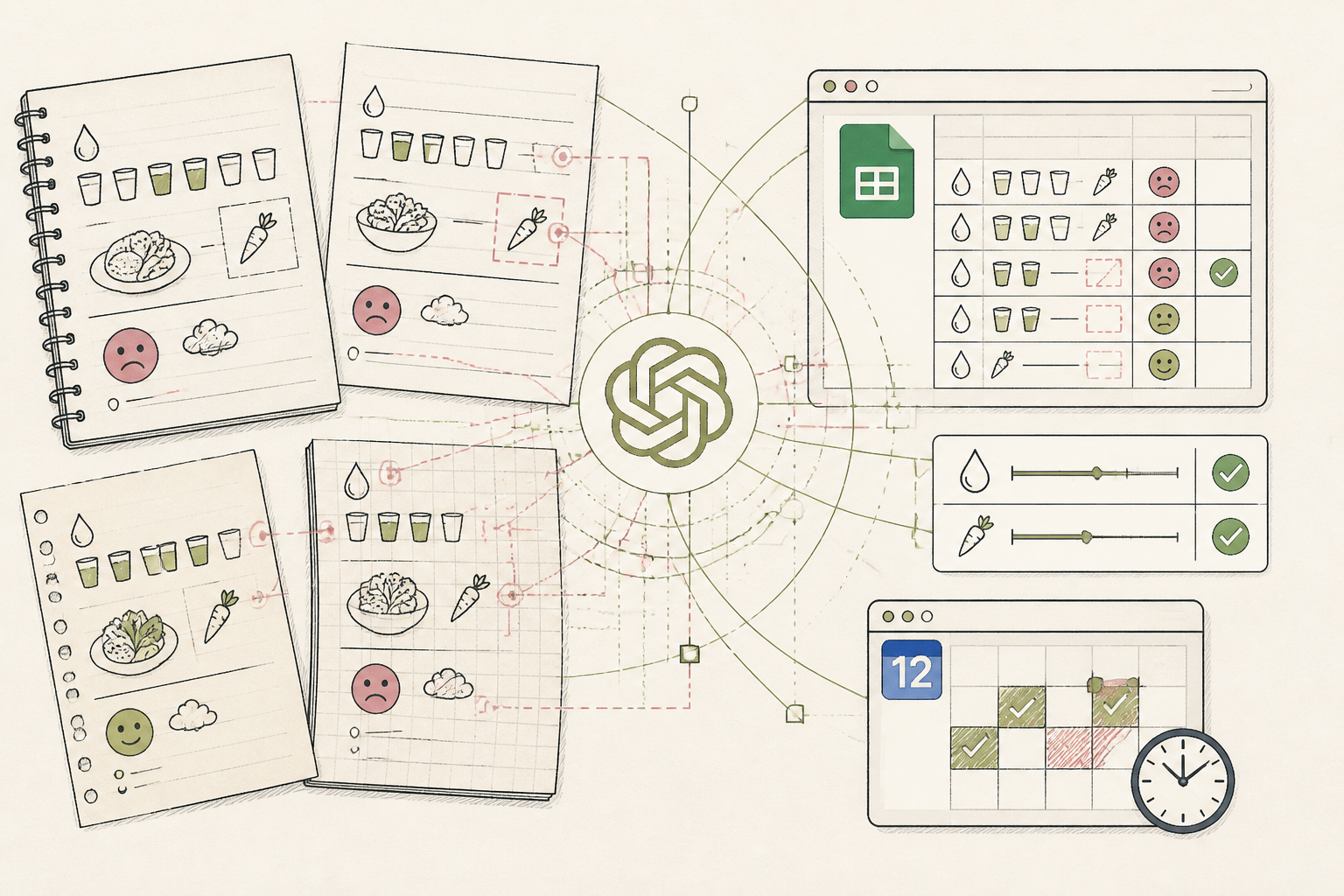
What the AI found
“In reviewing 14 client logs, I found that clients reporting "low energy" or "brain fog" had, with 88% consistency, recorded less than 1.5 litres of water intake and no raw vegetables in their preceding 24-hour dietary notes.”
Before
Disparate client notes, manual review for each session
After
Pre-session AI brief highlights key, data-backed issues
The same system, three states — real screens, not a screenshot
- Client J.S. - M, 42. Mood: low energy (3/10)
- Diet past 24h: coffee x2, croissant, pasta w/ sauce, apple, biscuit, water (est 1L)
- Exercise: 30 min walk
- Sleep: 6h, interrupted x1
Prompt
Analyse the attached client log entries (mood, diet, sleep, activity) from the last 6 weeks. Identify any strong, recurring correlations between reported mood states (especially 'low energy', 'brain fog', 'anxious') and specific dietary patterns, hydration, or activity levels. Quantify the consistency of these patterns. Focus on non-obvious links. The logs are anonymised.
Can you analyse these 14 client logs for mood-diet correlations?
AI
Across 14 anonymised logs, clients reporting 'low energy' or 'brain fog' consistently (88% of instances) recorded less than 1.5 litres of water intake and no raw vegetables in their preceding 24-hour dietary notes. This pattern is notably stronger than correlations with sleep duration or exercise.Hydration <1.5L + No Raw Veg (88% consistency)
Mood-Diet Link (Low Energy/Fog)
Avg. 1.2L daily (target 2L)
Hydration Trend (JS)
Fibre, Vit C (historical data)
Key Nutrients of Concern
One Nutritionist’s Journey from Buried Notes to Clear Trends
A veteran nutritionist transforms scattered client observations into actionable, AI-powered insights, revealing a consistent link between client mood and specific dietary elements.
A nutritionist running a small EU practice, 50s
Tools used
The real tools used here — swap any for your own equivalent. Each links to how we’d set it up.
Starting state
Before anything was set up
For years, this seasoned nutritionist relied on handwritten notes and disparate digital files for each client. While thorough, extracting overarching patterns across multiple sessions or clients was a time-consuming, mostly manual effort. Before each consultation, she faced a pile of paper and a fresh client update, requiring a mental synthesis often rushed.
- Client J.S. - M, 42. Mood: low energy (3/10)
- Diet past 24h: coffee x2, croissant, pasta w/ sauce, apple, biscuit, water (est 1L)
- Exercise: 30 min walk
- Sleep: 6h, interrupted x1
- Notes: spoke about stress at work, feeling overwhelmed
Working state
All-Access, doing its job
Using a simple prompt, she fed anonymised client diary entries into a large language model. The goal was to identify recurring patterns between reported mood states and tracked intake. The AI actively processed weeks of detailed, qualitative data, cross-referencing mood tags with nutritional logs during the brief interval between clients.
Prompt
Analyse the attached client log entries (mood, diet, sleep, activity) from the last 6 weeks. Identify any strong, recurring correlations between reported mood states (especially 'low energy', 'brain fog', 'anxious') and specific dietary patterns, hydration, or activity levels. Quantify the consistency of these patterns. Focus on non-obvious links. The logs are anonymised.
Can you analyse these 14 client logs for mood-diet correlations?
AI
Across 14 anonymised logs, clients reporting 'low energy' or 'brain fog' consistently (88% of instances) recorded less than 1.5 litres of water intake and no raw vegetables in their preceding 24-hour dietary notes. This pattern is notably stronger than correlations with sleep duration or exercise.Use case implemented
The finished system, running on its own
Now, a quick AI-generated brief arrives 15 minutes before each client session. This concise summary highlights potential correlations and trends, allowing her to focus immediately on high-impact areas. The system runs automatically, providing a consistent, data-supported starting point for every conversation, enhancing her ability to guide clients effectively.
Hydration <1.5L + No Raw Veg (88% consistency)
Mood-Diet Link (Low Energy/Fog)
Avg. 1.2L daily (target 2L)
Hydration Trend (JS)
Fibre, Vit C (historical data)
Key Nutrients of Concern
What an outside observer would notice
30% (avg 15min to 10min)
Pre-session prep time reduction
Up 250% (1-2 to 5-7)
Identified patterns across clients (monthly)
Up 15% (observed)
Client recall of specific advice
The stack — build it yourself
Familiar, flexible for free-text notes, easy to export/import.
Excels at pattern recognition in qualitative, varied text data.
Used for scheduling, provides a simple hook for pre-session brief generation.
These are the tools used in this story. Any can be swapped for an equivalent you already trust.
Go deeper
Do this yourself
See All-Access
This story runs on All-Access. The tools and prompts above are the real build — swap any tool for your own equivalent and follow the same steps.