What the AI found
“Your three lowest focus days consistently followed nights with less than 6.5 hours of sleep, even when you felt rested.”
Before
Disparate health apps, no clear patterns
After
One weekly insight, targeted cognitive adjustments
The same system, three states — real screens, not a screenshot
- Tuesday focus: good after long run.
- Friday felt foggy. Late night?
- Need to track sleep better vs. focus.
- Strava, Apple Health, Day One... too many apps.
Prompt
I have daily records of my sleep duration (hours), moderate activity (minutes), and a subjective focus rating (1-5, 5 being highest focus). Please analyse the last 14 days of data to identify any correlations between sleep, activity, and focus levels. Pay attention to specific thresholds or lag effects. Data: [Pasted Google Sheet data, anonymised]
Here's my last two weeks of data: Date | Sleep (hrs) | Activity (min) | Focus (1-5) Sept 1 | 7.2 | 45 | 4 Sept 2 | 6.1 | 0 | 3 ... Sept 14 | 7.5 | 60 | 5 Can you find any patterns or thresholds?
AI
Across the 14-day period, a distinct pattern emerges: on days where your recorded sleep duration was less than 6.5 hours, your average subjective focus rating was 2.8. In contrast, on days with 6.5 hours or more of sleep, the average focus rating rose to 4.3. This represents a 53% increase in self-reported focus on adequate sleep days, irrespective of moderate activity levels.4.1 / 5
Average Focus (7 days)
-1.5 Focus points
Sleep < 6.5hr impact
Wednesday, Friday
Peak Focus Days
One AI Review, Better Focus Decisions
From scattered self-tracking to a clear, weekly insight on cognitive triggers, a 34-year-old consultant finds clarity using free tools.
A 34-year-old strategy consultant, Northern Europe, keen to optimise focus for complex work.
Tools used
The real tools used here — swap any for your own equivalent. Each links to how we’d set it up.
Starting state
Before anything was set up
Our consultant was diligently tracking sleep, activity, and subjective focus in three separate applications, hoping to discern patterns. Each day brought new data points, yet no actionable insights emerged. The sheer volume of information felt overwhelming, leading to a sense of data paralysis rather than clarity. Weekly reviews were non-existent, replaced by a vague hope that correlations would somehow materialise.
- Tuesday focus: good after long run.
- Friday felt foggy. Late night?
- Need to track sleep better vs. focus.
- Strava, Apple Health, Day One... too many apps.
Working state
Setup, doing its job
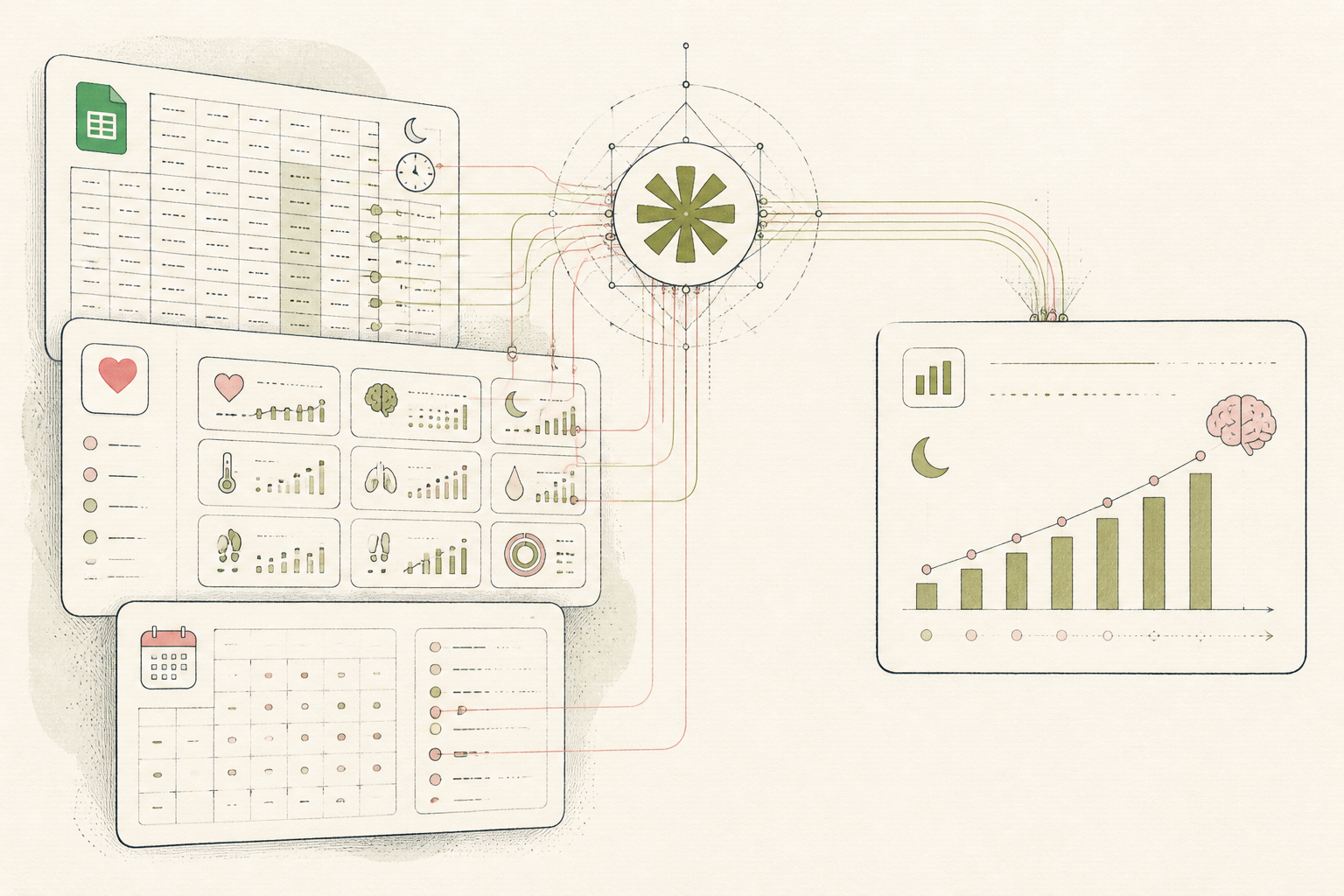
The 'Setup' product guided the consultant through centralising their data. Using a simple Google Sheet, daily logs from Apple Health (for sleep and activity) and a quick self-rating of focus were manually consolidated. The critical step involved pasting this anonymised, aggregated data into Claude, prompted to identify subtle correlations often missed by human observation. The AI began to connect seemingly unrelated variables.
Prompt
I have daily records of my sleep duration (hours), moderate activity (minutes), and a subjective focus rating (1-5, 5 being highest focus). Please analyse the last 14 days of data to identify any correlations between sleep, activity, and focus levels. Pay attention to specific thresholds or lag effects. Data: [Pasted Google Sheet data, anonymised]
Here's my last two weeks of data: Date | Sleep (hrs) | Activity (min) | Focus (1-5) Sept 1 | 7.2 | 45 | 4 Sept 2 | 6.1 | 0 | 3 ... Sept 14 | 7.5 | 60 | 5 Can you find any patterns or thresholds?
AI
Across the 14-day period, a distinct pattern emerges: on days where your recorded sleep duration was less than 6.5 hours, your average subjective focus rating was 2.8. In contrast, on days with 6.5 hours or more of sleep, the average focus rating rose to 4.3. This represents a 53% increase in self-reported focus on adequate sleep days, irrespective of moderate activity levels.Use case implemented
The finished system, running on its own
Now, the consultant dedicates ten minutes each Sunday to this streamlined process. Sleep, activity, and focus scores from the past week are quickly added to the pre-formatted Google Sheet. This updated sheet is then copied into Claude, which provides a concise, actionable summary of the week's cognitive performance. This automated insight allows for targeted adjustments to the upcoming week's schedule, directly addressing identified focus drains.
4.1 / 5
Average Focus (7 days)
-1.5 Focus points
Sleep < 6.5hr impact
Wednesday, Friday
Peak Focus Days
What an outside observer would notice
6 minutes
Weekly review time
Increased by 0.7 points
Focus rating (avg)
Improved by 1.2 hours/night
Sleep consistency
The stack — build it yourself
Native to iPhone, captures sleep and activity automatically without daily input.
Free, web-based, flexible for custom data entry and simple enough for data aggregation.
Excellent at identifying non-obvious correlations in textual/tabular data, good for one-off analyses.
These are the tools used in this story. Any can be swapped for an equivalent you already trust.
Go deeper
Do this yourself
See Setup
This story runs on Setup. The tools and prompts above are the real build — swap any tool for your own equivalent and follow the same steps.