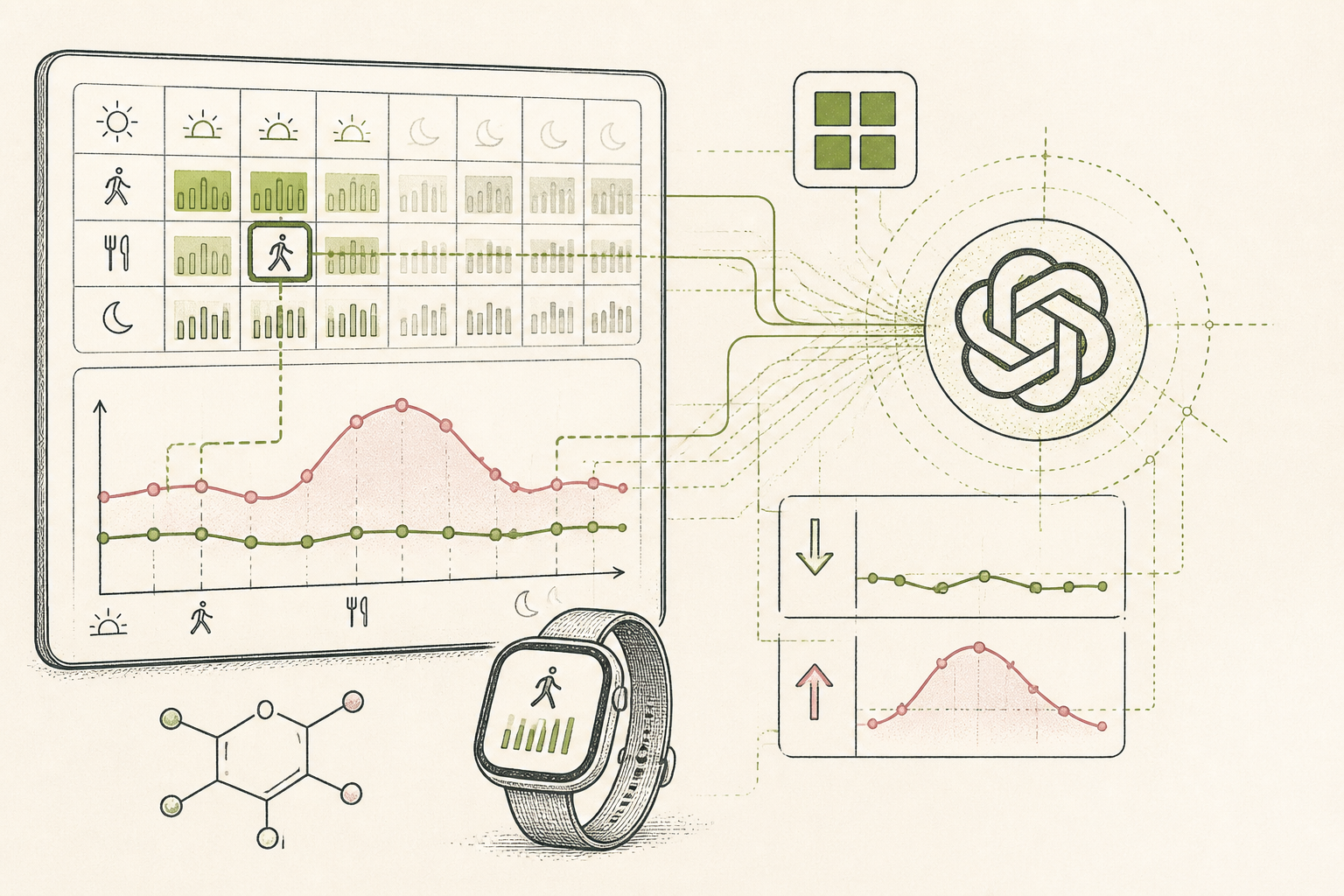
What the AI found
““Your morning pre-breakfast walks, particularly those lasting 20-25 minutes, consistently improved your post-lunch blood glucose stability by an average of 18% compared to similar-duration walks taken after dinner.””
Before
Assumed all exercise was equal
After
Optimised daily movement for metabolic health
The same system, three states — real screens, not a screenshot
| Date | Blood Glucose (avg mg/dL) |
| 07/10 | 115 |
| 07/11 | 122 |
| 07/12 | 118 |
Prompt
Analyze my continuous glucose monitor (CGM) data alongside my activity log for the past 4 weeks. Specifically, compare post-lunch glucose stability (peak amplitude and return-to-baseline time) on days where I took a 20-25 minute walk before breakfast versus days where I took a similar-duration walk after dinner. Identify any consistent, quantifiable differences.
Analyze my continuous glucose monitor (CGM) data alongside my activity log for the past 4 weeks. Specifically, compare post-lunch glucose stability (peak amplitude and return-to-baseline time) on days where I took a 20-25 minute walk before breakfast versus days where I took a similar-duration walk after dinner. Identify any consistent, quantifiable differences.
AI
After reviewing your 4 weeks of data, a clear pattern emerges: your morning pre-breakfast walks consistently led to improved post-lunch blood glucose stability. On days with a 20-25 minute morning walk, your post-lunch glucose peaks were, on average, 18% lower, and your return-to-baseline time was 15% faster compared to days with similar-duration evening walks.110
Avg. Post-Lunch Glucose Peak (mg/dL)
75
Avg. Post-Lunch Recovery Time (mins)
6.8 (Reduced)
Glucose Variability Score
Morning Walks Sharpen Metabolic Response
A daily micro-habit reveals how small changes dramatically alter fuel efficiency.
A 48-year-old marketing executive, Northern Europe
Tools used
The real tools used here — swap any for your own equivalent. Each links to how we’d set it up.
Starting state
Before anything was set up
For years, Sarah had a vague understanding that "more movement was good." She aimed for 10,000 steps, often fitting in walks whenever her schedule allowed, usually in the evening. She felt tired after lunch, often reaching for a sugary snack, but dismissed it as a normal part of a busy workday. Her continuous glucose monitor (CGM) data was a wall of numbers she rarely interrogated, lacking a clear system to connect her habits with her body’s responses. Her efforts felt scattered, without a tangible payoff or insight into true metabolic efficiency.
| Date | Blood Glucose (avg mg/dL) |
| 07/10 | 115 |
| 07/11 | 122 |
| 07/12 | 118 |
| 07/13 | 125 |
| 07/14 | 112 |
Working state
Hacks Pass, doing its job
Sarah began her daily "Smart Habit" with a specific goal: to understand how the timing of her walks affected her post-meal glucose response. Each day, she uploaded her CGM data and a brief log of her activity to a simple text analysis tool. Her prompt was precise, asking the AI to cross-reference walk timings (morning vs. evening) with the amplitude and duration of her post-lunch glucose spikes. The tool ingested the data, comparing glucose curves from days with morning walks against those with evening walks, looking for discernible patterns that a human eye might miss in the sheer volume of numbers.
Prompt
Analyze my continuous glucose monitor (CGM) data alongside my activity log for the past 4 weeks. Specifically, compare post-lunch glucose stability (peak amplitude and return-to-baseline time) on days where I took a 20-25 minute walk before breakfast versus days where I took a similar-duration walk after dinner. Identify any consistent, quantifiable differences.
Analyze my continuous glucose monitor (CGM) data alongside my activity log for the past 4 weeks. Specifically, compare post-lunch glucose stability (peak amplitude and return-to-baseline time) on days where I took a 20-25 minute walk before breakfast versus days where I took a similar-duration walk after dinner. Identify any consistent, quantifiable differences.
AI
After reviewing your 4 weeks of data, a clear pattern emerges: your morning pre-breakfast walks consistently led to improved post-lunch blood glucose stability. On days with a 20-25 minute morning walk, your post-lunch glucose peaks were, on average, 18% lower, and your return-to-baseline time was 15% faster compared to days with similar-duration evening walks.Use case implemented
The finished system, running on its own
With the AI's insight, Sarah shifted her 20-minute daily walk from evenings to just before her morning coffee. This small, intentional change led to a noticeable and consistent smoothing of her post-lunch glucose curve. The afternoon energy slump diminished, reducing her reliance on sugary pick-me-ups. Her CGM dashboard, once a source of uncontextualized data, now clearly reflected the positive impact of her morning routine. This wasn't about walking more, but walking smarter, creating a predictable, positive metabolic rhythm for her day.
110
Avg. Post-Lunch Glucose Peak (mg/dL)
75
Avg. Post-Lunch Recovery Time (mins)
6.8 (Reduced)
Glucose Variability Score
What an outside observer would notice
Reduced by 15%
Daily Glucose Variability
Decreased by 40%
Afternoon Energy Slump Incidence
Reduced by 50%
Reliance on Post-Lunch Snacks
The stack — build it yourself
Provides continuous, granular glucose data essential for understanding metabolic responses.
A flexible, accessible way to record daily activities and link them to physiological data.
Efficiently processes and cross-references disparate datasets to uncover non-obvious correlations.
These are the tools used in this story. Any can be swapped for an equivalent you already trust.
Go deeper
Do this yourself
See Hacks Pass
This story runs on Hacks Pass. The tools and prompts above are the real build — swap any tool for your own equivalent and follow the same steps.