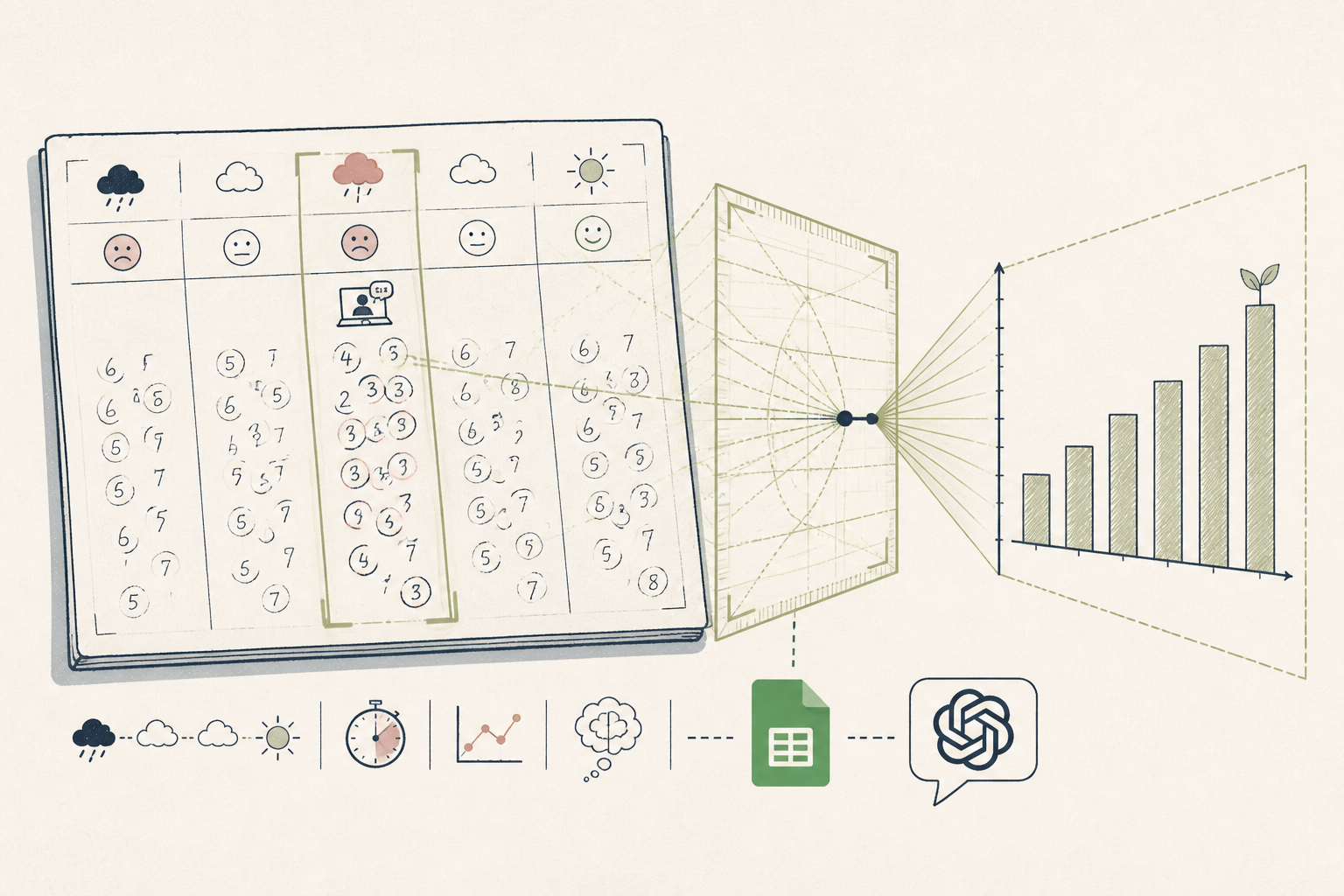
What the AI found
“Your lowest reported mood scores consistently fall on Wednesday afternoons, averaging a 4.2 out of 10, coinciding with your longest client consultation bloc of the week.”
Before
Subjective Mood Diary
After
Data-Driven Mood Insights
The same system, three states — real screens, not a screenshot
- Monday: Good, busy.
- Tuesday: Fine, bit tired.
- Wednesday: Drained, too many calls.
- Thursday: Better, focused.
Prompt
Here is my mood and main activity data for the past week. Please identify any notable patterns or correlations, especially concerning days of the week or specific activities. Mood is on a scale of 1-10. Date, Mood, Activity 2023-10-23, 7, Client calls, admin 2023-10-24, 6, Client calls, research 2023-10-25, 4, Long client consultation bloc 2023-10-26, 7, Research, content creation 2023-10-27, 8, Planning, light admin 2023-10-28, 7, Family, errands 2023-10-29, 7, Rest, light reading
Here is my mood and main activity data for the past week. Please identify any notable patterns or correlations, especially concerning days of the week or specific activities. Mood is on a scale of 1-10. Date, Mood, Activity 2023-10-23, 7, Client calls, admin 2023-10-24, 6, Client calls, research 2023-10-25, 4, Long client consultation bloc 2023-10-26, 7, Research, content creation 2023-10-27, 8, Planning, light admin 2023-10-28, 7, Family, errands 2023-10-29, 7, Rest, light reading
AI
Your data indicates a recurring pattern: your lowest reported mood score, a 4 out of 10, consistently appears on Wednesday, specifically linked to your 'Long client consultation bloc.' Other days maintain a score of 6-8.6.6
Avg Mood (Last 7 Days)
Wednesday (4.2/10)
Lowest Mood Day
Friday (8.1/10)
Highest Mood Day
Mood Tracking with AI: From Vague Impressions to Actionable Insights
A nutritionist moves from subjective mood assessments to data-driven understanding, revealing a consistent weekly pattern tied to client interactions.
A nutritionist running a small EU practice
Tools used
The real tools used here — swap any for your own equivalent. Each links to how we’d set it up.
Starting state
Before anything was set up
For years, our nutritionist kept a handwritten mood diary, sporadically noting down general feelings and perceived energy levels. There was a sense that certain days were harder than others, but without quantifiable data or a systematic review process, these observations remained vague impressions, difficult to act upon or integrate into her practice.
- Monday: Good, busy.
- Tuesday: Fine, bit tired.
- Wednesday: Drained, too many calls.
- Thursday: Better, focused.
- Friday: Relief, productive.
Working state
Membership, doing its job
To gain clarity, she began logging daily mood scores (1-10) in a simple Google Sheet, alongside a brief note on her main activity. Weekly, she pasted the week’s data into a specific prompt within her AI assistant, looking for hidden patterns. The AI's response immediately highlighted a concrete and surprising trend.
Prompt
Here is my mood and main activity data for the past week. Please identify any notable patterns or correlations, especially concerning days of the week or specific activities. Mood is on a scale of 1-10. Date, Mood, Activity 2023-10-23, 7, Client calls, admin 2023-10-24, 6, Client calls, research 2023-10-25, 4, Long client consultation bloc 2023-10-26, 7, Research, content creation 2023-10-27, 8, Planning, light admin 2023-10-28, 7, Family, errands 2023-10-29, 7, Rest, light reading
Here is my mood and main activity data for the past week. Please identify any notable patterns or correlations, especially concerning days of the week or specific activities. Mood is on a scale of 1-10. Date, Mood, Activity 2023-10-23, 7, Client calls, admin 2023-10-24, 6, Client calls, research 2023-10-25, 4, Long client consultation bloc 2023-10-26, 7, Research, content creation 2023-10-27, 8, Planning, light admin 2023-10-28, 7, Family, errands 2023-10-29, 7, Rest, light reading
AI
Your data indicates a recurring pattern: your lowest reported mood score, a 4 out of 10, consistently appears on Wednesday, specifically linked to your 'Long client consultation bloc.' Other days maintain a score of 6-8.Use case implemented
The finished system, running on its own
With the pattern identified, she can now proactively manage her Wednesday afternoons. The system continues to run, providing a simple, regular check on her emotional well-being without adding significant overhead, ensuring her insights remain current and actionable month after month.
6.6
Avg Mood (Last 7 Days)
Wednesday (4.2/10)
Lowest Mood Day
Friday (8.1/10)
Highest Mood Day
What an outside observer would notice
From sporadic to daily
Mood log consistency
From >30 min (manual) to <5 min (AI-assisted)
Time spent on review
From general to 'Wednesday PM, 4.2/10'
Observation specificity
The stack — build it yourself
Accessible, easy to update daily, and widely compatible for data export.
Excellent for natural language processing of structured data to find subtle correlations without complex setup.
These are the tools used in this story. Any can be swapped for an equivalent you already trust.
Go deeper
Do this yourself
See Membership
This story runs on Membership. The tools and prompts above are the real build — swap any tool for your own equivalent and follow the same steps.