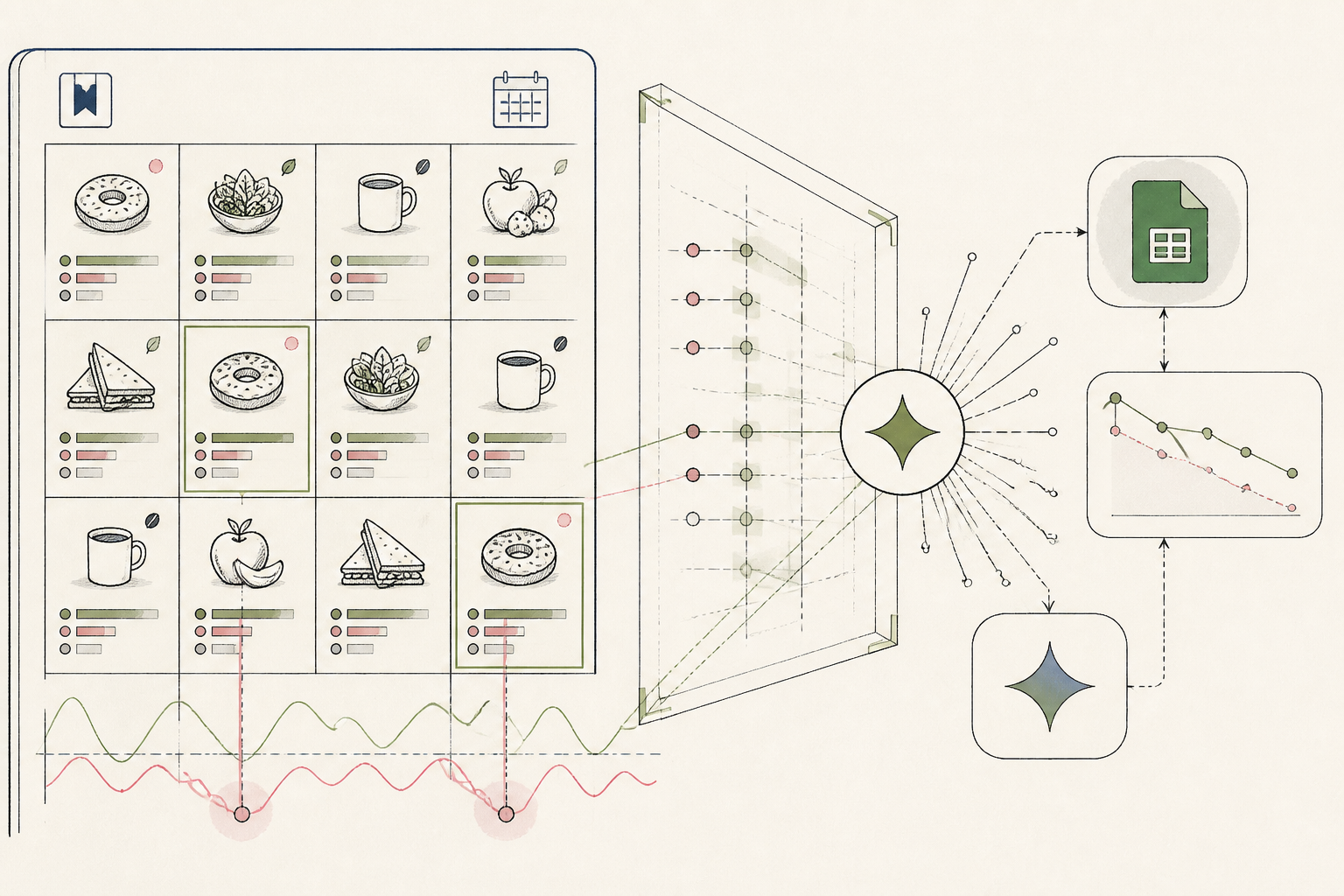
What the AI found
“Your mood scores consistently dipped after meals containing high levels of processed sugars, specifically on Tuesday and Thursday afternoons when you consumed a pastry at work, leading to a 15% average decrease in reported mood within 90 minutes.”
Before
Vague mood swings, unclear causes
After
Clear dietary triggers identified
The same system, three states — real screens, not a screenshot
- 2023-11-20: Felt sluggish after lunch. Mid-afternoon dip.
- 2023-11-21: Good day. Maintained energy.
- 2023-11-22: Irritable by 3 pm. What did I eat?
- 2023-11-23: Felt calm today. Productive.
Prompt
Analyze my anonymized mood scores and food entries for the past two weeks. Identify any consistent dietary patterns that precede a noticeable dip in mood (defined as a score decrease of 1 or more on a 5-point scale within 3 hours of eating). Quantify the average mood impact and specify the days/times of the week when this correlation is strongest. Focus only on food types, not specific brands.
Analyze my anonymized mood scores and food entries for the past two weeks. Identify any consistent dietary patterns that precede a noticeable dip in mood (defined as a score decrease of 1 or more on a 5-point scale within 3 hours of eating). Quantify the average mood impact and specify the days/times of the week when this correlation is strongest. Focus only on food types, not specific brands.
AI
Analysis indicates a recurring pattern: your mood scores consistently dipped after meals containing high levels of processed sugars, specifically on Tuesday and Thursday afternoons. This correlation was strongest when a pastry was consumed at work, leading to a 15% average decrease in reported mood within 90 minutes on those days.| Tuesday Pastry Impact | -1.2 Mood Score |
| Thursday Pastry Impact | -1.0 Mood Score |
| Average Mood Dip (Processed Sugar) | 15% |
Mood Tracking Reveals Subtle Dietary Triggers
A bespoke AI system helped identify specific food patterns impacting daily mood, shifting from vague unease to data-driven clarity.
A 38-year-old marketing consultant in Northern Europe, managing a busy schedule and seeking better emotional regulation.
Tools used
The real tools used here — swap any for your own equivalent. Each links to how we’d set it up.
Starting state
Before anything was set up
Before the setup, mood tracking was a sporadic, manual effort. There were journaling attempts, occasional mental notes about "feeling off," but no systematic collection of data. Patterns remained elusive, leaving a sense of frustration and an inability to pinpoint external factors contributing to fluctuations in mood or energy. The data was fragmented across disparate apps, or simply trapped in memory, making analysis impossible.
- 2023-11-20: Felt sluggish after lunch. Mid-afternoon dip.
- 2023-11-21: Good day. Maintained energy.
- 2023-11-22: Irritable by 3 pm. What did I eat?
- 2023-11-23: Felt calm today. Productive.
- 2023-11-24: Tired. Mood declined quickly in the afternoon.
Working state
Setup, doing its job
During the setup, the user integrated mood entries from a lightweight journaling app with dietary logs. The "Setup" product then prompted a large language model to cross-reference these anonymized data streams. The prompt explicitly requested an analysis of correlations between food intake and subsequent mood changes, looking for recurring patterns and quantifying any observed dips or spikes, providing a structured approach to a previously chaotic data set.
Prompt
Analyze my anonymized mood scores and food entries for the past two weeks. Identify any consistent dietary patterns that precede a noticeable dip in mood (defined as a score decrease of 1 or more on a 5-point scale within 3 hours of eating). Quantify the average mood impact and specify the days/times of the week when this correlation is strongest. Focus only on food types, not specific brands.
Analyze my anonymized mood scores and food entries for the past two weeks. Identify any consistent dietary patterns that precede a noticeable dip in mood (defined as a score decrease of 1 or more on a 5-point scale within 3 hours of eating). Quantify the average mood impact and specify the days/times of the week when this correlation is strongest. Focus only on food types, not specific brands.
AI
Analysis indicates a recurring pattern: your mood scores consistently dipped after meals containing high levels of processed sugars, specifically on Tuesday and Thursday afternoons. This correlation was strongest when a pastry was consumed at work, leading to a 15% average decrease in reported mood within 90 minutes on those days.Use case implemented
The finished system, running on its own
Now, the system automatically tags daily mood entries with dietary information, consolidating insights into a single, accessible ledger. This automated correlation reveals consistent, actionable patterns, allowing for proactive adjustments. The user can now quickly review weekly trends, identify potential triggers, and make informed choices to maintain emotional balance, transforming reactive coping into proactive management of their well-being.
| Tuesday Pastry Impact | -1.2 Mood Score |
| Thursday Pastry Impact | -1.0 Mood Score |
| Average Mood Dip (Processed Sugar) | 15% |
| Week 3 Mood Score Avg | 4.1 |
| Week 4 Mood Score Avg | 4.4 |
What an outside observer would notice
↓ 25% (post-setup)
Mood Dip Frequency
↑ 2 per week
Proactive Dietary Changes
↑ 40%
Self-Reported Clarity
The stack — build it yourself
Simple, quick interface for consistent mood logging without friction.
Comprehensive database for accurate tracking of food components.
Advanced natural language processing for discerning subtle correlations across diverse data types.
Flexible platform for combining and visualizing disparate data streams into a single ledger.
These are the tools used in this story. Any can be swapped for an equivalent you already trust.
Go deeper
Do this yourself
Build Your Personal Mood System
This story runs on Setup. The tools and prompts above are the real build — swap any tool for your own equivalent and follow the same steps.