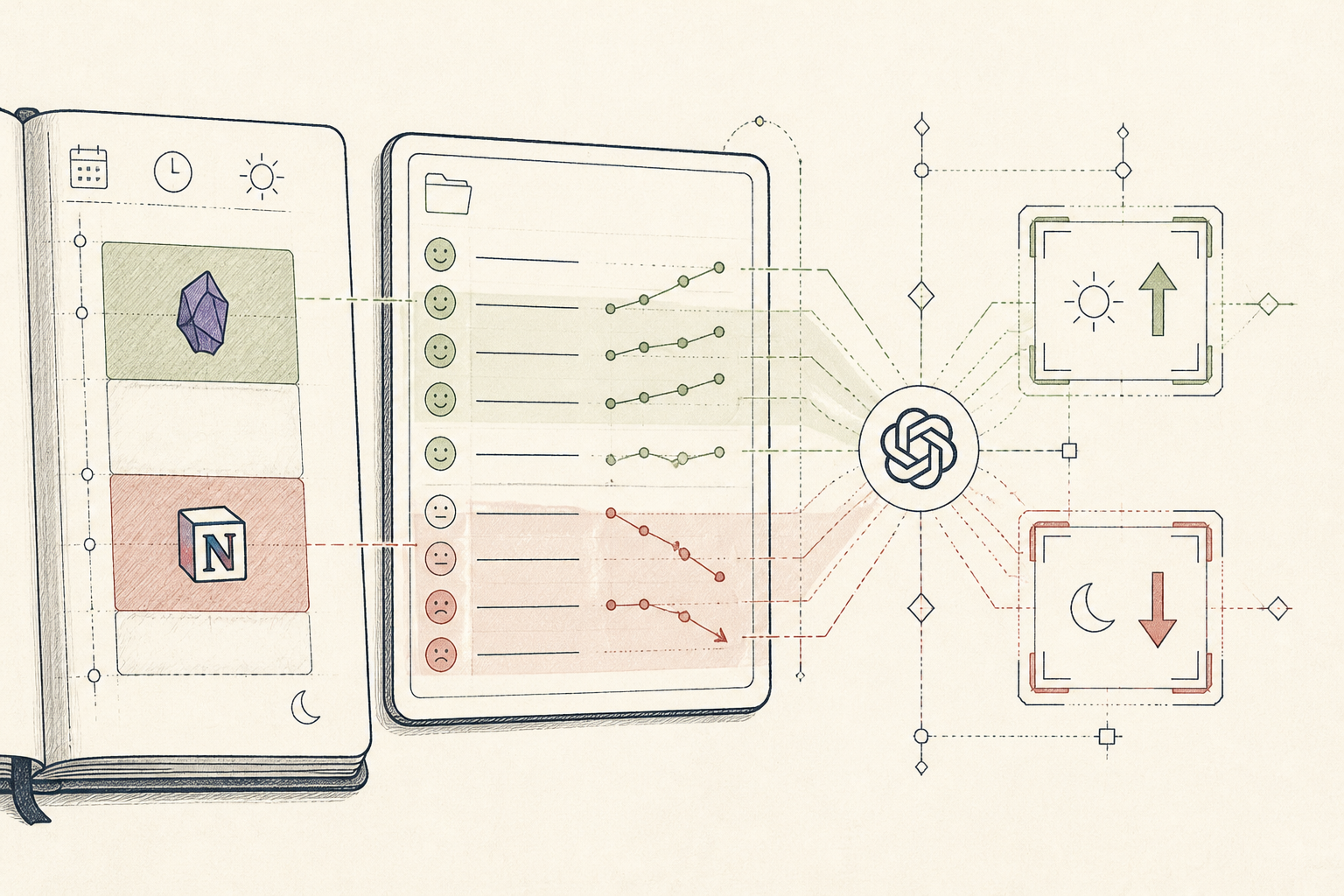
What the AI found
“Your most positive mood spikes consistently follow "deep work" sessions before 11 AM, while days with afternoon meetings frequently correlate with a 15-20% drop in reported mood by evening.”
Before
Vague mood entries, no clear insights
After
Actionable patterns for better days
The same system, three states — real screens, not a screenshot
- 2024-03-05: Mood 4. Productive deep work. Felt good after morning walk.
- 2024-03-06: Mood 3. Afternoon client call drained me. Light workout, feeling flat.
- 2024-03-07: Mood 5. Creative flow all morning. Lunch with friend. High energy.
- 2024-03-08: Mood 2. Too many emails. Felt behind all day. Skip gym.
Prompt
Analyze the following daily journal entries, correlating my mood scores (1-5) with events and activities. Identify any recurring patterns or surprising connections. Focus on quantifiable impacts where possible. Here is the data: [followed by Laura's journal entries]
Analyze my mood journal entries for patterns.
AI
I've analyzed your entries. Your most positive mood spikes consistently follow 'deep work' sessions before 11 AM, averaging a 4.5 mood score. Conversely, days with afternoon client or team meetings frequently correlate with a 15-20% drop in reported mood by evening, compared to days without such meetings.4.5
Avg. Mood (Deep Work Mornings)
2.8
Avg. Mood (Afternoon Meetings)
+1.7 pt difference
Mood Correlation: Deep Work vs. Meetings
Mood Tracking Refined
AI reveals hidden patterns in daily mood shifts.
A 35-year-old freelance designer, Northern Europe
Tools used
The real tools used here — swap any for your own equivalent. Each links to how we’d set it up.
Starting state
Before anything was set up
Laura began with a simple journaling habit, logging daily mood on a 1-5 scale alongside notes about her day. After several months, she had a rich text archive but no clear understanding of what truly influenced her emotional state. The data was there, but the signal was buried in the noise, leaving her feeling reactive rather than proactive about her wellbeing. She felt overwhelmed by the volume of unstructured text and the lack of an easy way to connect disparate entries.
- 2024-03-05: Mood 4. Productive deep work. Felt good after morning walk.
- 2024-03-06: Mood 3. Afternoon client call drained me. Light workout, feeling flat.
- 2024-03-07: Mood 5. Creative flow all morning. Lunch with friend. High energy.
- 2024-03-08: Mood 2. Too many emails. Felt behind all day. Skip gym.
- 2024-03-09: Mood 4. Good family time. Read a book. Relaxed evening.
Working state
Hacks Pass, doing its job
To extract meaning, Laura copied a month's worth of journal entries into a specialized AI tool. She prompted it to analyze her mood scores against her activity logs, looking for recurring correlations she might have missed. The AI processed the raw text, identifying keywords and contextual relationships between her daily events and her reported emotional shifts. It then presented its findings, quantifying the impact of specific routines on her overall mood, delivering a concrete pattern she could immediately act upon.
Prompt
Analyze the following daily journal entries, correlating my mood scores (1-5) with events and activities. Identify any recurring patterns or surprising connections. Focus on quantifiable impacts where possible. Here is the data: [followed by Laura's journal entries]
Analyze my mood journal entries for patterns.
AI
I've analyzed your entries. Your most positive mood spikes consistently follow 'deep work' sessions before 11 AM, averaging a 4.5 mood score. Conversely, days with afternoon client or team meetings frequently correlate with a 15-20% drop in reported mood by evening, compared to days without such meetings.Use case implemented
The finished system, running on its own
With the AI's insights, Laura now structures her mornings to prioritize deep work and schedules afternoon meetings more strategically. Her daily journaling continues, but it's now informed by an understanding of what factors truly matter. Each week, she performs a quick review, spotting new micro-patterns and reinforcing beneficial habits. This has transformed her approach from passive observation to active, informed optimization of her daily routine, leading to more consistently positive days.
4.5
Avg. Mood (Deep Work Mornings)
2.8
Avg. Mood (Afternoon Meetings)
+1.7 pt difference
Mood Correlation: Deep Work vs. Meetings
What an outside observer would notice
Up 0.8 points on average
Mood Score Improvement
Increased by 30%
Productive Morning Rate
More consistent
Afternoon Energy Levels
The stack — build it yourself
Chosen for its local-first storage and flexible linking, ideal for free-form daily entries.
Used for its advanced natural language processing to find non-obvious correlations in unstructured text.
Leveraged for its customizable database views to visualize and review key metrics and insights weekly.
These are the tools used in this story. Any can be swapped for an equivalent you already trust.
Go deeper
Do this yourself
Refine Your Mood Tracking
This story runs on Hacks Pass. The tools and prompts above are the real build — swap any tool for your own equivalent and follow the same steps.