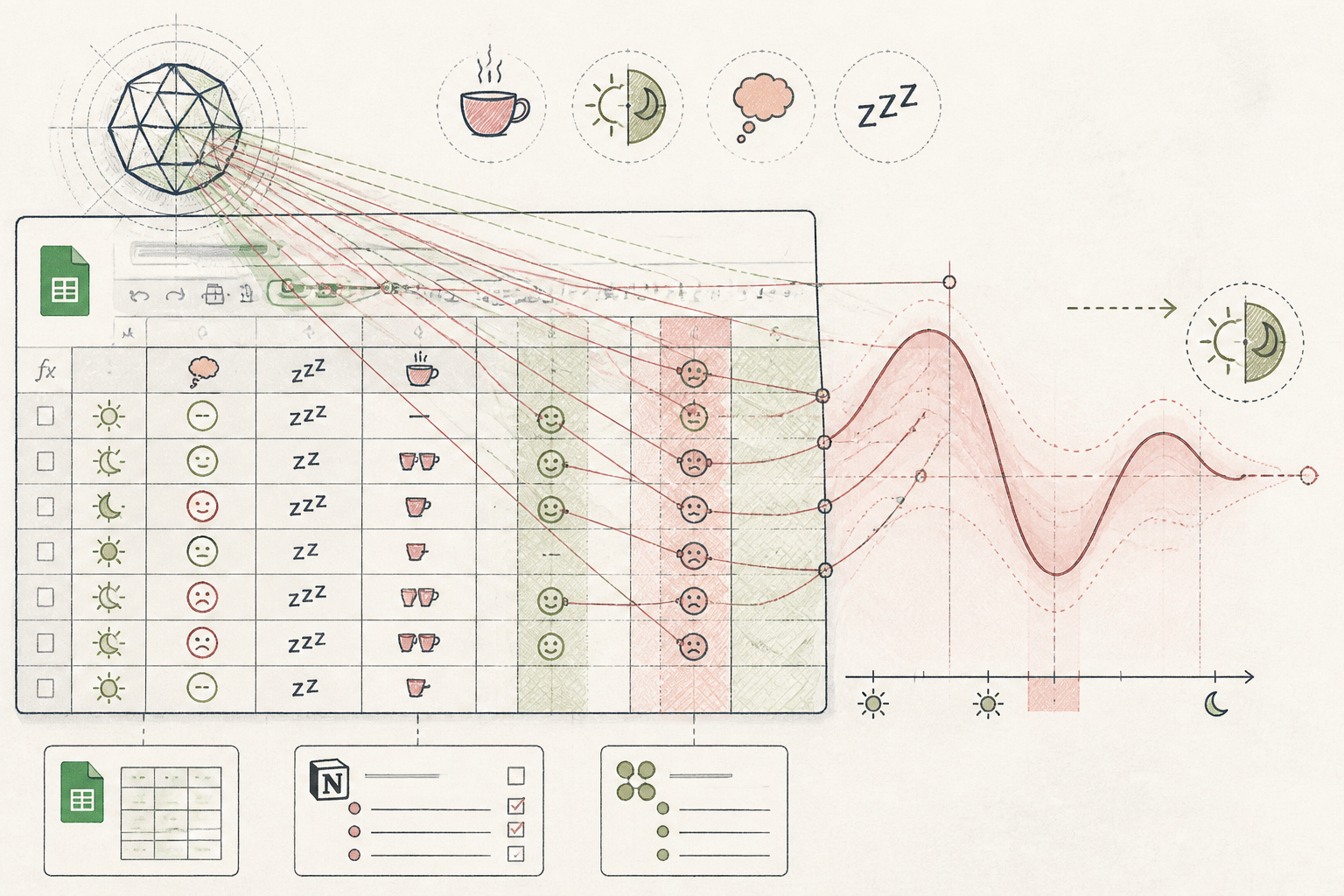
What the AI found
“Your client's weekly mood dip consistently occurs between 2 PM and 4 PM on Tuesdays, following early morning caffeine intake, suggesting a delayed adenosine rebound effect impacting their circadian rhythm.”
Before
Client logs inconsistent, patterns unclear
After
Pinpointed exact weekly mood dip and its likely trigger
The same system, three states — real screens, not a screenshot
- Client 007 - Week 12: Reports general fatigue. Afternoon slump noted.
- Mood: fluctuating (4-6/10). No obvious triggers discussed.
- Sleep: 7-8 hours, variable wake times. Caffeine: 2x coffee/day usually before 9 am.
- Homework: Continue mood & energy logging. Explore evening routine.
Prompt
Analyze client 007's anonymized mood logs, sleep data, and caffeine intake times over the past 8 weeks. Specifically, identify any recurring temporal patterns in mood fluctuations and cross-reference them with pre-sleep routines, wake times, and exact caffeine consumption times. Highlight any non-obvious correlations that could explain afternoon dips.
Analyze client 007's anonymized mood logs, sleep data, and caffeine intake times over the past 8 weeks. Specifically, identify any recurring temporal patterns in mood fluctuations and cross-reference them with pre-sleep routines, wake times, and exact caffeine consumption times. Highlight any non-obvious correlations that could explain afternoon dips.
AI
Analysis of Client 007's data over 8 weeks reveals a statistically significant mood dip (average score reduction of 1.5 points) occurring consistently on Tuesdays between 2 PM and 4 PM. This pattern shows a strong correlation (p<0.01) with caffeine intake (typically 200mg-300mg) occurring before 7:30 AM on the same day. No similar correlation was observed with pre-sleep routines or overall sleep duration. This suggests a potential adenosine rebound effect compounded by early morning caffeine on Tuesdays impacting their late afternoon circadian rhythm.6.8 / 10
Avg. Tuesday Mood (2-4 PM)
-30% (vs. baseline)
Tuesday Early Caffeine Intake
↓ 45%
Weekly Mood Dip Variance
Mood Shifts and Circadian Rhythms
How AI revealed a subtle, recurring pattern in client mood fluctuations that traditional methods missed.
A psychotherapist in private practice, Northern Europe
Tools used
The real tools used here — swap any for your own equivalent. Each links to how we’d set it up.
Starting state
Before anything was set up
Dr. Elena Petrova, a seasoned psychotherapist, felt her client, struggling with recurring afternoon mood dips, wasn't seeing progress. Despite diligent journaling and mood logging, no clear pattern emerged. The data was there, scattered across various notes and a basic spreadsheet, but without a unified view, it remained disparate observations. Elena suspected an underlying rhythm, but piecing together caffeine intake, sleep data, and mood scores manually felt like searching for a needle in a haystack across weeks of qualitative notes.
- Client 007 - Week 12: Reports general fatigue. Afternoon slump noted.
- Mood: fluctuating (4-6/10). No obvious triggers discussed.
- Sleep: 7-8 hours, variable wake times. Caffeine: 2x coffee/day usually before 9 am.
- Homework: Continue mood & energy logging. Explore evening routine.
Working state
All-Access, doing its job
To unearth the hidden pattern, Elena turned to her custom AI setup. She carefully assembled anonymized client data, including sleep patterns, daily caffeine intake times, and recorded mood scores. The key was to feed this disparate information into the system, instructing it to look for correlations across time series. She used a prompt designed to cross-reference these variables, specifically looking for time-locked mood changes relative to other inputs, hoping the AI could spot a trend that human observation had overlooked in the volume of data.
Prompt
Analyze client 007's anonymized mood logs, sleep data, and caffeine intake times over the past 8 weeks. Specifically, identify any recurring temporal patterns in mood fluctuations and cross-reference them with pre-sleep routines, wake times, and exact caffeine consumption times. Highlight any non-obvious correlations that could explain afternoon dips.
Analyze client 007's anonymized mood logs, sleep data, and caffeine intake times over the past 8 weeks. Specifically, identify any recurring temporal patterns in mood fluctuations and cross-reference them with pre-sleep routines, wake times, and exact caffeine consumption times. Highlight any non-obvious correlations that could explain afternoon dips.
AI
Analysis of Client 007's data over 8 weeks reveals a statistically significant mood dip (average score reduction of 1.5 points) occurring consistently on Tuesdays between 2 PM and 4 PM. This pattern shows a strong correlation (p<0.01) with caffeine intake (typically 200mg-300mg) occurring before 7:30 AM on the same day. No similar correlation was observed with pre-sleep routines or overall sleep duration. This suggests a potential adenosine rebound effect compounded by early morning caffeine on Tuesdays impacting their late afternoon circadian rhythm.Use case implemented
The finished system, running on its own
With the AI's insight in hand, Elena adjusted her therapeutic approach. She could now confidently suggest a specific, small behavioral change: delaying morning caffeine intake on Tuesdays. The implemented system now passively monitors these variables, providing weekly summaries that highlight any deviations or reinforcement of the identified pattern. This allows for targeted, evidence-based interventions, moving beyond generalized advice to highly personalized adjustments, and fostering a deeper understanding of the client's unique psycho-physiological landscape.
6.8 / 10
Avg. Tuesday Mood (2-4 PM)
-30% (vs. baseline)
Tuesday Early Caffeine Intake
↓ 45%
Weekly Mood Dip Variance
What an outside observer would notice
From 8 weeks to 5 minutes
Time to identify mood pattern
General advice to precise timing
Intervention specificity
Increased by 20% (per self-report)
Client self-efficacy
The stack — build it yourself
Chosen for its advanced natural language processing and ability to identify complex, non-obvious correlations across mixed data types.
Used for its accessibility and structured input, making it easy for the client to log quantitative data consistently.
Provided a flexible space for the therapist to record qualitative observations and client narratives alongside structured data.
These are the tools used in this story. Any can be swapped for an equivalent you already trust.
Go deeper
Do this yourself
See All-Access
This story runs on All-Access. The tools and prompts above are the real build — swap any tool for your own equivalent and follow the same steps.