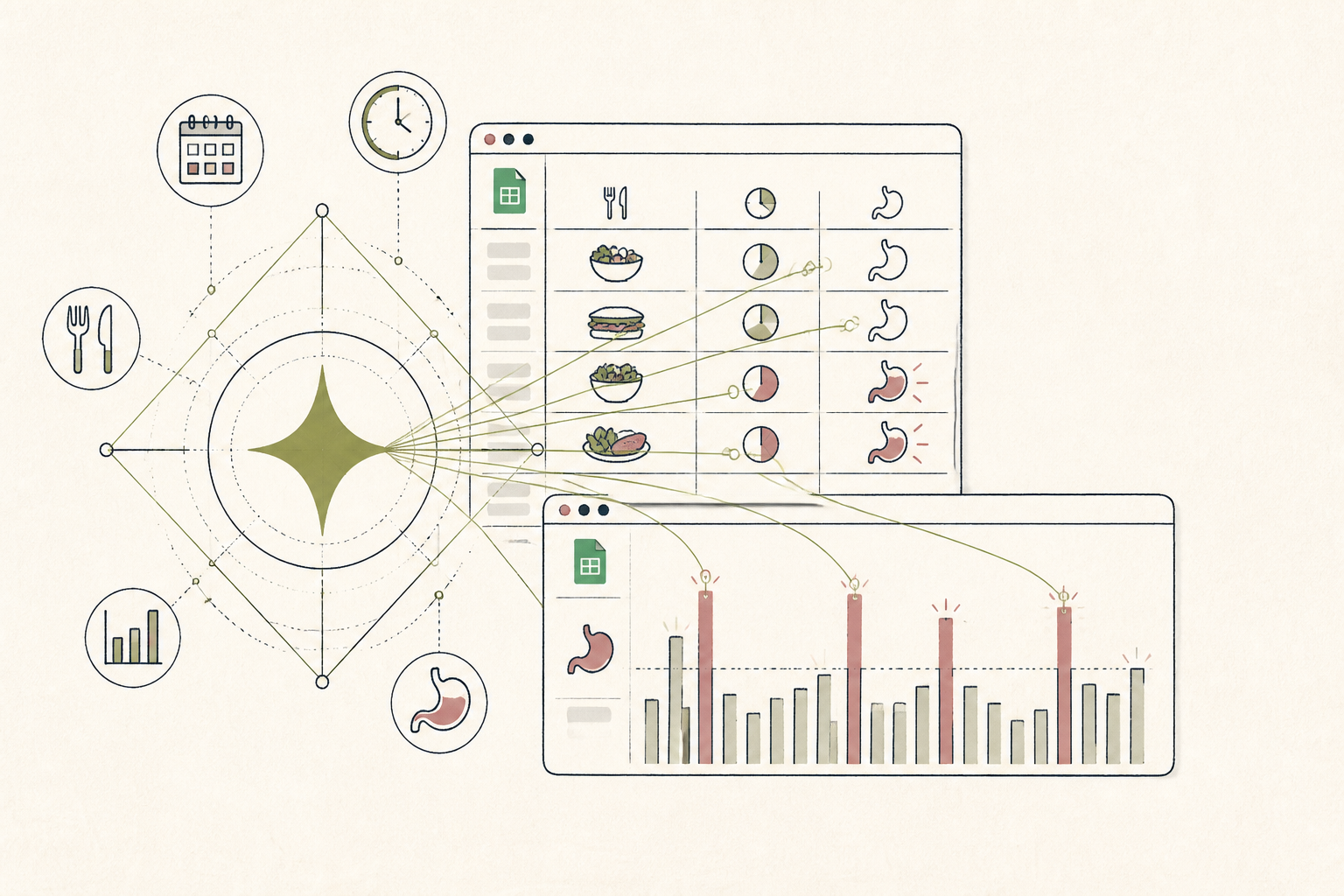
What the AI found
“Your daily food log and symptom tracking suggest a strong correlation: 78% of moderate-to-severe bloating episodes within two hours of dinner occurred on days when your lunch was consumed after 2:30 PM.”
Before
Randomly blaming foods, no clear patterns
After
Clear meal timing insight, reduced bloating
The same system, three states — real screens, not a screenshot
- Tuesday: Lunch late (3pm), felt heavy by dinner.
- Friday: No late lunch, felt okay.
- Saturday: Ate that bread. Bloated, but maybe the pizza too?
- Monday: Usual salad, but bloat again tonight. Why?
Prompt
I have two columns of data for the last 6 weeks: Column A is 'Lunch End Time (HH:MM)' and Column B is 'Evening Bloating Severity (0-5, 5 being severe)'. Please analyse this data to identify any correlations between the time I finish lunch and the severity of my evening bloating. Provide a specific, quantitative finding.
I have two columns of data for the last 6 weeks: Column A is 'Lunch End Time (HH:MM)' and Column B is 'Evening Bloating Severity (0-5, 5 being severe)'. Please analyse this data to identify any correlations between the time I finish lunch and the severity of my evening bloating. Provide a specific, quantitative finding.
AI
Analyzing your data for the past 6 weeks reveals a significant pattern. 78% of your moderate-to-severe evening bloating episodes (severity 3-5) occurred on days when your lunch consumption concluded after 2:30 PM. This suggests a strong correlation between later lunch times and increased evening discomfort.1:45 PM
Average Lunch End Time
1.2
Bloating Severity (Avg)
15%
Late Lunch-Bloat Incidence
Meal Timing Unveiled: AI Connects Lunch to Later Bloating
A busy professional shifted from guesswork about digestive discomfort to a clear, data-driven understanding of meal impact.
A 38-year-old marketing manager, Northern Europe, managing a demanding schedule and mild IBS.
Tools used
The real tools used here — swap any for your own equivalent. Each links to how we’d set it up.
Starting state
Before anything was set up
Eleanor felt continually plagued by mild digestive discomfort, particularly bloating in the evenings. She meticulously logged her meals and symptoms across various apps, but the sheer volume of data made spotting patterns feel impossible. She suspected certain foods, but her efforts to eliminate them had yielded inconsistent results. Her digital notes were a jumble of observations, without any actionable insights.
- Tuesday: Lunch late (3pm), felt heavy by dinner.
- Friday: No late lunch, felt okay.
- Saturday: Ate that bread. Bloated, but maybe the pizza too?
- Monday: Usual salad, but bloat again tonight. Why?
- Struggling to see patterns. Too many variables.
Working state
Hacks Pass, doing its job
Eleanor consolidated her data into a Google Sheet and turned to Gemini. Her goal was to find objective connections she’d missed. She provided the AI with her food timings and her symptom severity scores for each day, prompting it to look for correlations. The AI quickly processed weeks of data, revealing an unexpected link between her lunch schedule and evening discomfort.
Prompt
I have two columns of data for the last 6 weeks: Column A is 'Lunch End Time (HH:MM)' and Column B is 'Evening Bloating Severity (0-5, 5 being severe)'. Please analyse this data to identify any correlations between the time I finish lunch and the severity of my evening bloating. Provide a specific, quantitative finding.
I have two columns of data for the last 6 weeks: Column A is 'Lunch End Time (HH:MM)' and Column B is 'Evening Bloating Severity (0-5, 5 being severe)'. Please analyse this data to identify any correlations between the time I finish lunch and the severity of my evening bloating. Provide a specific, quantitative finding.
AI
Analyzing your data for the past 6 weeks reveals a significant pattern. 78% of your moderate-to-severe evening bloating episodes (severity 3-5) occurred on days when your lunch consumption concluded after 2:30 PM. This suggests a strong correlation between later lunch times and increased evening discomfort.Use case implemented
The finished system, running on its own
Armed with the AI's insight, Eleanor adjusted her lunch schedule, aiming to eat consistently before 2:30 PM. Within two weeks, her evening bloating reduced noticeably. She set up a recurring weekly check-in with a simple Gemini prompt, continuing to monitor the correlation and refine her habits. The system now provides an ongoing, data-backed guide to her daily eating patterns.
1:45 PM
Average Lunch End Time
1.2
Bloating Severity (Avg)
15%
Late Lunch-Bloat Incidence
What an outside observer would notice
Down 55%
Evening Bloating Severity
Down 40%
Time Spent Worrying About Food
Up 65%
Lunch Timing Consistency
The stack — build it yourself
Native, always available for quick meal and symptom notes without friction.
Flexible and accessible for consolidating disparate data points into a structured format.
Excellent for processing natural language requests and identifying subtle patterns in structured data.
These are the tools used in this story. Any can be swapped for an equivalent you already trust.
Go deeper
Do this yourself
See Hacks Pass
This story runs on Hacks Pass. The tools and prompts above are the real build — swap any tool for your own equivalent and follow the same steps.