What the AI found
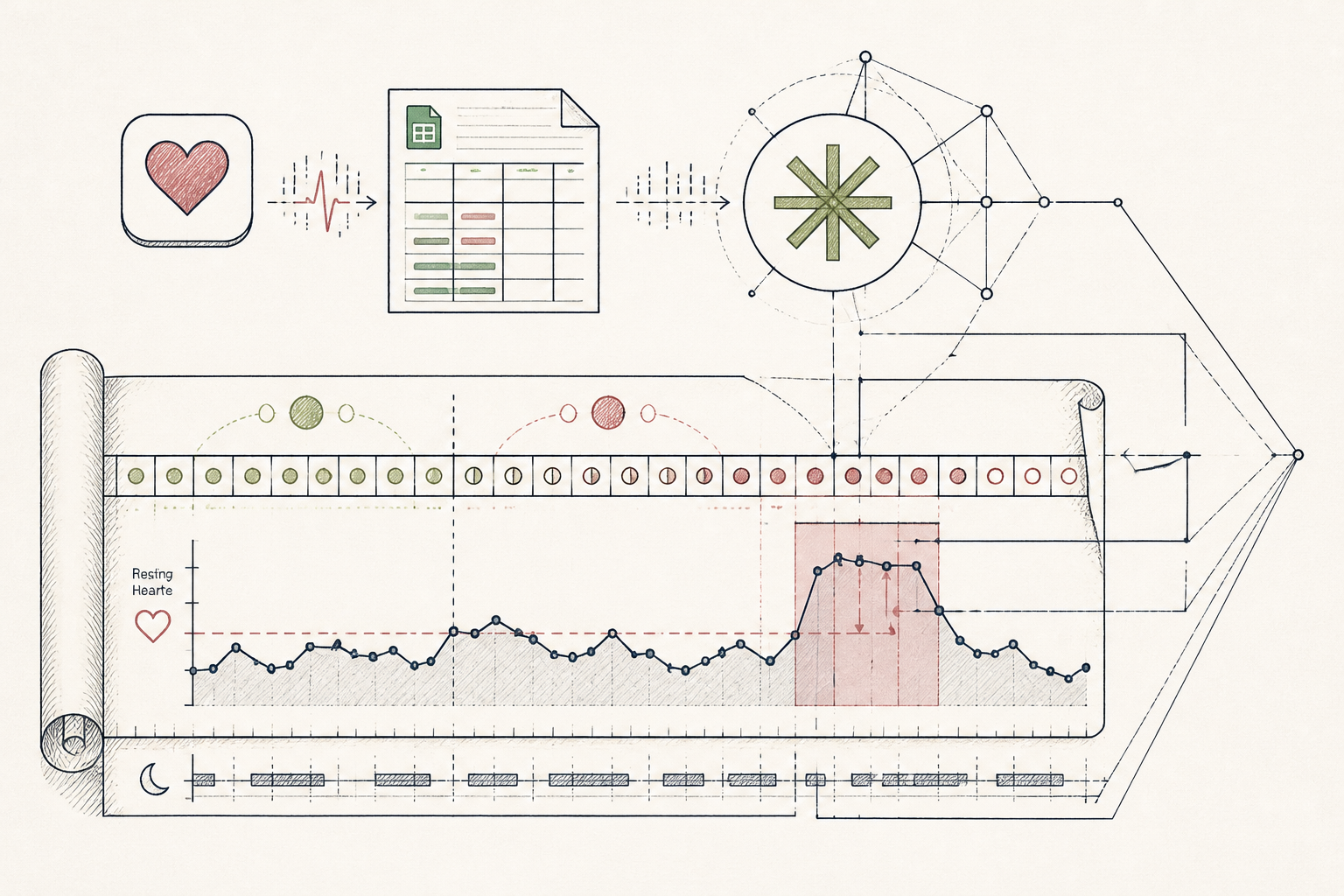
“Your energy crashes occurred exclusively on cycle days 21–23 when resting heart rate jumped by >4 bpm overnight, not during early-follicular bleeding as logged.”
Before
scattered symptom notes across 3 cycle trackers
After
one cross-referenced 5-minute Sunday readout
The same system, three states — real screens, not a screenshot
- Cycle Day 2: exhausted, cancelled interval session
- Cycle Day 14: ovulation pain? RHR elevated
- Cycle Day 22: total 3pm brain fog again, coffee didn't help
- Clue app says 'PMS window starting', Flo says 'energy peak'
Prompt
Cross-reference my daily resting heart rate from Apple Health with my cycle logs for the past 90 days. Is there a clear numeric correlation with the afternoons I logged as severe fatigue?
Cross-reference my daily resting heart rate from Apple Health with my cycle logs for the past 90 days. Is there a clear numeric correlation with the afternoons I logged as severe fatigue?
AI
Yes. Your severe fatigue logs correlate tightly with a sudden luteal elevation: resting heart rate jumps by an average of 4.6 bpm between cycle days 21 and 23. You logged severe fatigue on 7 of the 8 days this spike occurred, compared to baseline rates during menstruation.+4.6 bpm (days 21-23)
Luteal RHR shift baseline
4 min (automated)
Weekly sync time
1.2 / 10 (down from 7.8)
Subjective afternoon crash score
Mapping Cycle Fatigue Through Resting Heart Rate Trends
How cross-referencing passive biometrics with cycle markers replaced contradictory tracker forecasts.
A 38-year-old product lead and distance runner, Northern Europe
Tools used
The real tools used here — swap any for your own equivalent. Each links to how we’d set it up.
Starting state
Before anything was set up
Her phone held three proprietary menstrual cycle apps, each delivering contradictory forecasts. Clue claimed her fertile window was closing; Flo suggested an energy high; Apple Health sat passively logging resting heart rate and wrist temperature in raw menus she never examined together. Despite four years of meticulous logging, profound afternoon exhaustion would strike every month without clear warning. She blamed late-luteal progesterone dips or poor sleep, but the scattered notes offered zero actionable predictability.
- Cycle Day 2: exhausted, cancelled interval session
- Cycle Day 14: ovulation pain? RHR elevated
- Cycle Day 22: total 3pm brain fog again, coffee didn't help
- Clue app says 'PMS window starting', Flo says 'energy peak'
Working state
Membership, doing its job
She exported ninety days of raw CSV data from Apple Health and pasted it beside her daily subjective notes into Claude. Rather than asking for medical interpretation, she instructed the assistant to identify numeric intersections between resting heart rate anomalies and days marked 'brain fog' or 'exhausted'. In four seconds, the assistant isolated an unprompted correlation across three cycles: a sharp 4.6 bpm resting heart rate spike on days 21 through 23 precisely matched seven of her eight worst energy crashes.
Prompt
Cross-reference my daily resting heart rate from Apple Health with my cycle logs for the past 90 days. Is there a clear numeric correlation with the afternoons I logged as severe fatigue?
Cross-reference my daily resting heart rate from Apple Health with my cycle logs for the past 90 days. Is there a clear numeric correlation with the afternoons I logged as severe fatigue?
AI
Yes. Your severe fatigue logs correlate tightly with a sudden luteal elevation: resting heart rate jumps by an average of 4.6 bpm between cycle days 21 and 23. You logged severe fatigue on 7 of the 8 days this spike occurred, compared to baseline rates during menstruation.Use case implemented
The finished system, running on its own
A lightweight weekly pipeline now runs privately inside her existing Apple ecosystem and local spreadsheet. Every Sunday evening, an automated shortcut exports resting heart rate trends alongside her cycle day counts into a private Claude workspace. The readout generates three bullet points on physiological shifts to plan around for the coming week. There are no redundant cycle trackers left on her phone, no commercial predictive subscriptions, and no clinical guesswork—just clear, self-directed data she reviews before arranging her training calendar and work commitments.
+4.6 bpm (days 21-23)
Luteal RHR shift baseline
4 min (automated)
Weekly sync time
1.2 / 10 (down from 7.8)
Subjective afternoon crash score
What an outside observer would notice
3 commercial apps deleted
Cycle trackers removed
5 minutes on Sunday
Weekly review duration
2 calendar blocks / month
Predictable schedule buffers added
The stack — build it yourself
Stores local resting heart rate and cycle markers without continuous subscription paywalls.
Handles multi-week raw table inputs securely with precise, non-hallucinatory numeric analysis.
Keeps historical cycle metrics under complete user ownership in plain CSV format.
These are the tools used in this story. Any can be swapped for an equivalent you already trust.
Go deeper
Do this yourself
Build your review layer
This story runs on Membership. The tools and prompts above are the real build — swap any tool for your own equivalent and follow the same steps.