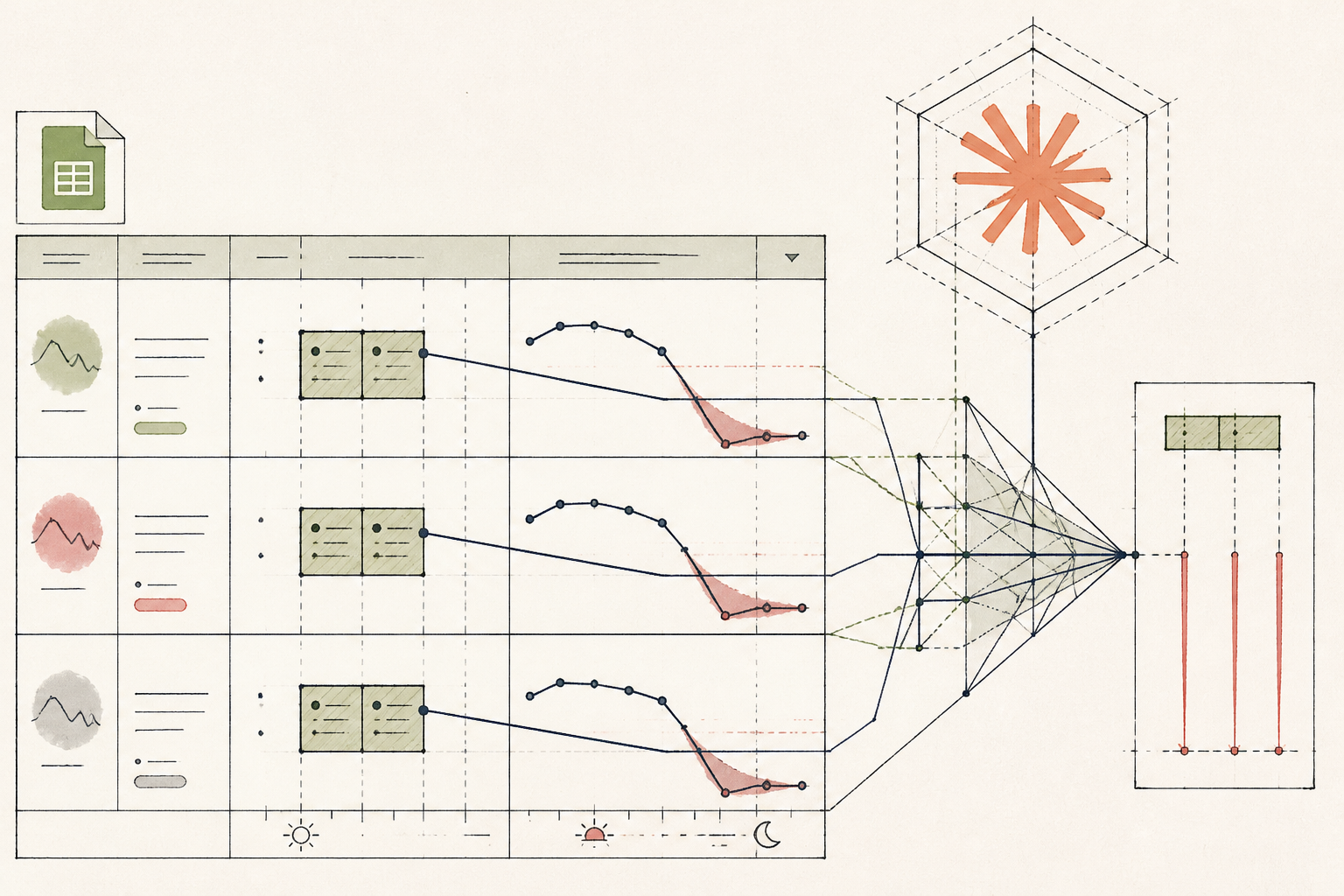
What the AI found
“Three clients reported sharp afternoon drop-offs precisely on days with two back-to-back morning meetings, not on high-workload days.”
Before
scattered text files, manual cross-checks, missing context
After
one shared prompt, clear client patterns, zero lost data
The same system, three states — real screens, not a screenshot
- Client M: feeling drained around 3pm, thinks work stress
- Client T: low focus Thursdays, blames sleep
- Client R: rough Tuesday afternoon, forgot lunch?
- Need to cross-reference their work hours manually
Prompt
Analyse the attached anonymised log. Map self-reported afternoon mood dips (scores 1-3) against morning meeting density versus total daily work hours. Flag any recurring situational patterns.
Analyse the last 4 weeks of anonymised logs for Client M, T, and R. Compare reported 3pm energy dips against morning calendar structure and total logged hours.
AI
Across all three clients, 3pm mood and energy drops do not correlate with total daily hours (r = 0.12). However, 11 of 14 drops occurred on days with two or more back-to-back morning meetings with zero buffer time.4 min / session
Client review prep
Instant
Context retrieval
3 trends flagged
Pattern visibility
Mapping Client Mood Patterns Across Fragmented Daily Logs
How an independent counsellor structured daily client reflections into a governed synthesis layer.
An independent integrative counsellor, Northern Europe
Tools used
The real tools used here — swap any for your own equivalent. Each links to how we’d set it up.
Starting state
Before anything was set up
Every Friday, the counsellor sat with twenty client logs scattered across Apple Notes, email summaries, and exported forms. Patterns remained invisible inside dense paragraphs of subjective prose. She spent twenty minutes before each consultation skimming entries, trying to guess whether an afternoon slump stemmed from poor sleep, heavy workloads, or diet. Without a structured synthesis layer, nuance dissolved into guesswork.
- Client M: feeling drained around 3pm, thinks work stress
- Client T: low focus Thursdays, blames sleep
- Client R: rough Tuesday afternoon, forgot lunch?
- Need to cross-reference their work hours manually
Working state
Membership, doing its job
She standardised client submissions into a basic Google Sheet with four columns: date, meeting count, total hours, and mood note. Pasting the week's anonymised export into Claude with a precise pattern-matching prompt immediately cut through the noise, surfacing a non-obvious operational link across several clients that changed how she approached schedule design.
Prompt
Analyse the attached anonymised log. Map self-reported afternoon mood dips (scores 1-3) against morning meeting density versus total daily work hours. Flag any recurring situational patterns.
Analyse the last 4 weeks of anonymised logs for Client M, T, and R. Compare reported 3pm energy dips against morning calendar structure and total logged hours.
AI
Across all three clients, 3pm mood and energy drops do not correlate with total daily hours (r = 0.12). However, 11 of 14 drops occurred on days with two or more back-to-back morning meetings with zero buffer time.Use case implemented
The finished system, running on its own
The practitioner now runs consultations with a simple, private Google Sheet connected to Claude. Before each afternoon block, a single macro-templated prompt parses client-logged timestamps and brief mood reflections without exposing personal identifiers. She spots structural triggers—like consecutive calendar obligations—before the client even sits down, turning vague reports into focused conversations about day architecture.
4 min / session
Client review prep
Instant
Context retrieval
3 trends flagged
Pattern visibility
What an outside observer would notice
From 22 min to 4 min
Pre-session review time
100% of repeated drop-offs
Multi-week correlation pickup
The stack — build it yourself
Handles nuanced prose reflections and tabular timestamps without training on private enterprise data.
Simple, exportable, practitioner-owned container that clients already know how to fill.
These are the tools used in this story. Any can be swapped for an equivalent you already trust.
Go deeper
Do this yourself
Read the build walkthrough
This story runs on Membership. The tools and prompts above are the real build — swap any tool for your own equivalent and follow the same steps.