What the AI found
“Your afternoon crash spikes on days with back-to-back morning meetings, not short sleep; midday walking cut your self-reported 4pm fatigue by 42%.”
Before
diffuse 4pm exhaustion and random supplement tweaks
After
one 12-min Friday review and a protected calendar block
The same system, three states — real screens, not a screenshot
- Oct 12: Exhausted by 3:30pm. Bought L-theanine.
- Oct 19: Slept 8h10m, still crashed during sprint review.
- Oct 26: Tried cold shower + no coffee past 11am. No shift.
- Nov 02: 4pm brain fog again. Needs systematic look.
Prompt
Attached is my 21-day ledger covering sleep duration, morning meeting blocks, step counts, and 4pm fatigue scores (1-10). Synthesize the literature on cognitive fatigue triggers, then analyze this ledger for primary correlations with high afternoon fatigue (score >= 7).
Attached is my 21-day ledger covering sleep duration, morning meeting blocks, step counts, and 4pm fatigue scores (1-10). Synthesize the literature on cognitive fatigue triggers, then analyze this ledger for primary correlations with high afternoon fatigue (score >= 7).
AI
Across your 21 days, sleep duration shows no meaningful correlation with your 4pm fatigue (r = -0.09). However, morning meeting density shows a strong relationship (r = 0.74). Your worst fatigue scores (>= 7) occurred exclusively on days with >120 consecutive minutes of morning calls. Crucially: on the 4 days you accumulated >2,500 steps before 1:00 PM, 4pm fatigue dropped by 42% regardless of meeting load.3,420 avg
Midday Step Count
7.2 / 10
4pm Energy Score
25m held
Calendar Buffer
Isolating the True Driver of Afternoon Cognitive Fatigue
How a software architect isolated the real trigger of his afternoon fatigue using a three-layer personal protocol.
A 38-year-old software architect, Northern Europe
Tools used
The real tools used here — swap any for your own equivalent. Each links to how we’d set it up.
Starting state
Before anything was set up
A persistent, heavy mental fog arrived predictably at four in the afternoon. He had spent three months cycling through assorted remedies—ashwagandha, strict screen cut-offs at nine, premium magnesium blends—guided only by fragmentary podcast advice and vague impressions. His notes app contained disconnected fragments of sleep scores and supplement dosages, but nothing tied the observations together. The exhaustion persisted regardless of how cleanly he had slept the night before.
- Oct 12: Exhausted by 3:30pm. Bought L-theanine.
- Oct 19: Slept 8h10m, still crashed during sprint review.
- Oct 26: Tried cold shower + no coffee past 11am. No shift.
- Nov 02: 4pm brain fog again. Needs systematic look.
Working state
Core Course, doing its job
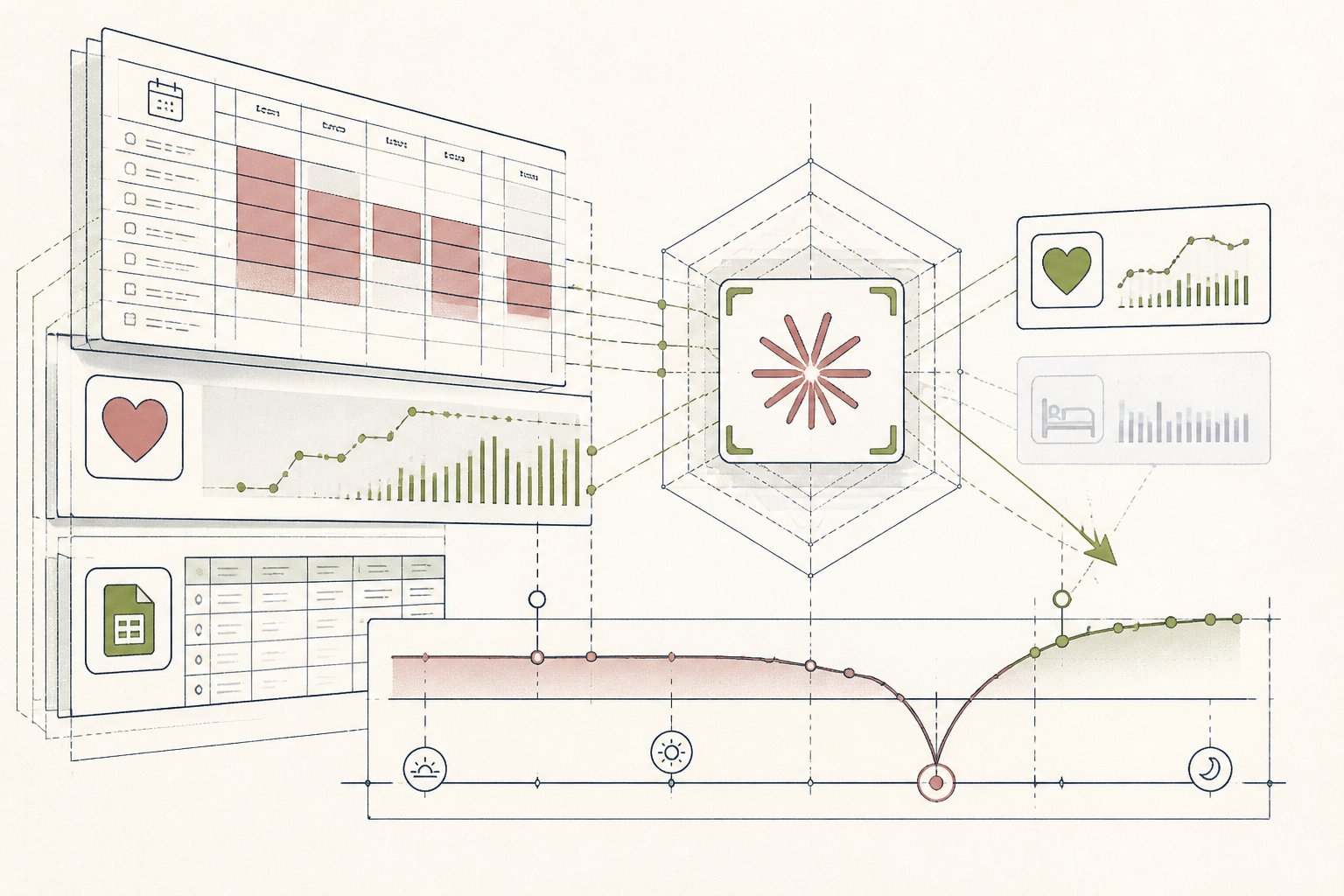
During Week 2 of the Core Course, he transferred three weeks of raw observations into a standardized ledger. He paired his calendar data, step metrics from Apple Health, and daily 4pm energy ratings. Instead of asking for broad wellness tips, he pasted the structured data alongside a literature prompt into Claude to isolate the dominant variable. Within seconds, the system separated physiological myth from observable signal.
Prompt
Attached is my 21-day ledger covering sleep duration, morning meeting blocks, step counts, and 4pm fatigue scores (1-10). Synthesize the literature on cognitive fatigue triggers, then analyze this ledger for primary correlations with high afternoon fatigue (score >= 7).
Attached is my 21-day ledger covering sleep duration, morning meeting blocks, step counts, and 4pm fatigue scores (1-10). Synthesize the literature on cognitive fatigue triggers, then analyze this ledger for primary correlations with high afternoon fatigue (score >= 7).
AI
Across your 21 days, sleep duration shows no meaningful correlation with your 4pm fatigue (r = -0.09). However, morning meeting density shows a strong relationship (r = 0.74). Your worst fatigue scores (>= 7) occurred exclusively on days with >120 consecutive minutes of morning calls. Crucially: on the 4 days you accumulated >2,500 steps before 1:00 PM, 4pm fatigue dropped by 42% regardless of meeting load.Use case implemented
The finished system, running on its own
The three layers now operate automatically each week. The Ledger lives in a single spreadsheet updated in forty seconds every evening. On Friday afternoons, thirty lines of structured personal entries export directly into Claude, cross-referenced against the baseline research synthesis. No frantic lifestyle overhauls or unverified powders; simply one bounded behavioral variable tested every seven days. A non-negotiable twenty-minute buffer now sits between his morning review calls and his lunch, protecting the afternoon workload.
3,420 avg
Midday Step Count
7.2 / 10
4pm Energy Score
25m held
Calendar Buffer
What an outside observer would notice
-42% over 3 weeks
4pm energy crash rating
12 minutes
Friday review time
The stack — build it yourself
Zero-friction two-column logging for daily sleep, meeting counts, and subjective energy.
Excels at dense tabular reasoning and unbiased cross-variable pattern extraction.
Reliable, ambient step tracking without manual input or wearable subscription fees.
These are the tools used in this story. Any can be swapped for an equivalent you already trust.
Go deeper
Do this yourself
Explore the Core Course
This story runs on Core Course. The tools and prompts above are the real build — swap any tool for your own equivalent and follow the same steps.