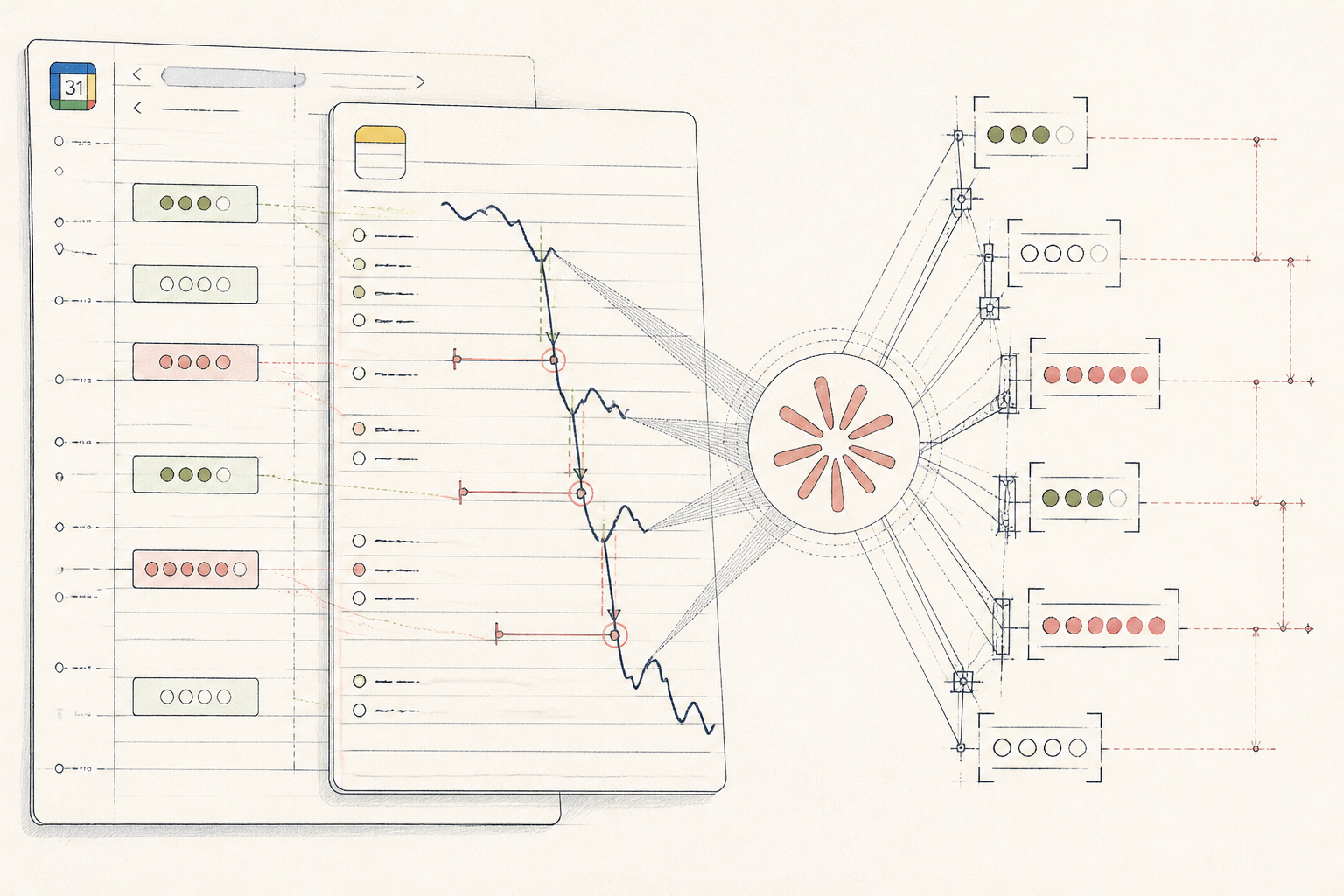
What the AI found
“Your focus drop starts 42 minutes after any meeting with more than 4 attendees, regardless of meeting length or coffee intake.”
Before
14 context switches daily, afternoon brain fog by 2pm
After
4 uninterrupted deep work hours every Tuesday and Thursday
The same system, three states — real screens, not a screenshot
- Mon: 2:15pm brain completely flat, dragged through memo
- Tue: heavy fog after lunch, needed 3rd espresso at 3pm
- Thu: lost the afternoon, could not focus on drafting
- Fri: totally depleted by 1pm, postponed all analytical work
Prompt
I have pasted my last 6 weeks of Google Calendar events and my daily 1-10 focus ratings. Cross-reference my lowest focus windows (<5/10) against meeting duration, time of day, and attendee count. What specifically precedes the drop?
I have pasted my last 6 weeks of Google Calendar events and my daily 1-10 focus ratings. Cross-reference my lowest focus windows (<5/10) against meeting duration, time of day, and attendee count. What specifically precedes the drop?
AI
Your lowest focus scores (averaging 3.2/10) do not correlate with total meeting hours or lunch timing. They correlate with attendee size: a focus drop starts 42 minutes after any meeting with more than 4 attendees, regardless of duration. Small 1-on-1s produced no such drop.8 hrs / week
Deep blocks protected
4 / day avg
Context switches
7.8 / 10
Afternoon energy score
Isolating the Hidden Variable Behind an Afternoon Focus Slump
How a policy researcher isolated the hidden driver of her afternoon cognitive slump using calendar logs and Claude.
A 37-year-old policy researcher, Northern Europe
Tools used
The real tools used here — swap any for your own equivalent. Each links to how we’d set it up.
Starting state
Before anything was set up
Every afternoon between 1:30 and 3:00, her analytical ability vanished. She stared at draft policy briefs unable to parse complex sentences, attributing the slump to poor sleep, carbohydrate crashes, or declining stamina. She tried intermittent fasting, cold showers, and scheduled walks, but her journal remained a graveyard of half-finished working blocks and noted fatigue. She had twelve weeks of calendar entries and two daily focus ratings scrawled into raw notes, completely unanalyzed and disconnected.
- Mon: 2:15pm brain completely flat, dragged through memo
- Tue: heavy fog after lunch, needed 3rd espresso at 3pm
- Thu: lost the afternoon, could not focus on drafting
- Fri: totally depleted by 1pm, postponed all analytical work
Working state
Resources, doing its job
She exported six weeks of calendar events as text and paired them with her terse daily focus notes. Using the Cognition Playbook prompt, she fed both files into Claude. Instead of offering generic advice about circadian rhythms or hydration, the model mapped timestamps against subjective energy scores. It isolated group size—not session duration—as the primary cognitive tax, pinpointing a recurring forty-minute latency between social coordination load and executive exhaustion.
Prompt
I have pasted my last 6 weeks of Google Calendar events and my daily 1-10 focus ratings. Cross-reference my lowest focus windows (<5/10) against meeting duration, time of day, and attendee count. What specifically precedes the drop?
I have pasted my last 6 weeks of Google Calendar events and my daily 1-10 focus ratings. Cross-reference my lowest focus windows (<5/10) against meeting duration, time of day, and attendee count. What specifically precedes the drop?
AI
Your lowest focus scores (averaging 3.2/10) do not correlate with total meeting hours or lunch timing. They correlate with attendee size: a focus drop starts 42 minutes after any meeting with more than 4 attendees, regardless of duration. Small 1-on-1s produced no such drop.Use case implemented
The finished system, running on its own
Two months later, the cognitive buffer system runs automatically. Her calendar holds two inviolable four-hour focus blocks on Tuesday and Thursday mornings, configured around the recovery curves the model surfaced. High-headcount meetings are restricted to late Wednesday afternoons, buffered by fifteen minutes of quiet transit. The 2pm cognitive cliff disappeared without adding caffeine or changing sleep hours. She reviews the protocol every third Sunday in under four minutes, adjusting thresholds as her project load shifts.
8 hrs / week
Deep blocks protected
4 / day avg
Context switches
7.8 / 10
Afternoon energy score
What an outside observer would notice
3.8 hrs/day
Avg uninterrupted focus
Pooled to Wed
High-headcount meetings
The stack — build it yourself
Clean timestamped records of meeting duration and attendee counts.
Frictionless two-line ratings captured at 11am and 4pm.
Large context window accepts raw calendar exports and subjective logs together.
These are the tools used in this story. Any can be swapped for an equivalent you already trust.
Go deeper
Do this yourself
Read the Cognition Playbook
This story runs on Resources. The tools and prompts above are the real build — swap any tool for your own equivalent and follow the same steps.