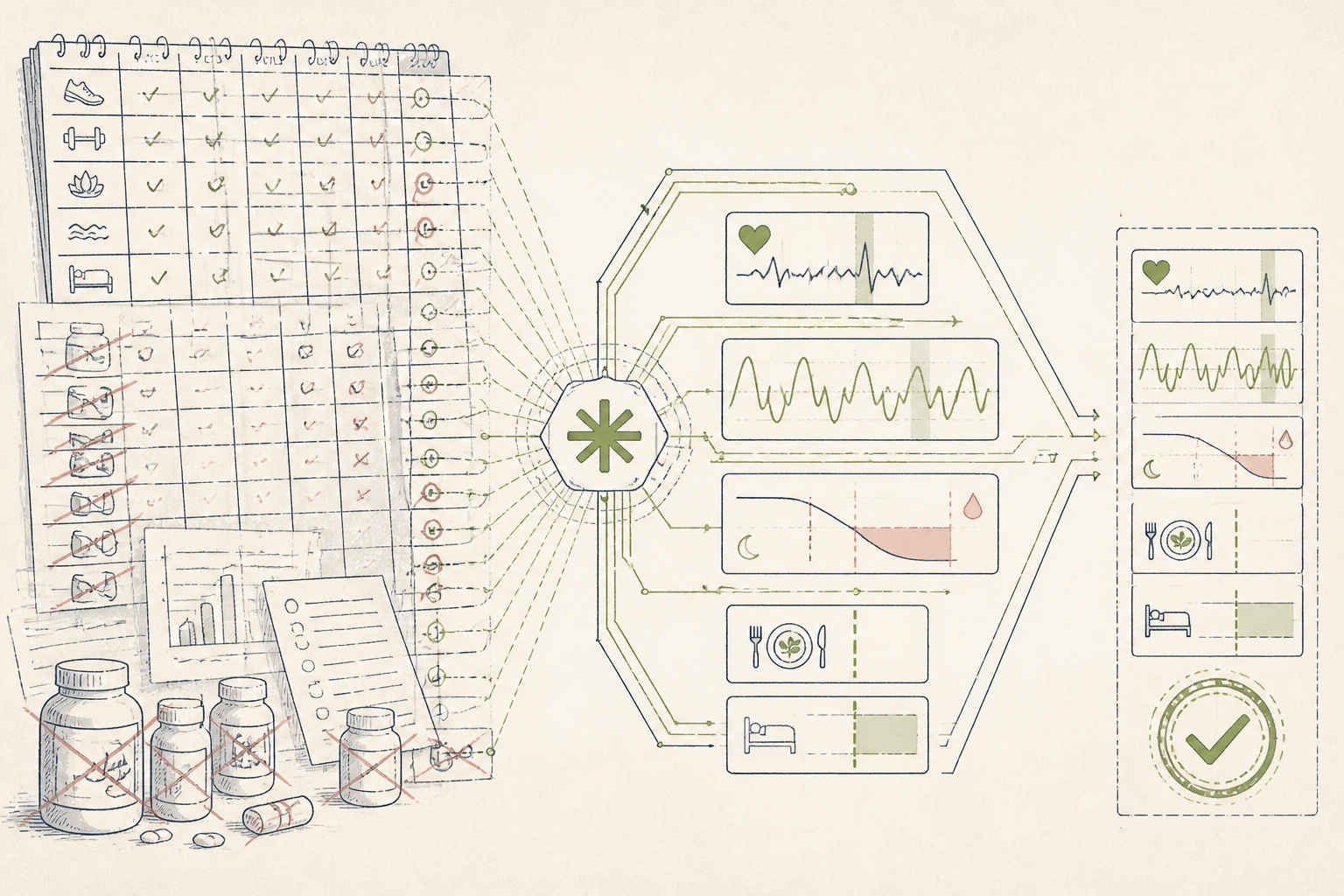
What the AI found
“Your highest HRV readings followed rest days with an early dinner, while your evening cold showers correlated with a 22-minute delay in deep sleep onset.”
Before
14 open tabs and 6 unvetted morning supplements
After
one 4-row sheet and a 12-minute Sunday audit
The same system, three states — real screens, not a screenshot
- Protocol ideas: NMN vs NR? Cold shower 21:00
- Stack: Resveratrol, Magnesium, Ashwagandha, D3, K2, Zinc
- Sleep score says 71% but woke up groggy again
- Need to read 2023 paper on meal timing and autophagy
Prompt
Here is 30 days of Apple Health export data alongside my daily intervention log. Look across sleep onset latency, deep sleep duration, and nocturnal HRV. Correlate them against my three experimental variables: evening cold showers, dinner finish time, and the supplement stack. Identify any clear signal.
Here is 30 days of Apple Health export data alongside my daily intervention log. Look across sleep onset latency, deep sleep duration, and nocturnal HRV. Correlate them against my three experimental variables: evening cold showers, dinner finish time, and the supplement stack. Identify any clear signal.
AI
Two correlations stand out across the 30-day window: 1. Thermal timing: On the 11 nights you took a cold shower after 20:30, your deep sleep onset was delayed by an average of 22 minutes compared to your baseline. 2. Meal timing: Finishing dinner before 19:00 correlated with an average +9 ms increase in nocturnal HRV, regardless of supplement use. Your supplement variations showed no statistically distinguishable signal against sleep quality metrics.38 min avg
Deep sleep onset
100% (1 variable)
Weekly protocol compliance
54 ms (+9 ms)
Evening HRV baseline
How one designer stripped down an erratic longevity routine
How a 46-year-old designer used the 3-Layer Method to replace speculative supplements with a single-variable weekly audit.
A 46-year-old architectural designer, Northern Europe
Tools used
The real tools used here — swap any for your own equivalent. Each links to how we’d set it up.
Starting state
Before anything was set up
His bedside table was cluttered with amber bottles: six supplements recommended across three different health podcasts. In his browser, fourteen bookmarked studies on fasting windows, cellular senescence, and thermal therapy sat half-read. He wore a fitness watch continuously, but its daily readiness scores produced only vague anxiety. He was changing three variables every week—adjusting his bedtime, taking new compounds, trying evening cold exposure—without knowing which intervention altered his recovery.
- Protocol ideas: NMN vs NR? Cold shower 21:00
- Stack: Resveratrol, Magnesium, Ashwagandha, D3, K2, Zinc
- Sleep score says 71% but woke up groggy again
- Need to read 2023 paper on meal timing and autophagy
Working state
Core Course, doing its job
Following the Core Course modules, he separated his routine into three layers. First, Research: using Claude to summarize clinical consensus on thermal timing and circadian digestion. Second, Ledger: exporting thirty days of clean Apple Health data into Google Sheets. Third, Protocol: running a structured prompt to audit the relationship between his evening habits and sleep architecture, isolating signal from self-reported noise.
Prompt
Here is 30 days of Apple Health export data alongside my daily intervention log. Look across sleep onset latency, deep sleep duration, and nocturnal HRV. Correlate them against my three experimental variables: evening cold showers, dinner finish time, and the supplement stack. Identify any clear signal.
Here is 30 days of Apple Health export data alongside my daily intervention log. Look across sleep onset latency, deep sleep duration, and nocturnal HRV. Correlate them against my three experimental variables: evening cold showers, dinner finish time, and the supplement stack. Identify any clear signal.
AI
Two correlations stand out across the 30-day window: 1. Thermal timing: On the 11 nights you took a cold shower after 20:30, your deep sleep onset was delayed by an average of 22 minutes compared to your baseline. 2. Meal timing: Finishing dinner before 19:00 correlated with an average +9 ms increase in nocturnal HRV, regardless of supplement use. Your supplement variations showed no statistically distinguishable signal against sleep quality metrics.Use case implemented
The finished system, running on its own
The noise has cleared. Every Sunday at 18:00, he exports seven days of Apple Health metrics into a private Google Sheets template. He tests exactly one variable at a time across fourteen days. He stopped the cold showers, shifted his final meal to 18:30, and reduced his daily supplements from six to two evidence-backed staples. His resting physiology is calmer, his evenings are quiet, and he no longer spends weekend mornings cross-referencing conflicting longevity podcasts.
38 min avg
Deep sleep onset
100% (1 variable)
Weekly protocol compliance
54 ms (+9 ms)
Evening HRV baseline
What an outside observer would notice
Reduced from 6 to 2
Daily supplements taken
12 min/week (down from 4 hrs)
Time spent vetting protocols
1 (previously untracked)
Variables tested concurrently
The stack — build it yourself
Large context window handles messy health data exports without truncating historical weeks.
Zero-friction tabular tracking that keeps data local, structured, and easy to export.
Consistent, background physiological baseline tracking without manual logging overhead.
These are the tools used in this story. Any can be swapped for an equivalent you already trust.
Go deeper
Do this yourself
Explore the Core Course
This story runs on Core Course. The tools and prompts above are the real build — swap any tool for your own equivalent and follow the same steps.