What the AI found
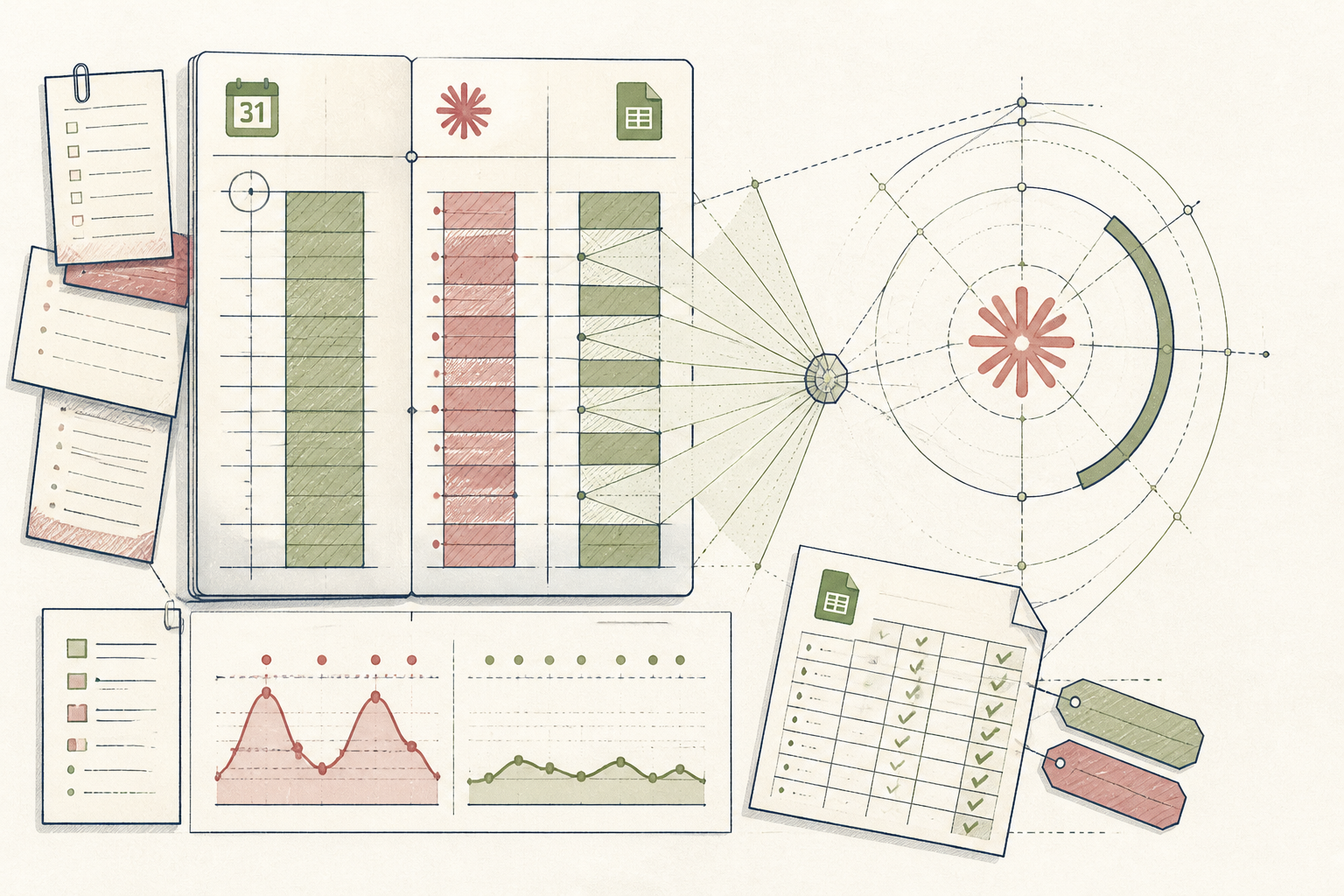
“Your self-reported peak tension scores clustered on Thursdays after back-to-back 45-minute slots, whereas Tuesdays with identical volume had zero spikes due to forced 15-minute buffers.”
Before
22 client hours booked, 11 hours unbilled admin chaos
After
One 4-minute calendar triage, zero Friday backlogs
The same system, three states — real screens, not a screenshot
- Thurs 18:30: Completely drained, 4 files still open.
- Need to stop booking 5 in a row.
- Lost another weekend to session write-ups.
- Admin backlog: 11 hours unbilled this week.
Prompt
Analyze these 8 weeks of anonymised calendar entries and daily 1-5 strain ratings. Compare Tuesdays and Thursdays: identical total client hours, but severe reported fatigue on Thursdays. Find the structural difference in booking intervals and note latency.
I have pasted my anonymised calendar density for the last eight weeks alongside my end-of-day strain notes (rated 1 to 5). Identify why my Thursday fatigue is consistently double my Tuesday fatigue despite identical client hours.
AI
Your caseload volume is identical (5 sessions), but your pacing is structurally different. On Tuesdays, you have a natural 15-minute gap between every client, and your strain rating never exceeded 2. On Thursdays, all 5 sessions run back-to-back with zero transition time; notes are delayed until evening, creating an average 112-minute backlog and a 4.6 strain rating. Volume is not your stress driver; transition friction is.1.5 hrs
Weekly Admin Load
0 this mo
Threshold Breach Alerts
15 min locked
Post-Slot Prep Gap
How an Independent Therapist Reclaimed Nine Hours of Weekly Practice Overhead
How an independent therapist used local AI auditing inside her calendar to dismantle administrative drag.
A private psychotherapist running an independent practice, Northern Europe
Tools used
The real tools used here — swap any for your own equivalent. Each links to how we’d set it up.
Starting state
Before anything was set up
She was seeing twenty-two clients a week, but the calendar felt like an uncontrolled spill. Apple Notes held fragmented reflections on fatigue; Google Calendar showed solid blocks of colour with zero breathing room; open client charts spilled into Saturday mornings. She had attempted general productivity templates, yet each demanded manual data entry she lacked the energy to sustain. Her professional boundaries were eroding under eleven hours of unstructured administrative catch-up every weekend.
- Thurs 18:30: Completely drained, 4 files still open.
- Need to stop booking 5 in a row.
- Lost another weekend to session write-ups.
- Admin backlog: 11 hours unbilled this week.
Working state
Membership, doing its job
She exported eight weeks of anonymised scheduling timestamps alongside her numerical end-of-day friction ratings into Claude. Using the Membership workflow templates, she directed the model to run a comparative structural audit on session density rather than emotional content. Within thirty seconds, the analysis exposed an operational flaw she had normalised for eighteen months: her Thursdays lacked transition space, delaying record completion into the night and compounding administrative fatigue.
Prompt
Analyze these 8 weeks of anonymised calendar entries and daily 1-5 strain ratings. Compare Tuesdays and Thursdays: identical total client hours, but severe reported fatigue on Thursdays. Find the structural difference in booking intervals and note latency.
I have pasted my anonymised calendar density for the last eight weeks alongside my end-of-day strain notes (rated 1 to 5). Identify why my Thursday fatigue is consistently double my Tuesday fatigue despite identical client hours.
AI
Your caseload volume is identical (5 sessions), but your pacing is structurally different. On Tuesdays, you have a natural 15-minute gap between every client, and your strain rating never exceeded 2. On Thursdays, all 5 sessions run back-to-back with zero transition time; notes are delayed until evening, creating an average 112-minute backlog and a 4.6 strain rating. Volume is not your stress driver; transition friction is.Use case implemented
The finished system, running on its own
By week three, the membership structure ran autonomously across her native workspace. Calendar rules automatically enforced fifteen-minute buffers after any high-intensity client slot, while a lightweight Google Sheet logged daily capacity ratings via a single keystroke. Rather than wading through disparate notes on Sunday evenings, she reviewed an automated four-minute summary highlighting scheduling density before fatigue accumulated. Her practice maintained full booking capacity, but the administrative overhang and end-of-week exhaustion quietly vanished from her routine.
1.5 hrs
Weekly Admin Load
0 this mo
Threshold Breach Alerts
15 min locked
Post-Slot Prep Gap
What an outside observer would notice
Reduced from 11h to 1.5h
Admin time per week
100% across 22 client slots
Calendar buffer compliance
0 open files at 5pm
Friday record backlog
The stack — build it yourself
Offers large context windows and strict privacy controls for reviewing anonymised scheduling logs.
Her existing daily source of truth for all appointment bookings.
A neutral, local table to track self-reported friction scores without adding third-party apps.
These are the tools used in this story. Any can be swapped for an equivalent you already trust.
Go deeper
Do this yourself
Explore the membership build
This story runs on Membership. The tools and prompts above are the real build — swap any tool for your own equivalent and follow the same steps.