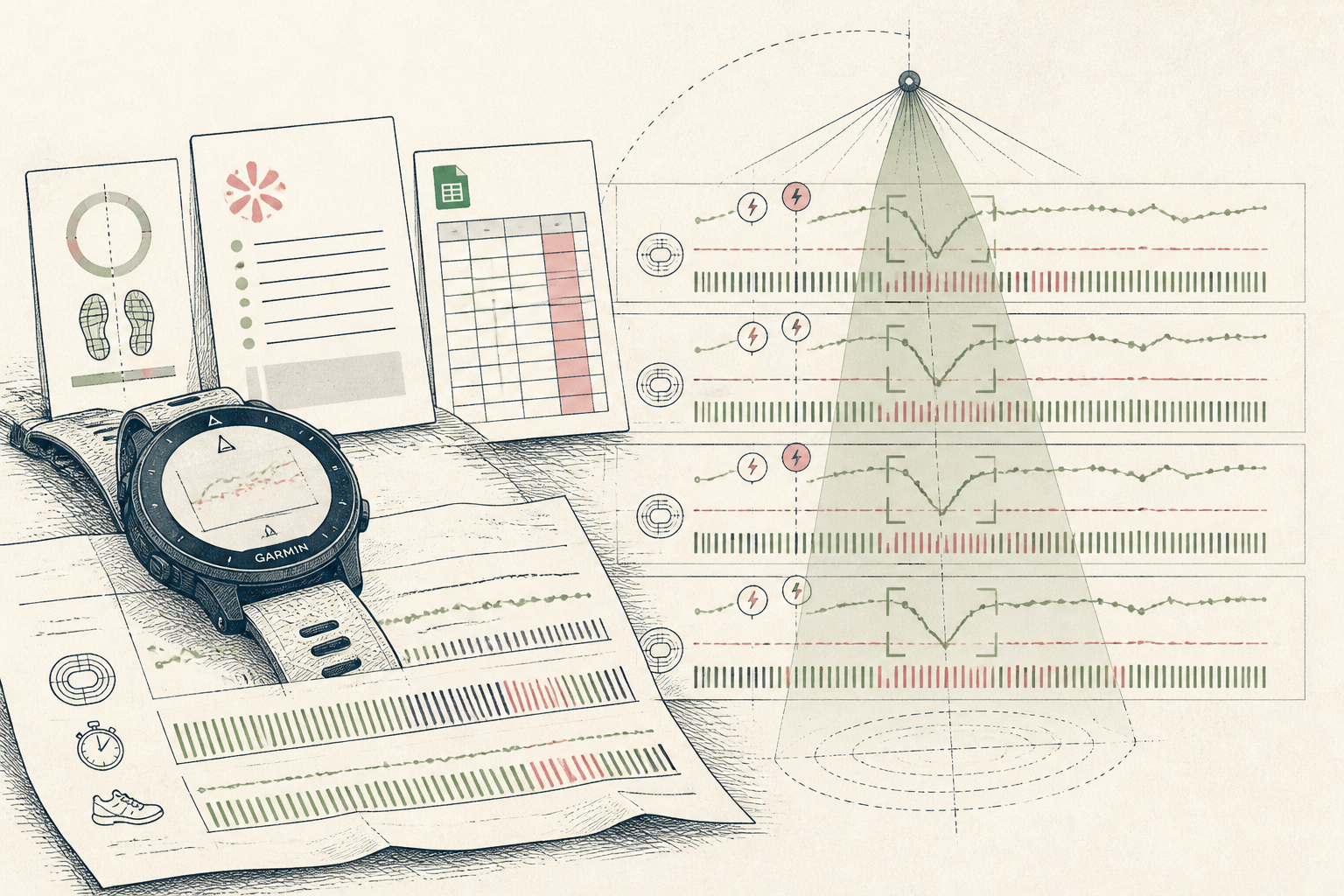
What the AI found
“"Across four weeks, your client's cadence dropped 6% only on Thursdays following Wednesday evening sprint sessions, despite normal resting heart rate."”
Before
Three client WhatsApp threads and unread Garmin exports
After
One 4-minute Monday audit that spots fatigue early
The same system, three states — real screens, not a screenshot
- Mark: complaint of heavy legs on Friday tempo
- Garmin weekly mileage: 58km (on target)
- WhatsApp: "Sleep was 8 hrs, HR fine, but strides felt dead"
- Need to cross-check Thursday split cadences vs baseline
Prompt
Analyze this runner's last 4 weeks of Garmin interval data against their post-run notes. Check cadence, stride length, and ground contact time balance against session time-of-day. Flag any mechanical degradation that precedes subjective fatigue reports.
Analyze this runner's last 4 weeks of Garmin interval data against their post-run notes. Check cadence, stride length, and ground contact time balance against session time-of-day. Flag any mechanical degradation that precedes subjective fatigue reports.
AI
Across four weeks, your client's cadence dropped 6% only on Thursdays following Wednesday evening sprint sessions, despite normal resting heart rate. Ground contact time asymmetry shifted 2.1% to the left on those specific morning runs. Suggest moving Wednesday intervals before 18:00 or adding 12 hours of recovery before tempo efforts.4m 12s
Audit time / client
1 pattern
Flagged deltas (Wk 4)
0
Unread client exports
How an EU Running Coach Spots Neuromuscular Fatigue in Minutes
How an independent running coach turned disparate wearable files into a four-minute weekly biomechanics check.
An independent endurance running coach working with 12 amateur marathoners, EU
Tools used
The real tools used here — swap any for your own equivalent. Each links to how we’d set it up.
Starting state
Before anything was set up
Sunday night meant twelve open tabs, raw Garmin Connect exports, and mismatched WhatsApp messages from athletes reporting heavy legs despite normal sleep metrics. The coach had columns of pace, cadence, and heart rate across four weeks for an amateur marathoner who was stalling on Thursday workouts. She knew subtle fatigue was accumulating, but tracing step rate regressions across interval sets manually took twenty minutes per runner, so adjustments were made on gut feeling rather than verifiable patterns.
- Mark: complaint of heavy legs on Friday tempo
- Garmin weekly mileage: 58km (on target)
- WhatsApp: "Sleep was 8 hrs, HR fine, but strides felt dead"
- Need to cross-check Thursday split cadences vs baseline
Working state
Resources, doing its job
Using the practitioner movement audit resource, the coach downloaded the raw interval metrics from Garmin Connect and pasted the tabular data directly into Claude alongside the athlete's qualitative log. The prompt instructed the model to cross-examine mechanical markers—specifically cadence and ground contact balance—against the timing of midweek workouts. Within seconds, the model isolated the single training variable that standard readiness scores had missed.
Prompt
Analyze this runner's last 4 weeks of Garmin interval data against their post-run notes. Check cadence, stride length, and ground contact time balance against session time-of-day. Flag any mechanical degradation that precedes subjective fatigue reports.
Analyze this runner's last 4 weeks of Garmin interval data against their post-run notes. Check cadence, stride length, and ground contact time balance against session time-of-day. Flag any mechanical degradation that precedes subjective fatigue reports.
AI
Across four weeks, your client's cadence dropped 6% only on Thursdays following Wednesday evening sprint sessions, despite normal resting heart rate. Ground contact time asymmetry shifted 2.1% to the left on those specific morning runs. Suggest moving Wednesday intervals before 18:00 or adding 12 hours of recovery before tempo efforts.Use case implemented
The finished system, running on its own
The coach now runs the playbook every Monday morning. She exports the prior week's CSV exports into a single raw folder, feeds them through Claude alongside the prompt template, and pastes the resulting two-sentence brief directly into the client's training plan. No manual charting, no cross-checking heart rate against cadence spreadsheets on Sunday nights. The client receives one targeted adjustment before their Tuesday intervals, while the coach keeps her review time under five minutes per runner.
4m 12s
Audit time / client
1 pattern
Flagged deltas (Wk 4)
0
Unread client exports
What an outside observer would notice
22m to 4m
Weekly audit time per client
3 in 4 weeks
Mid-week load adjustments
The stack — build it yourself
Standardized CSV exports for cadence, pace, and split times across all clients.
Accurate handling of multi-column athletic data and strict obedience to analytical formatting.
Simple, non-proprietary log that preserves raw values without subscription lock-in.
These are the tools used in this story. Any can be swapped for an equivalent you already trust.
Go deeper
Do this yourself
Explore the practitioner movement audit resource
This story runs on Resources. The tools and prompts above are the real build — swap any tool for your own equivalent and follow the same steps.