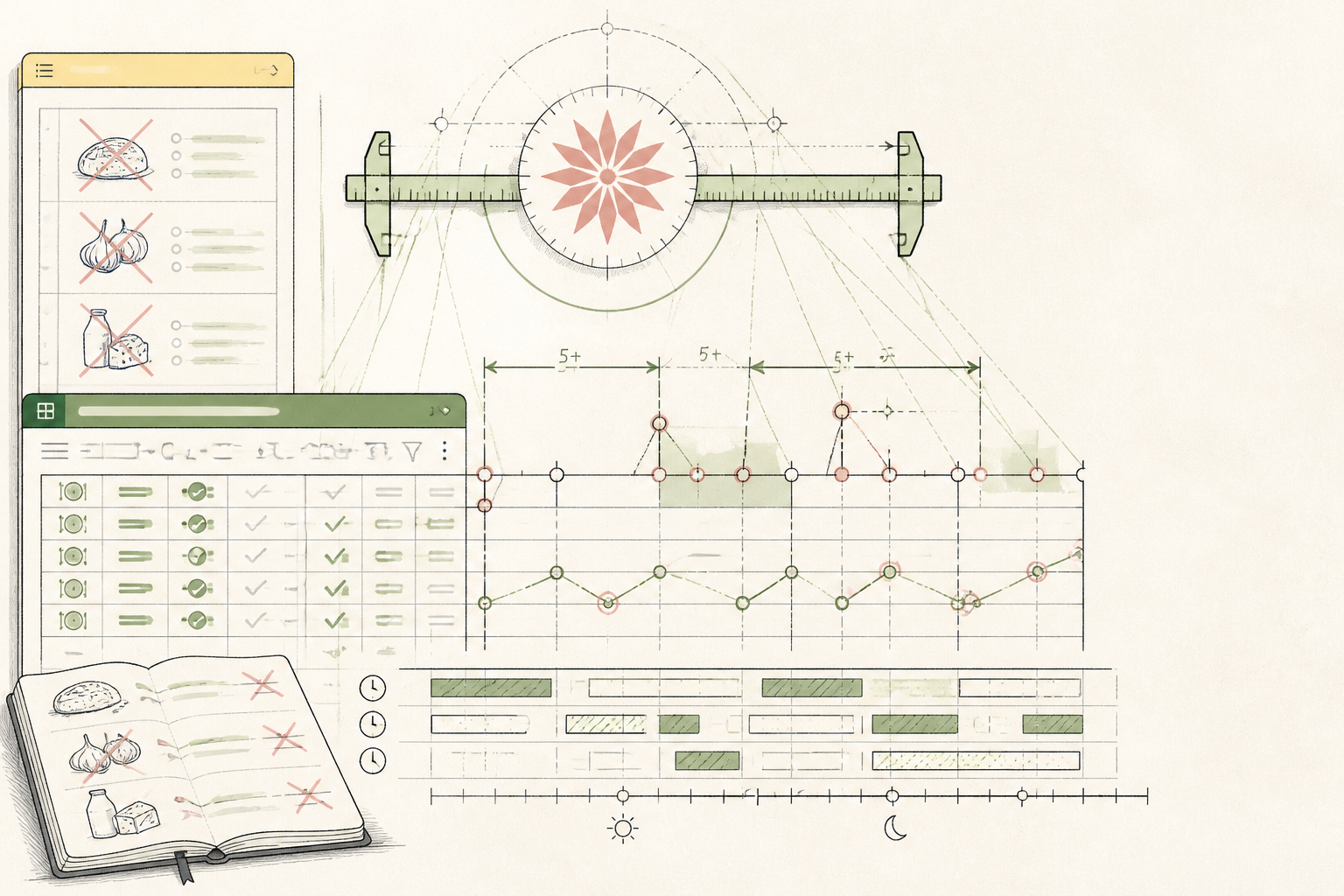
What the AI found
“Your bloating scores correlate at 0.71 with workday lunch gaps over 5 hours, not with sourdough, alliums, or dairy as you logged.”
Before
18 months of elimination diets and vague food logs
After
one 4-minute Friday check with zero food anxiety
The same system, three states — real screens, not a screenshot
- Tue: bloated again at 4pm. Was it the sourdough crust?
- Thu: omitted onion powder completely. Still distended.
- Sat: 10k run fine, then evening stomach ache. Skip dairy next.
- Current no-fly list: lentils, yogurt, rye, garlic, stone fruit
Prompt
Here is my four-week log of meal timestamps, food ingredients, and 1-5 bloating scores from Google Sheets. Identify non-obvious correlations between ingredient tags, workout times, and symptom severity.
Here is my four-week log of meal timestamps, food ingredients, and 1-5 bloating scores from Google Sheets. Identify non-obvious correlations between ingredient tags, workout times, and symptom severity.
AI
Your bloating scores show near-zero correlation with sourdough (0.08), alliums (-0.04), or dairy (0.11). Instead, your scores correlate at 0.71 with workday lunch gaps exceeding 5 hours. Every day you rated a 4 or 5 followed a morning shift where breakfast occurred before 07:30 and lunch was delayed past 13:45.3m 42s
Friday sync time
4.5h threshold
Meal interval alert
14 items
Safe foods restored
How a hospital administrator solved chronic bloating by tracking meal intervals instead of ingredients
How a simple analytical prompt over basic spreadsheets separated digestive timing from dietary guilt.
A 38-year-old hospital administrator and weekend runner, Northern Europe
Tools used
The real tools used here — swap any for your own equivalent. Each links to how we’d set it up.
Starting state
Before anything was set up
His phone held eighteen months of defensive logging across three apps that never communicated. When his abdomen distended at 4:00 pm, he opened a fresh note and blamed whatever had crossed his plate at noon: a sourdough sandwich, a pinch of garlic, Greek yogurt. His allowable pantry shrank to white rice, poached chicken, and steamed zucchini, yet the evening discomfort persisted without an identifiable pattern.
- Tue: bloated again at 4pm. Was it the sourdough crust?
- Thu: omitted onion powder completely. Still distended.
- Sat: 10k run fine, then evening stomach ache. Skip dairy next.
- Current no-fly list: lentils, yogurt, rye, garlic, stone fruit
Working state
Membership, doing its job
Under the Membership setup, he stopped buying dedicated symptom trackers. Instead, he dictated thirty-second notes between clinic rounds into Apple Notes and dumped the CSV into a private Google Sheet. On Sunday morning, he ran a structured audit prompt through Claude, asking for statistical correlation rather than dietary advice. Within forty seconds, the system disproved his primary assumption about food intolerances.
Prompt
Here is my four-week log of meal timestamps, food ingredients, and 1-5 bloating scores from Google Sheets. Identify non-obvious correlations between ingredient tags, workout times, and symptom severity.
Here is my four-week log of meal timestamps, food ingredients, and 1-5 bloating scores from Google Sheets. Identify non-obvious correlations between ingredient tags, workout times, and symptom severity.
AI
Your bloating scores show near-zero correlation with sourdough (0.08), alliums (-0.04), or dairy (0.11). Instead, your scores correlate at 0.71 with workday lunch gaps exceeding 5 hours. Every day you rated a 4 or 5 followed a morning shift where breakfast occurred before 07:30 and lunch was delayed past 13:45.Use case implemented
The finished system, running on its own
By month two, the setup ran on quiet autopilot. Apple Notes captured voice memos on the commute; a light script pushed timestamps to Google Sheets; Claude checked the sheet once on Friday mornings. He stopped restricting entire food groups and set a calendar chime for 1:30 pm on clinic days. The bloating dropped not because he purged his kitchen, but because his digestive tract finally had predictable mechanical intervals between meals.
3m 42s
Friday sync time
4.5h threshold
Meal interval alert
14 items
Safe foods restored
What an outside observer would notice
14 foods reintroduced
Restored staples
4 min on Fridays
Weekly logging friction
Down 68% over 6 wks
Post-lunch flare frequency
The stack — build it yourself
Native audio transcription let him record lunch times and discomfort ratings in under eight seconds between meetings.
Kept raw symptom numbers and meal timestamps in a neutral, private table he completely owned and could export anytime.
Handled messy tabular time-series correlation without training on or retaining his health notes.
These are the tools used in this story. Any can be swapped for an equivalent you already trust.
Go deeper
Do this yourself
Install the self-governed health layer
This story runs on Membership. The tools and prompts above are the real build — swap any tool for your own equivalent and follow the same steps.