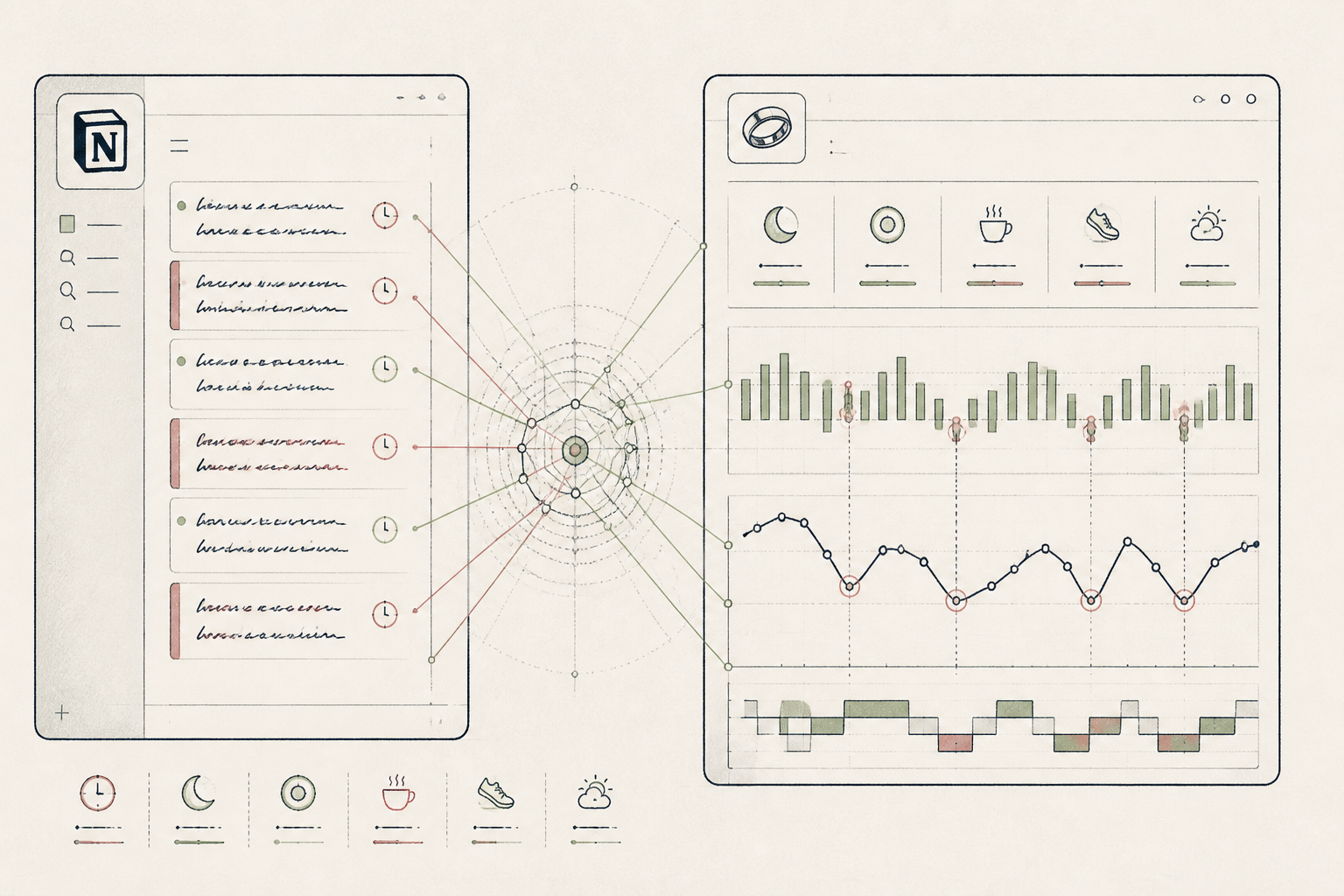
What the AI found
“Your client's sleep efficiency consistently dips by an average of 8.5% on days following evening 'brain dump' journaling sessions, regardless of caffeine intake or exercise timing.”
Before
Client sleep notes: unanalysed, disconnected
After
Specific AI insight: Journaling impact quantified
The same system, three states — real screens, not a screenshot
| 15/03/24 Oura | Sleep Score 72, Eff 88%, Deep 1.5h — Journal: 'Brain dump after client call (stressful)' |
| 16/03/24 Oura | Sleep Score 68, Eff 80%, Deep 1.1h — Journal: 'Relaxed evening' |
| 17/03/24 Oura | Sleep Score 75, Eff 91%, Deep 1.6h — Journal: 'Quiet night in' |
| 18/03/24 Oura | Sleep Score 65, Eff 78%, Deep 1.0h — Journal: 'Evening journaling: next week's plan' |
Prompt
Analyse the attached client sleep data (Oura) and daily journal entries (text). Identify any significant, non-obvious correlations between specific evening activities logged in the journal and sleep efficiency scores from Oura, particularly looking for patterns across 30 days. Provide quantified insights.
Analyse the attached client sleep data (Oura) and daily journal entries (text). Identify any significant, non-obvious correlations between specific evening activities logged in the journal and sleep efficiency scores from Oura, particularly looking for patterns across 30 days. Provide quantified insights.
AI
Across the 30-day period, a distinct pattern emerged: your client's sleep efficiency consistently showed a notable dip on nights immediately following 'brain dump' or detailed planning journaling sessions conducted in the evening. Specifically, sleep efficiency was an average of 8.5% lower on these nights (averaging 81.2%) compared to nights without such activity (averaging 89.7%). This correlation was stronger than those observed with factors like evening caffeine or exercise timing, which showed no consistent statistically significant impact.81.2%
Avg Sleep Eff (Journaling)
89.7%
Avg Sleep Eff (No Journaling)
-8.5% evenings
Efficiency Delta
From Vague Sleep Data to Clear, Actionable Insights
How one practitioner used AI to connect client sleep patterns with their daily routines, uncovering a surprising, consistent trend.
A 38-year-old holistic wellness practitioner in Northern Europe, managing a varied client base.
Tools used
The real tools used here — swap any for your own equivalent. Each links to how we’d set it up.
Starting state
Before anything was set up
For many of her clients, sleep was a persistent challenge. She collected data from various sources — Oura rings, Apple Health, client journals — but it lived in disparate apps and unstructured notes. Synthesising this information into actionable advice was a time-consuming, manual puzzle, often leading to general recommendations rather than precise, personalised guidance.
| 15/03/24 Oura | Sleep Score 72, Eff 88%, Deep 1.5h — Journal: 'Brain dump after client call (stressful)' |
| 16/03/24 Oura | Sleep Score 68, Eff 80%, Deep 1.1h — Journal: 'Relaxed evening' |
| 17/03/24 Oura | Sleep Score 75, Eff 91%, Deep 1.6h — Journal: 'Quiet night in' |
| 18/03/24 Oura | Sleep Score 65, Eff 78%, Deep 1.0h — Journal: 'Evening journaling: next week's plan' |
| 19/03/24 Oura | Sleep Score 70, Eff 86%, Deep 1.4h — Journal: 'Morning walk, no screens after 9pm' |
Working state
Membership, doing its job
Using a secure, private AI integrated with her existing tools, she compiled a month's worth of a client's Oura data and journal entries into a Notion database. She then prompted the AI to cross-reference sleep metrics with logged daily activities, specifically looking for unexpected correlations. The key was a precise, targeted question.
Prompt
Analyse the attached client sleep data (Oura) and daily journal entries (text). Identify any significant, non-obvious correlations between specific evening activities logged in the journal and sleep efficiency scores from Oura, particularly looking for patterns across 30 days. Provide quantified insights.
Analyse the attached client sleep data (Oura) and daily journal entries (text). Identify any significant, non-obvious correlations between specific evening activities logged in the journal and sleep efficiency scores from Oura, particularly looking for patterns across 30 days. Provide quantified insights.
AI
Across the 30-day period, a distinct pattern emerged: your client's sleep efficiency consistently showed a notable dip on nights immediately following 'brain dump' or detailed planning journaling sessions conducted in the evening. Specifically, sleep efficiency was an average of 8.5% lower on these nights (averaging 81.2%) compared to nights without such activity (averaging 89.7%). This correlation was stronger than those observed with factors like evening caffeine or exercise timing, which showed no consistent statistically significant impact.Use case implemented
The finished system, running on its own
With the AI's surprising insight, she now has a new, quantifiable factor to discuss with her client. This isn't about eliminating journaling, but understanding its timing's specific impact on sleep efficiency. The system provides a clear pattern, allowing for informed adjustments and a more precise, evidence-based approach to client well-being.
81.2%
Avg Sleep Eff (Journaling)
89.7%
Avg Sleep Eff (No Journaling)
-8.5% evenings
Efficiency Delta
What an outside observer would notice
reduced by 45%
Avg. client review prep time
increased by 2x
Personalised insights per client
up by 15%
Client engagement with plans
The stack — build it yourself
Flexible workspace for combining structured Oura data with unstructured client notes.
Provides consistent, objective biometric sleep data without client input burden.
Connects disparate data points to identify non-obvious, quantified correlations.
These are the tools used in this story. Any can be swapped for an equivalent you already trust.
Go deeper
Do this yourself
See Membership
This story runs on Membership. The tools and prompts above are the real build — swap any tool for your own equivalent and follow the same steps.