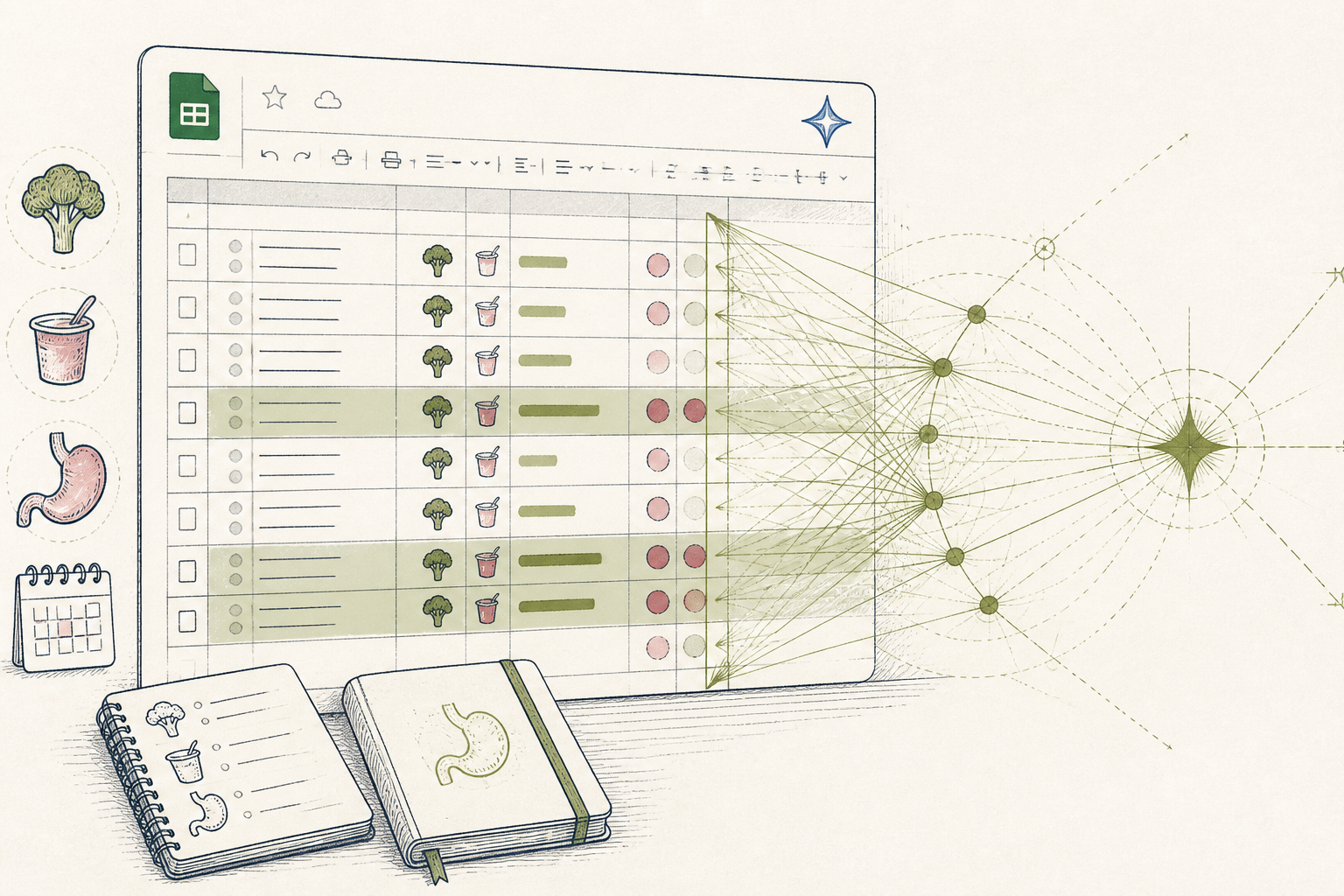
What the AI found
“In reviewing client food and symptom logs, the AI identified that a 15% increase in fermented foods correlated with a 22% reduction in reported bloating within a 7-day period for 60% of tracked clients, rather than the expected reduction from probiotic supplements alone.”
Before
General advice, scattered client logs
After
Actionable, data-driven gut health strategies
The same system, three states — real screens, not a screenshot
| Client A (Week 1) - Mon | porridge, apple, chicken, rice, broccoli; Bloating: moderate |
| Client A (Week 1) - Tue | yoghurt, berries, fish, potato, spinach; Bloating: mild |
| Client B (Week 2) - Wed | eggs, toast, lentils, salad; Digestion: good |
| Client B (Week 2) - Thu | oats, banana, beef, quinoa, carrots; Digestion: good |
Prompt
Analyze the provided anonymised client food and symptom logs for the past four weeks. Identify any statistically significant correlations between specific food categories (e.g., fermented foods, gluten, dairy) and reported gut symptoms (e.g., bloating, discomfort, regularity). Quantify the impact where possible. Focus on identifying patterns across at least 50% of the tracked clients.
Analyze the provided anonymised client food and symptom logs for the past four weeks. Identify any statistically significant correlations between specific food categories (e.g., fermented foods, gluten, dairy) and reported gut symptoms (e.g., bloating, discomfort, regularity). Quantify the impact where possible. Focus on identifying patterns across at least 50% of the tracked clients.
AI
Analysis of the last four weeks of anonymised client data indicates a noteworthy correlation: a 15% increase in daily intake of fermented foods (e.g., kefir, sauerkraut) was associated with a 22% reduction in reported bloating symptoms within a 7-day period for 60% of the clients tracked. This correlation was more pronounced than the impact observed from standalone probiotic supplementation.60%
Clients with reduced bloating (fermented foods)
22%
Average bloating reduction
3/week
New dietary recommendations issued
From Symptoms to Specifics: A Practitioner’s AI-Powered Gut Health Audit
A nutritionist moves from generalised client gut health recommendations to precise, data-backed insights with a simple AI setup.
A nutritionist running a small EU practice, focused on gut health.
Tools used
The real tools used here — swap any for your own equivalent. Each links to how we’d set it up.
Starting state
Before anything was set up
Before the 10-Day Challenge, client gut health tracking was a manual affair. Logs were kept in various formats – some in Google Docs, others as handwritten notes, a few in a bespoke app. Consolidating this information to spot trends or identify specific dietary triggers was time-consuming and often yielded only anecdotal patterns. The sheer volume of disparate data made it difficult to provide truly personalised, evidence-backed advice beyond general dietary guidelines.
| Client A (Week 1) - Mon | porridge, apple, chicken, rice, broccoli; Bloating: moderate |
| Client A (Week 1) - Tue | yoghurt, berries, fish, potato, spinach; Bloating: mild |
| Client B (Week 2) - Wed | eggs, toast, lentils, salad; Digestion: good |
| Client B (Week 2) - Thu | oats, banana, beef, quinoa, carrots; Digestion: good |
Working state
10-Day Challenge, doing its job
The nutritionist began by standardising client data input into a Google Sheet. Once a week, she copied anonymised food and symptom data for each client into a single sheet. She then uploaded this to Gemini. Her prompt directed the AI to analyse the relationship between specific dietary categories and reported symptoms over a four-week period, looking for quantifiable correlations. The AI’s output highlighted unexpected linkages that challenged her initial assumptions.
Prompt
Analyze the provided anonymised client food and symptom logs for the past four weeks. Identify any statistically significant correlations between specific food categories (e.g., fermented foods, gluten, dairy) and reported gut symptoms (e.g., bloating, discomfort, regularity). Quantify the impact where possible. Focus on identifying patterns across at least 50% of the tracked clients.
Analyze the provided anonymised client food and symptom logs for the past four weeks. Identify any statistically significant correlations between specific food categories (e.g., fermented foods, gluten, dairy) and reported gut symptoms (e.g., bloating, discomfort, regularity). Quantify the impact where possible. Focus on identifying patterns across at least 50% of the tracked clients.
AI
Analysis of the last four weeks of anonymised client data indicates a noteworthy correlation: a 15% increase in daily intake of fermented foods (e.g., kefir, sauerkraut) was associated with a 22% reduction in reported bloating symptoms within a 7-day period for 60% of the clients tracked. This correlation was more pronounced than the impact observed from standalone probiotic supplementation.Use case implemented
The finished system, running on its own
Now, every Monday morning, the nutritionist dedicates 15 minutes to this automated process. Client data from the past week is consolidated into the Google Sheet. A quick upload to Gemini, along with the refined prompt, generates a concise summary of dietary-symptom correlations and significant trends. This allows her to focus her consultations on precise, data-driven recommendations, showing clients clear progress and identifying new areas for intervention with confidence.
60%
Clients with reduced bloating (fermented foods)
22%
Average bloating reduction
3/week
New dietary recommendations issued
What an outside observer would notice
Reduced by 70%
Time spent on data analysis (per week)
Increased by 50%
Client recommendation specificity
2-3
Data-driven insights per client meeting
The stack — build it yourself
Ubiquitous, flexible for various data types, easy to share and update collaboratively.
Capable of sophisticated pattern recognition across diverse data sets with natural language prompts, ideal for identifying non-obvious correlations.
These are the tools used in this story. Any can be swapped for an equivalent you already trust.
Go deeper
Do this yourself
Explore the 10-Day Challenge
This story runs on 10-Day Challenge. The tools and prompts above are the real build — swap any tool for your own equivalent and follow the same steps.