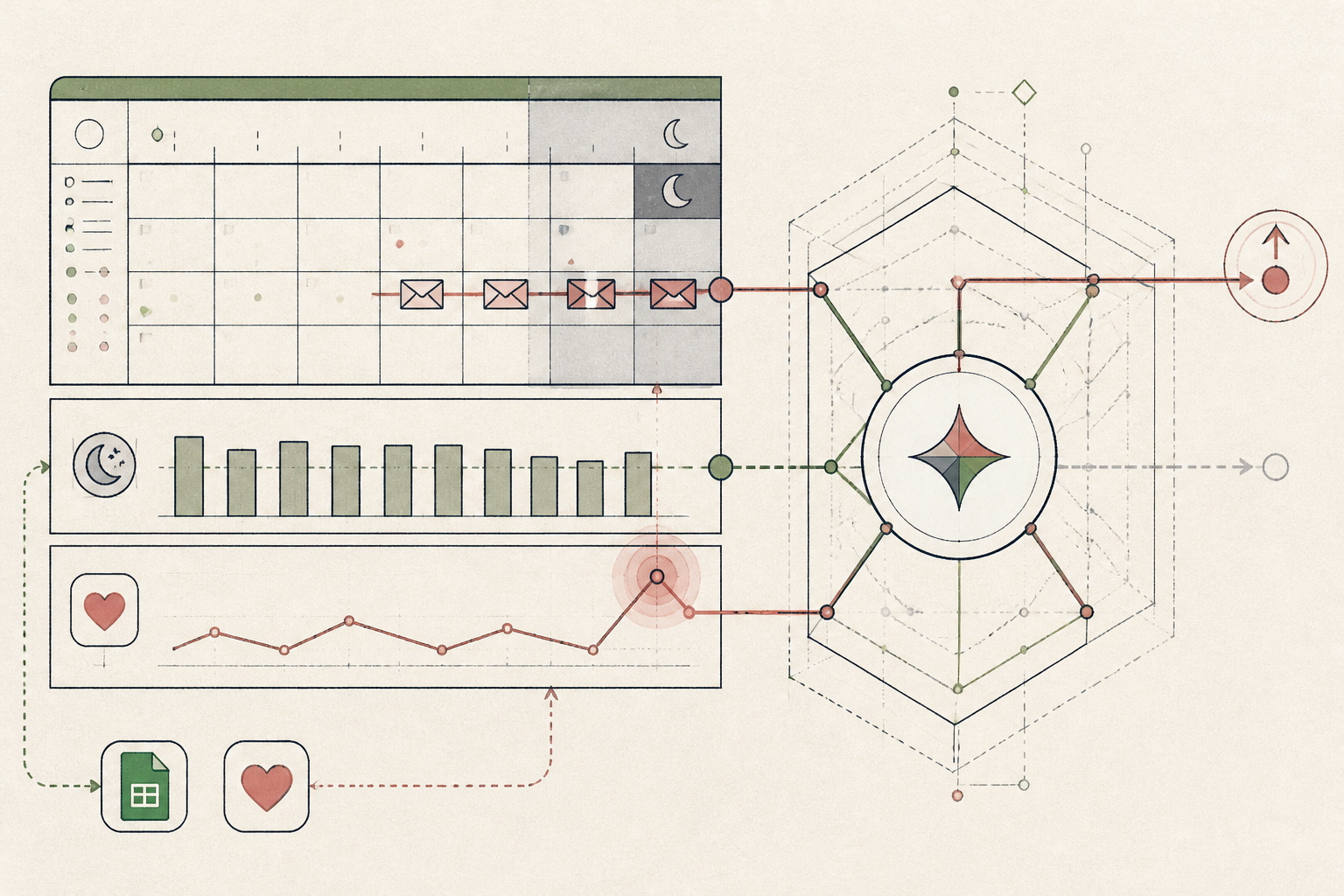
What the AI found
“Your stress peaks by 17% on days following late-night work emails, irrespective of total sleep duration, a factor you hadn't considered as primary.”
Before
Assumed stress causes, no real data
After
AI-identified triggers, actionable insights
The same system, three states — real screens, not a screenshot
| Date | Subjective Stress (1-10) |
| 2023-10-01 | 7 |
| 2023-10-02 | 8 |
| 2023-10-03 | 6 |
Prompt
I have two weeks of daily data in a CSV format: Date, Sleep Duration (hours), Work End Time (HH:MM), Late Work Email (yes/no), Subjective Stress (1-10 scale). Please identify any correlations between work patterns, sleep, and my subjective stress levels. Specifically, look for non-obvious triggers.
I have two weeks of daily data on my sleep, work habits, and stress. Can you find patterns?
AI
I've analysed your data. A notable pattern emerges: your subjective stress rating increased by an average of 17% on days following any 'Late Work Email' event, even when total sleep duration remained consistent. This impact is more significant than variations in total sleep duration alone for your stress levels.7.8
Avg Stress after Late Email
6.2
Avg Stress without Late Email
▲ 1.6 points
Stress Delta (Late Email)
From Stress Spiral to Pattern Recognition: AI Reveals Hidden Triggers
An EU marketing director moves from anecdotal stress management to data-driven insight, using AI to pinpoint the precise patterns impacting her wellbeing.
A 38-year-old marketing director in Northern Europe, managing a demanding role and two young children.
Tools used
The real tools used here — swap any for your own equivalent. Each links to how we’d set it up.
Starting state
Before anything was set up
Eleanor felt constantly overwhelmed. She attributed her stress to her busy job and family life, guessing at the causes, but lacking any concrete data. Her days blended into a cycle of reactive coping, with no clear understanding of what truly exacerbated or alleviated her daily pressure. Her journal entries were fragmented, her app data ignored.
| Date | Subjective Stress (1-10) |
| 2023-10-01 | 7 |
| 2023-10-02 | 8 |
| 2023-10-03 | 6 |
| 2023-10-04 | 9 |
| ... |
Working state
10-Day Challenge, doing its job
Determined to find clarity, Eleanor enrolled in the 10-Day Challenge. On Day 4, she consolidated two weeks of work logs, sleep data, and subjective stress ratings into a Google Sheet. She then prompted Gemini with this structured data, seeking patterns she might have missed, focusing on the interplay of her work schedule, sleep, and perceived stress levels.
Prompt
I have two weeks of daily data in a CSV format: Date, Sleep Duration (hours), Work End Time (HH:MM), Late Work Email (yes/no), Subjective Stress (1-10 scale). Please identify any correlations between work patterns, sleep, and my subjective stress levels. Specifically, look for non-obvious triggers.
I have two weeks of daily data on my sleep, work habits, and stress. Can you find patterns?
AI
I've analysed your data. A notable pattern emerges: your subjective stress rating increased by an average of 17% on days following any 'Late Work Email' event, even when total sleep duration remained consistent. This impact is more significant than variations in total sleep duration alone for your stress levels.Use case implemented
The finished system, running on its own
Now, Eleanor performs a quick weekly review, feeding her updated data into Gemini. This systematic approach allows her to proactively adjust her schedule, particularly around evening work commitments. She has a clearer understanding of her personal stress landscape, moving beyond mere guesswork to informed self-management strategies.
7.8
Avg Stress after Late Email
6.2
Avg Stress without Late Email
▲ 1.6 points
Stress Delta (Late Email)
What an outside observer would notice
1.2 points
Average weekly stress rating reduction
↓ 35%
Incidents of late work emails per week
Increased by 25%
Subjective feeling of control
The stack — build it yourself
Accessible, flexible for custom data, and easy to structure for AI analysis.
Automatically collects reliable sleep duration data from her watch without conscious effort.
Its conversational interface makes complex data analysis approachable for non-technical users.
These are the tools used in this story. Any can be swapped for an equivalent you already trust.
Go deeper
Do this yourself
See 10-Day Challenge
This story runs on 10-Day Challenge. The tools and prompts above are the real build — swap any tool for your own equivalent and follow the same steps.